


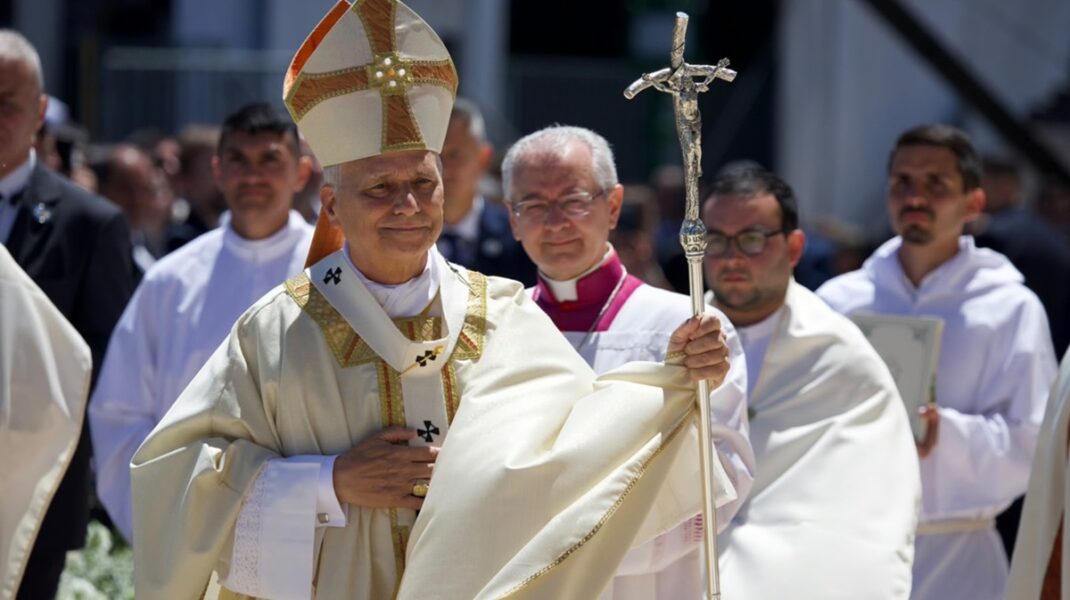
Pope Leo XIV celebrated his first Mass in Argentina on Monday before the Monument to the Spaniards, in the Palermo neighborhood of Buenos Aires, with an attendance of about two million people, according to sources from the city government cited by the AFP news agency. The Pope, who arrived in the country on Sunday as part of the apostolic journey that from November 6 to 17 takes him to Uruguay, Argentina, and Peru, is the first Pontiff to visit Argentina since Saint John Paul II in 1987.
The celebration coincided with the feast of the Dedication of the Basilica of Saint John Lateran, which Leo XIV presented as the seat of the Bishop of Rome and, therefore, a sign of unity and communion for all the Churches of the world, which is why it is called the “Mother of all Churches.” That motherhood, he explained, is expressed in the “service of communion,” so that all the baptized may recognize one another as brothers and sisters in the one household. The image of the temple, which united the day’s readings, structured a homily whose main focus was the family.
Against the temptation to “bargain with God”
Commenting on the passage in which Jesus drives the merchants from the temple (Jn 2:15), the Pontiff stated that humanity has always been tempted to bargain with God. He described the “give-to-get” mentality as a “pagan logic,” defining it as the illusion of obtaining God’s favor by offering something of one’s own in return. Christ, he stressed, eradicates that mentality, because God is the Father always ready to give every good, and the temple thus becomes once again a house of prayer for all his children.
Ezekiel’s vision of the river flowing from the temple and healing the waters that run toward the Arabah, the desert region descending to the Dead Sea, served him to describe a passage from death to life: where there was sickness, now there is health; where there was aridity, fertility. Later he applied the image to the Church, which offers the living water, Jesus, who heals and cures wounds.
The family, “a pillar” against precariousness
Drawing on Psalm 46, Leo XIV listed the complex situations families often face: lack of stability, social difficulties, precarious work, domestic violence, painful separations, and addictions that destroy young people’s future and damage family relationships. In the face of these, he recalled that on the rock, which is Christ, families and all of society find the foundation that sustains the house.
The Pope affirmed that Argentine history, culture, and society have found in the family the source of the people’s fundamental values, and that it is within the family that faith, human virtues, the culture of work, respect for elders, the defense of life, and fidelity to one’s word have been transmitted. “Do not resign yourselves to the voices that repeat that the Christian family is outdated,” he urged, before stating that today, more than ever, it represents a pillar amid the many precariousness of our time.
A country that marries less and less
The homily comes at a time of sharp decline in marriage in Argentina. In the city of Buenos Aires, a total of 9,549 marriages were celebrated in 2025, the lowest figure of the century if the pandemic year is excluded and 43 % fewer than in 2000, according to the latest nuptiality report from the Buenos Aires Institute of Statistics and Censuses (Idecba). According to a study published by the Institute of Marriage and Family of the Catholic University of Argentina (UCA), divorces reach 53%.
According to the latest data published by the Buenos Aires Civil Registry in 2024 civil unions increased by 60% compared to the same period the previous year, while marriages decreased by 12%. These figures reveal a record in the growth of civil unions and a downward trend in the number of traditional marriages.
From the blessing of the table to Sunday Mass
“Open the doors of your homes to Christ,” the Pope urged, encouraging parents to speak naturally of Jesus to their children. He explained that faith is transmitted in the home through the simplest gestures: the blessing before meals, a prayer before sleep, mutual forgiveness and listening, grandparents teaching how to pray, Sunday Mass, the preparation of a retreat or a pilgrimage. The family, he said, is the privileged place to know and encounter Christ.
To illustrate this, he quoted “our beloved Pope Francis, who was bishop of this city,” a mention that the faithful received with applause. The chosen text was number 29 of Amoris laetitia, from the initial biblical chapter of the exhortation, according to which the family is called to share daily prayer, the reading of the Word of God, and eucharistic communion in order to become ever more a temple where the Spirit dwells. The reference takes on special significance in the city that Jorge Mario Bergoglio governed as archbishop and to which he did not return during his twelve years as pontiff.
Saint John Paul II was the other magisterial reference of the homily. Leo XIV turned to Familiaris consortio (n. 39), which describes the educational mission of parents as a true ministry through which the Gospel is transmitted and radiates. “Dear families, I exhort you to be protagonists in evangelization! The Argentine Church needs you,” he declared, before asking them to support in their mission the bishops, parish priests, pastoral agents, and catechists.
The homily concluded with the entrustment of all families to the Virgin Mary, Our Lady of Luján, and to Saint Joseph, and with the prayer that, like the Holy Family of Nazareth, homes too may be temples of God’s presence.