


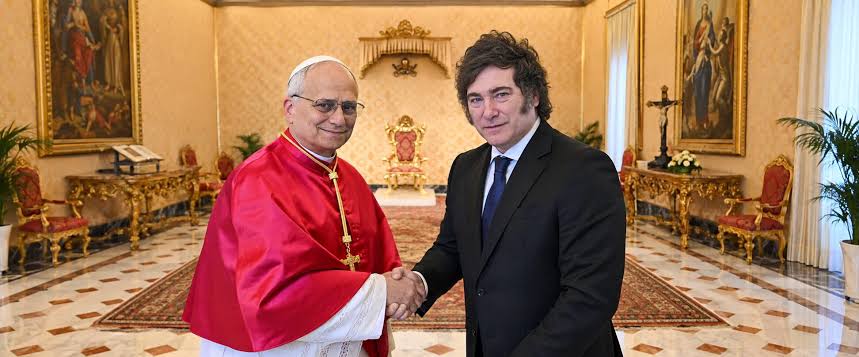
The Pope meets this afternoon with the Argentine president at Casa Rosada. In their previous encounter, held at the Vatican in June 2025, Leo XIV received him without the stole he had worn the day before before the Italian president, a protocol reserved for Catholic heads of state.
Leo XIV and Javier Milei hold their second official meeting this afternoon in Buenos Aires. The Pope, who lands at 16:30 from Montevideo, will be received at Casa Rosada with a welcome ceremony at 17:20 and will then hold a private meeting with the president. It is the first visit by a pontiff to Argentina since John Paul II in 1987, as part of a South American tour that also includes Uruguay and Peru.
The trip brings back into focus a detail from their first audience. On June 7, 2025, Leo XIV received Milei at the Apostolic Palace without a stole. The day before, on June 6, he had worn one during the audience with the president of Italy, Sergio Mattarella.
The protocol rule
Vatican analyst Andrea Gagliarducci explained at the time that Leo XIV was following the tradition of wearing the stole in audiences with Catholic heads of state and dispensing with it before leaders of other faiths or with no religious affiliation. According to that explanation, Milei’s audience fell under the second category.
The Holy See made no statement on the matter, and the gesture has no canonical significance. Its interest lies in the contrast between two consecutive receptions, held in the same setting and under the same protocol.
Milei’s statements on his faith
Milei has publicly described himself as Catholic, but has also spoken of his closeness to Judaism. “I am Catholic and I also practice Judaism a little,” he said in February 2024. On several occasions he has expressed his intention to convert and has linked the postponement of that decision to the difficulty of reconciling religious observance with presidential duties.
These statements are accompanied by his trips to Israel and his relationship with leaders of the Jewish community. The Church has not commented on the president’s religious situation.
Inconsistency and belonging
The protocol criterion focuses on the leader’s confession and sets aside his conduct or his country’s legislation. A Catholic head of state who promotes laws contrary to Church teaching remains, for protocol purposes, a Catholic, and is received as such. His inconsistency may be serious, and the Church may reproach him for it through other channels, but it does not alter his belonging.
The case of someone who declares himself partially Jewish or announces his intention to convert is of a different nature. The question ceases to be moral and begins to affect religious identity itself. The Catholic who sins continues to profess the faith he fails to live. Whoever says he practices another religion and is preparing to embrace it introduces a reservation about that profession.
Read this way, the June 2025 audience offers a lesson on syncretism, the tendency to combine elements of different beliefs without resolving their contradictions. A Catholic may study the Torah, appreciate the Jewish tradition and maintain a close relationship with its communities without departing from his faith. The difficulty arises when that approach is presented as one’s own religious practice, because both confessions hold incompatible claims about Jesus Christ. Protocol, obliged to adopt a concrete form, cannot reflect a half-belonging.
A different context
The comparison with today’s meeting has limits. During apostolic journeys, the Pope’s attire follows different guidelines from those governing audiences at the Apostolic Palace, so the images from Buenos Aires will not allow an equivalent reading to that of June 2025.
The Pope’s agenda in Argentina runs until November 11 and includes events in Buenos Aires, Córdoba and Luján, before departing for Lima.