


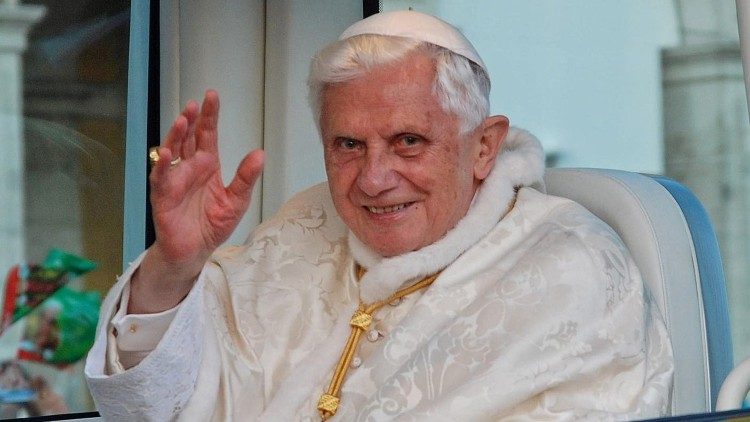
More than 140 participants have gathered this week in Almería to delve into the figure and legacy of Benedict XVI, at an international congress that concludes this Thursday, October 29, and has brought together cardinals, bishops, theologians, and representatives from the academic and cultural world.
Under the title “Joseph Ratzinger: a pope for the history of the Church and the world,” the event, organized by the Providentia Association, has addressed some of the major issues that marked the intellectual and pastoral trajectory of the German Pontiff: the relationship between faith and reason, the centrality of Jesus Christ, freedom, liturgy, and the presence of the Church in contemporary society.
The initiative is part of the preparatory events for the centenary of Joseph Ratzinger’s birth, which will be commemorated on April 16, 2027, and has been held primarily at the Museum of Contemporary Spanish Realism (MUREC) in Almería.
According to information released by the Provincial Council of Almería, the congress seeks to deepen the theological, philosophical, and human legacy of Benedict XVI and bring his thought to contemporary society.
Theologians, bishops, and academics explore Ratzinger’s thought
The congress began on Monday, October 26, with the inaugural lecture “Benedict XVI, a man for eternity,” delivered by Pablo Blanco Sarto, Professor of Systematic Theology at the University of Navarra and recipient of the 2023 Ratzinger Prize in Theology.
In the following days, various figures connected to the study of the German Pope’s thought have taken part, including Cardinal Antonio María Rouco Varela, Archbishop Emeritus of Madrid; Juan Antonio Martínez Camino, Auxiliary Bishop of Madrid; José Luis Restán, President of the Ábside Media Group; Lydia Jiménez, President of the Spanish University Foundation; Mexican philosopher Alejandro Sada; and Marcela Jiménez-Unquiles, President of the International Ratzinger Foundation.
Jaime Mayor Oreja, President of the NEOS Foundation and trustee of the International Ratzinger Foundation, has also participated.
In a report published by El Confidencial Digital, José Francisco Serrano Óceja highlights that the interventions have revolved around the primacy of God and the proposal of the truth of the Christian faith in the contemporary world.
Among the reflections gathered is an anecdote shared by Lydia Jiménez about the doubts the young Ratzinger experienced regarding his priestly vocation. Although he was passionate about theology and teaching, he was aware that the priesthood also required dedicating himself to pastoral life and attending to people.
According to Jiménez, Ratzinger recalled that those doubts disappeared upon receiving the diaconate, when his decision to become a priest became a definitive yes.
Faith and reason, a central issue in Benedict XVI’s magisterium
One of the main focuses of the meeting has been the relationship between Christian faith and reason, an issue that accompanied Joseph Ratzinger throughout his career as a theologian, Prefect of the Congregation for the Doctrine of the Faith, and later as Pope.
The program has paid special attention to the twentieth anniversary of the famous address delivered by Benedict XVI at the University of Regensburg on September 12, 2006.
In that speech, the Pontiff defended the need to broaden the concept of reason so that it would not be limited solely to what can be verified through the methods of the experimental sciences.
Ratzinger maintained that the Christian faith is not opposed to reason and that dialogue between the two is essential for understanding the truth about God and about man.
This reflection has been present in the congress lectures, along with issues such as human freedom, the personal encounter with Jesus Christ, and beauty as a path of evangelization.
Liturgy and the Christian’s presence in the world, protagonists of the closing
Thursday, October 29, is dedicated to two matters especially linked to Benedict XVI’s thought: liturgy and the mission of Christians in society.
According to the official congress program, the closing sessions include the lectures “Living the Mystery: The Spirit of the Liturgy” and “The Christian in the World.”
The first refers to one of Joseph Ratzinger’s best-known theological works, The Spirit of the Liturgy, in which he explored the meaning of divine worship, adoration, and the continuity of the Church’s liturgical tradition.
The program will conclude with a Eucharistic celebration at Almería Cathedral, scheduled for 8:00 p.m. and presided over by the diocesan bishop, Antonio Gómez Cantero.
Almería, El Ejido, and Benahadux pay public tribute to Benedict XVI
The congress has also had a cultural and institutional dimension, with tributes to the German Pontiff in various municipalities of the province.
On Monday, October 26, the inauguration of a monument dedicated to Benedict XVI was held in Almería’s Nicolás Salmerón Park, promoted by the City Council.
On Wednesday, October 28, activities moved to El Ejido, where an institutional reception and the inauguration of a street named after the German Pope took place.
That same day, Benahadux hosted the events planned to dedicate a square to him and to bless a monument of Saint Joseph with Benedict XVI.
These initiatives are part of the program of public tributes that accompanies the academic lectures and religious celebrations.
The Diocese of Almería has highlighted the participation of ecclesial, academic, and cultural institutions in an event that has also included Eucharistic celebrations at the Cathedral.