


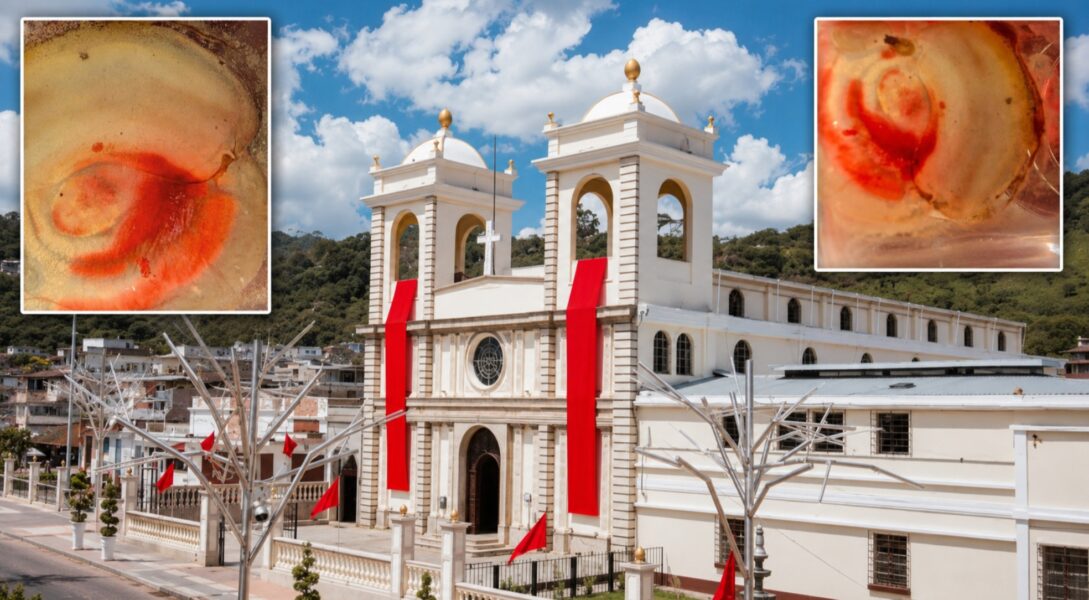
The possible Eucharistic manifestation that occurred on July 30 in Cuilapa, Guatemala, has once again sparked interest nearly three months after the events. The program Primer Impacto, from the U.S. network Univisión, aired a report on October 21 featuring new testimonies from the priests and faithful who were familiar with the case of a consecrated host that, after being placed in water, did not dissolve and showed reddish stains. The pastor of the El Niño Dios Cathedral has explained that the Host must undergo scientific studies to determine the nature of the substance.
The report includes statements from Father José Alejandro García, who confirmed that the case is pending the corresponding analyses. “Here I believe we are focusing our attention on the host, which has a reddish substance, and science will take care of it, because now a process of study is coming,” the priest stated, explaining that the tests could last several months.
The television report also notes that the reddish coloration remained visible more than a month after its appearance, a circumstance that has drawn the attention of numerous faithful. So far, no scientific results have been released that would identify the substance or establish its origin.
A host that did not dissolve and showed reddish stains
The events date back to July 30, during the Missionary Eucharistic Week organized by the El Niño Dios Cathedral parish, belonging to the Diocese of Santa Rosa de Lima.
During a Mass celebrated at a private school in Cuilapa, a teenager received Holy Communion, but the priest noticed that he was trying to remove the Host from his mouth. The celebrant quickly approached and managed to prevent him from throwing it to the ground.
Following the procedures established for such cases, the priest placed the consecrated host in a glass container with water in the chapel of the parish house so that it would dissolve.
A week later, on August 6, a collaborator cleaning the chapel observed that the Host had not dissolved and showed reddish stains that, according to the parish statement, “could be blood.”
The collaborator immediately notified a deacon and a priest, who were also able to confirm the presence of those stains. Subsequently, the pastor recorded their testimony and documented what had happened.
In the following days, a deacon, a priest, and three laypeople personally observed the Host. On August 15, the pastor showed photographs to the Bishop of Santa Rosa de Lima, Monsignor José Cayetano Parra Novo, to inform him of the event.
“Now a process of study is coming”
In a report aired by Primer Impacto, the parish priests explain how they learned of the discovery and the actions taken after the reddish stains appeared.
Father José Alejandro García stated that scientific analyses will be necessary to clarify the nature of the substance. According to him, the studies must determine, among other things, whether it is human blood.
“A series of tests will be conducted. It will take time. Although science is quite advanced, it could take months,” he indicated.
The investigation must provide elements for the ecclesiastical discernment of what occurred, without any pronouncement so far recognizing the supernatural character of the phenomenon.
The report also includes the testimony of the parish collaborator who discovered the stains and that of several faithful who have closely followed the case.
One of the testimonies expresses the emotion the discovery has caused among Catholics in Cuilapa: “It’s something that makes you want to cry. It makes you want to tell people: ‘It’s Jesus, it’s Jesus.’”
Those interviewed also noted that the event has sparked greater interest in prayer and the sacramental life of the parish.
The parish keeps the Host under custody
On August 22, the El Niño Dios parish released an official statement titled “Possible Eucharistic Manifestation,” in which it explained the events and asked the faithful to act with prudence while discernment takes place.
“It is necessary to remember that the Church asks that the event be judged with prudence and moderation,” the document stated.
The parish leaders recalled that throughout its history the Church has known testimonies of extraordinary phenomena related to the real presence of Jesus Christ in the Eucharist, but that these events require careful examination.
“These cases have not been at all common or easy to discern, so they cannot be called miracles until an entire investigation that must be carried out is concluded and will take time,” the statement added.
The parish then reported that the Host had been reserved in a special place and would not be publicly exposed. It also specified that it would be up to the diocesan bishop to give the necessary instructions for its study.
In the new statements broadcast by Univisión, it is indicated that the Host will remain in the custody of the parish until the scientific investigation begins.
“Jesus is alive in the Eucharist; it is not something, it is Someone”
Since the events became known, the leaders of Cuilapa Cathedral have insisted that the occurrence should above all be an occasion to renew faith in the real presence of Jesus Christ in the Eucharist.
In its August statement, the parish recalled that the greatest Eucharistic miracle occurs at every Mass, when the bread and wine truly become the Body and Blood of Christ.
“This event should motivate Catholics to renew our faith and devotion in the greatest miracle: the real presence of Jesus Christ in every celebration of the Holy Mass,” the text stated.
The priests also invited the faithful to make reparation for offenses against the Blessed Sacrament, to participate more devoutly in the Eucharistic celebration, and to frequent the sacrament of Confession.
“May today be the moment to make reparation for all the offenses Jesus receives in this Sacrament of Love, an invitation to live the Holy Mass attentively and devoutly, and an offering to frequent Confession. Let us not forget that Jesus is alive in the Eucharist; it is not something, it is Someone,” the parish statement concluded.