


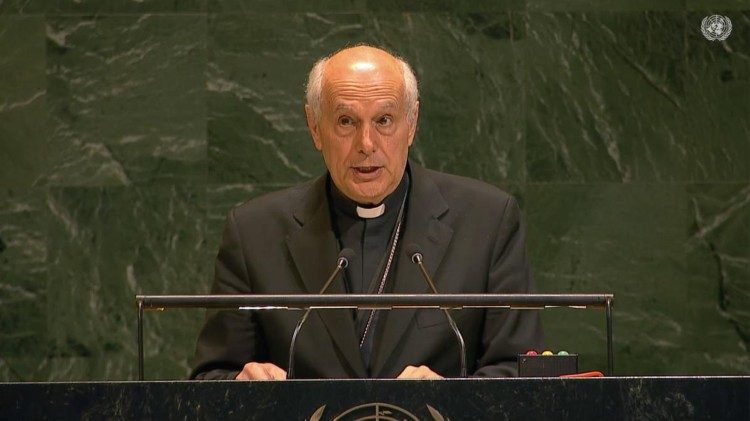
Archbishop Gabriele Caccia, apostolic nuncio to the United States, stated that interreligious dialogue does not require being less rooted in one’s own faith. During the inauguration of the G20 Interfaith Forum, held from October 15 to 17 in Salt Lake City, the papal representative highlighted the importance of knowing one’s own beliefs in order to foster a sincere encounter among people of different religious traditions.
“Authentic interreligious dialogue does not ask us to be less rooted in our own faith. On the contrary, if we know who we are and what we believe, we can meet others in a more sincere way,” the archbishop noted, according to a report by the Fides Agency on October 17.
The intervention took place on October 15 at the Tabernacle of Temple Square, during a ceremony that brought together representatives of various religious confessions and international organizations.
The contribution of religions to current challenges
In his speech, Caccia addressed the role of religious communities in the face of major economic, social, and technological challenges. He explained that their contribution does not necessarily consist in offering technical solutions, but in providing reflection on the dignity of the person and responsibility toward others.
The nuncio posed a question to the participants: “What kind of human future are we building together?”
From there, he referred to the meeting’s motto, “Resilient Hope, Shared Future,” and noted that hope goes beyond optimism. He described it as the decision to work together for the future without losing sight of the human person.
Technological development and artificial intelligence
Caccia also referred to economic growth, energy security, and the development of new technologies, especially artificial intelligence.
“Technology offers extraordinary possibilities, but innovation alone does not tell us what is good,” he stated.
The papal representative noted that technological advances must be accompanied by reflection on their consequences and on the people they serve.
In this context, he recalled Pope Leo XIV’s encyclical Magnifica humanitas and its warning against reducing the human person to data and measurable results.
Pope Leo XIV sends a message to the participants
At the end of his intervention, the nuncio read a message sent on behalf of Pope Leo XIV by Cardinal Pietro Parolin, Secretary of State of the Holy See.
The Pontiff expressed his hope that the forum would be “a luminous example of the solidarity of the human family” and would help strengthen the commitment of nations to “the universal principles of human dignity, religious freedom, and the common good.”
He also expressed his hope that the deliberations, carried out “with gentleness and respect,” would encourage believers to offer answers to those who ask them for the reason of their hope.
The message concluded with the Pope’s prayer for the fruits of the meeting and his blessing upon the participants.
A meeting with representatives of different religious traditions
The G20 Interfaith Forum brought together religious leaders, academics, civil society representatives, and policymakers in Salt Lake City to address issues related to international challenges.
The inaugural ceremony included Sheikh-ul-Islam Allahshukur Pashazadeh, president of the Board of Muslims of the Caucasus; Metropolitan Emmanuel of Chalcedon, of the Ecumenical Patriarchate; Pujya Sadhvi Bhagawati Saraswati, secretary general of the Global Interfaith WASH Alliance; Rabbi Mark Dratch; and Francis Kuria Kagema, secretary general of Religions for Peace.
Dallin H. Oaks, president of The Church of Jesus Christ of Latter-day Saints, welcomed the attendees.
The forum has been held since 2014 and seeks to incorporate the perspectives of religious communities into international debates linked to the G20 agenda. Previous editions took place in Bologna, Abu Dhabi, Pune, Brasília, and Cape Town.