


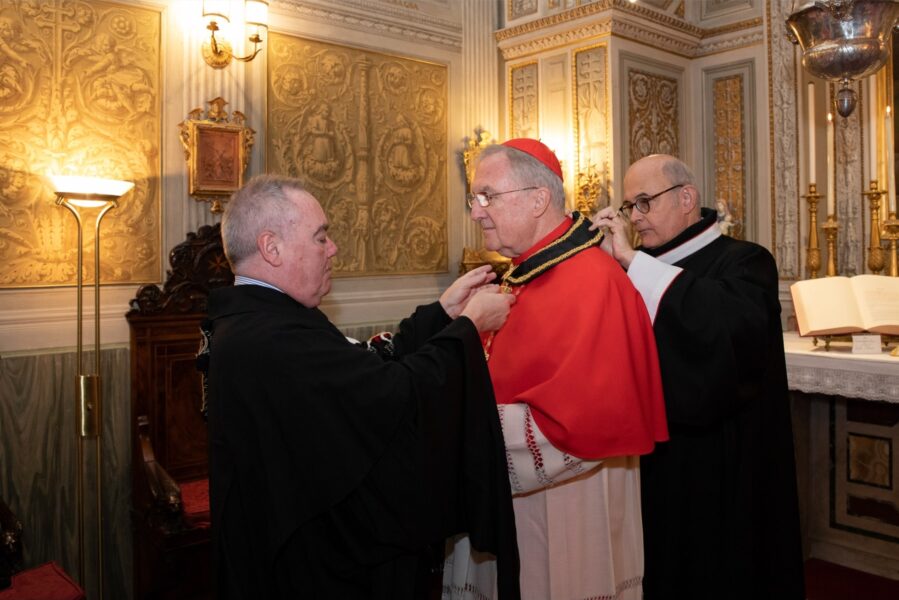
Among Catholics concerned about the traditional Mass, the news has been received with the twisted expression of one who sees an adversary rise. Monsignor Vittorio Francesco Viola, a Franciscan, liturgist at San Anselmo and secretary of Divine Worship since that spring of 2021 when Traditionis custodes was being cooked up, has been named archpriest of St. Peter’s Basilica, vicar general for Vatican City and president of the Fabric of St. Peter. He fills the post left vacant by Cardinal Gambetti when he departed for Chieti-Vasto. A Franciscan replaces another Franciscan, and Michelangelo’s dome now falls under the custody of one of the men who most zealously applied the restrictions on the ancient Mass.
No one is going to pop any corks. But the move deserves a more measured reading than the first jolt, because it has a reverse side.
The missing piece on the board
The great liturgical decision of the pontificate of Leo XIV will bear the name of one person: that of the successor to Cardinal Arthur Roche. The prefect has already turned seventy-six, and since spring his replacement has been considered imminent. What happens with Traditionis custodes, with permissions doled out bishop by bishop, with parishes banished to parish halls, will depend in large measure on who occupies that chair.
And in the Curia the secretary is the natural heir, the dauphin who knows the files, the consultors and the house’s plumbing. Viola had all the tickets. Elevating him from the secretariat to the prefecture would have been the most comfortable solution, the most curial, and, for all Catholics concerned about the Mass, the worst imaginable: the definitive consecration of the apparatus that drafted and executed the restrictions.
That path has been closed. St. Peter’s is a post of prestige, of solemn pontificals and perpetual scaffolding, with much that is honorific and very little governance over the liturgy of the universal Church. Viola now commands marbles, sacristies and stonemasons; over the Mass celebrated in a village in Navarre or in a chapel in Wisconsin, considerably less. It is true that he votes in conclave and that must not be overlooked.
A desk secretary
To replace him, the Pope has chosen the Spaniard Aurelio García Macías, from Pollos in Valladolid, doctor in Liturgy from San Anselmo, former rector of the seminary of Valladolid and undersecretary of the dicastery since 2021. He arrived in Rome in 2015, summoned to the dicastery when it was led by Cardinal Robert Sarah, and there he climbed the ladder with the patience of a functionary.
His profile is more administrative than ideological. No campaigns against the traditional Mass are known of him, nor inflammatory conferences on the irreversibility of the reform, nor the taste for surveillance that has characterized the current leadership. With the same frankness it must be said that he is not a man of Summorum Pontificum either: he translated into Spanish Liturgia y belleza by Piero Marini, the master of ceremonies who brought the spirit of Bugnini to the papal altars, and his formation is that of post-conciliar academic liturgy. It is best not to harbor illusions.
The Sarah factor, however, weighs. The Guinean cardinal followed his own itinerary, and in it he came to understand that the way one prays shapes the way one believes, that the ancient Mass guards a wisdom no decree can file away. His vision ended up being the antithesis of Traditionis custodes: defense of Summorum Pontificum and the desire to delve even deeper into the traditional liturgy. García Macías became a curialist in that house and in those years. Nothing guarantees that he made that sensibility his own, although he knew from within a dicastery where the Mass of all time was treated with respect.
A bureaucratic secretary follows the line of whichever prefect he serves. If the next prefect does not make the persecution of the traditional Mass his banner, it would seem logical to expect that García Macías will not raise it on his own account. There lies the difference with Viola, who was part of the program.
Against deck optimism
The opposite vice, which has become customary among many of the faithful, must be avoided. There is a form of hope that too closely resembles the orchestra on the Titanic: every bad appointment is reinterpreted as a masterstroke, every defeat as preparation for a secret victory, and the water keeps rising while the waltz plays. The liturgical appointments of these years do not invite euphoria, and today’s keeps intact the team Roche formed in 2021. Continuity is its dominant note.
The virtue asked for here is what the classics called prudence: seeing things as they are, without embellishing or blackening them. And what they are fits in a few lines: one of the most dangerous candidates to succeed Roche has left the race, headed for a post with more incense than power, and the secretariat is left in the hands of a man with no known agenda against the traditional Mass.
It is little. But it is a cleared unknown, and on a board where almost all the pieces are moving in the same direction, knowing where the danger no longer lies is also information. The decisive game has yet to be played, and it has only one blank name: that of the next prefect.