


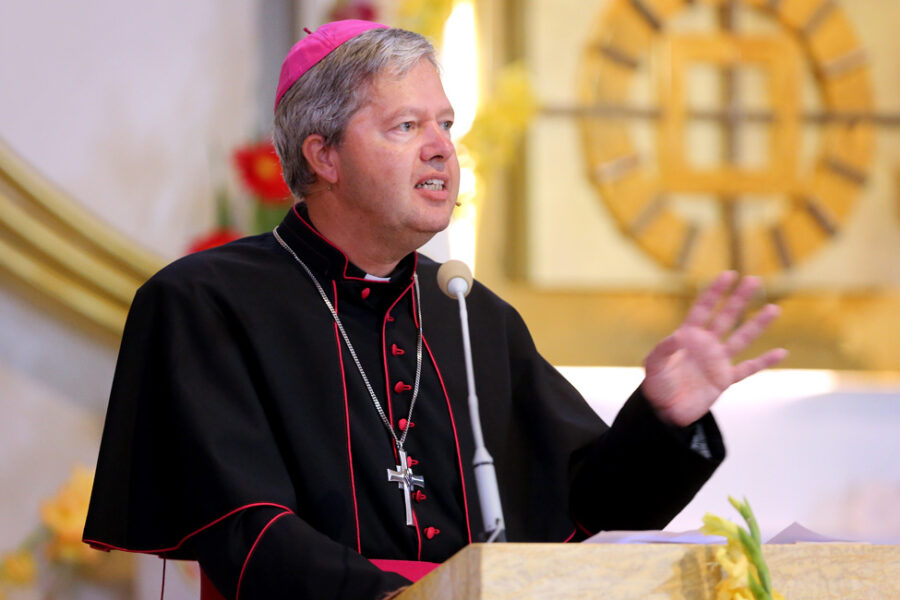
Auxiliary Bishop of ’s-Hertogenbosch, Robert Mutsaerts, has advised Catholics attending parishes where the liturgy is celebrated irreverently to seek another community where their faith can be nourished, including a church where the traditional Mass is celebrated, rather than remaining in a place that may ultimately weaken it.
In an interview given to LifeSiteNews during the Catholic Identity Conference held in Pittsburgh, the Dutch prelate explained that for years he had believed the faithful should remain attached to their own parish and try to support it. Now, however, he considers that there are situations in which such permanence can be detrimental to spiritual life.
“If there is a bad Novus Ordo Mass, I’m afraid you can’t change those priests. So go somewhere else,” Mutsaerts stated. “I used to think: ‘Support your own parish.’ I no longer say that, because there you can lose the faith.”
The bishop recommended seeking a community where the liturgy, doctrine, and parish life effectively help preserve the faith. “Go somewhere where you think: ‘This is right, this is authentic, this is true,’” he noted.
Seek a liturgy where the sacred is present
Mutsaerts placed particular emphasis on families with children and young Catholics. In his view, the choice of parish should not depend solely on geographical proximity, but also on the real possibility of finding a community where faith can grow and where the liturgical celebration retains its sacred character.
The prelate clarified that young people can find such an environment both in communities linked to the Vetus Ordo and in parishes where the Novus Ordo is celebrated worthily. His criterion, therefore, is not limited to the liturgical form, but to the reverence with which it is celebrated and the solidity of the community.
“Young people find one another in the Vetus Ordo, in the Novus Ordo, but in places where they find the sacred, where the liturgy is in order,” he explained.
Mutsaerts added that for a young believer it is also important to share the faith with other Catholics of their age. “If you have children or young people, go where they can meet other young people. That encourages them,” he stated. In his opinion, it is difficult for an 18-year-old Catholic to find such support if they are completely isolated in an aging community with little youth presence.
His words enter directly into a recurring debate among Catholics who suffer from deficient liturgical celebrations: whether to remain in the territorial parish to try to improve it from within or to travel to another church where they can find a more reverent liturgy and a more solid Catholic life.
Mutsaerts believes that when one’s own perseverance in the faith is at stake, the priority must be clear.
“Do the Catholic things of always”
During the same interview, the Dutch bishop addressed the general situation of the Church and once again expressed his reservations about the synodality process.
Asked how to preserve the faith in the current ecclesial context, Mutsaerts recommended maintaining the ordinary practices of Catholic life: attending a good Mass, praying the Rosary, seeking the truth, and setting a good example.
“Do the Catholic things of always. Go to a Mass where there is a proper liturgy, pray the Rosary, set a good example,” he stated.
The bishop was also very critical of the results of the synodal process. “If synodality means nothing to you, don’t go; it’s a waste of time. We’ve been at this for eight years. Can you see the fruits? I don’t,” he declared.
This is not the first time Mutsaerts has publicly expressed this position. In August he addressed an open letter to Leo XIV in which he questioned the fruits of synodality and asked the Pope to once again place the salvation of souls at the center of the Church’s life.
“Let us not try to adapt to the secular world”
Mutsaerts also warned against the temptation to accommodate Catholic identity to the dominant criteria of secular society.
“We are trying to be too accommodating to the secular world. No! What is our identity? We must remain faithful to the identity: Jesus Christ,” he maintained.
For the prelate, the Church’s point of reference cannot be the world’s acceptance, but Christ and the truth He has revealed. Hence he insisted on the need to persevere in prayer and in a consistently Catholic life even in times of ecclesial crisis.
Addressing young people specifically, he again insisted on the same pillars: the Mass, the Rosary, sound formation, and a life in accordance with the faith.
“Go to Mass, even if it may not mean much to you or the sermon is a bit boring, or totally boring. Go to Mass and try to find a parish where the Mass is done well,” he advised.
He also recommended reading good books and the Church Fathers, listening to solid Catholic content, and not allowing oneself to be carried away by relativism, secularism, or subjectivism.
“There is a truth that applies to everyone,” Mutsaerts concluded. “If you do not live according to it, some things begin to go wrong.”