


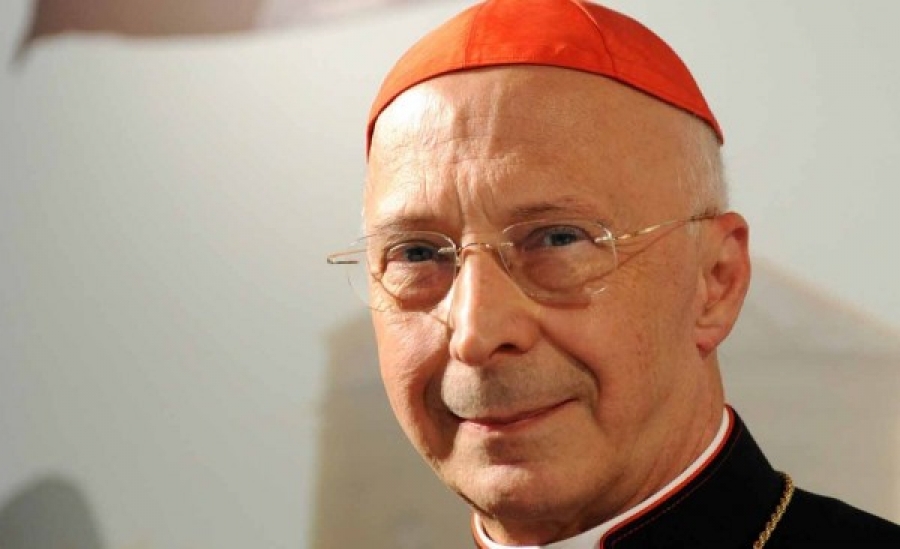
Cardinal Angelo Bagnasco has called on European confraternities to become protagonists of evangelization and help awaken a Europe that, in his view, is living in a deep “lethargy.” The former president of the Italian Episcopal Conference also claimed the value of Christian traditions as a vehicle for transmitting a truth that does not age: “Christ’s love for us.”
Bagnasco spoke in Enna, Sicily, during the VII Pan-European Forum of Confraternities, held from October 2 to 7 and bringing together representatives from various European countries. According to data presented at the meeting, there are around 26,500 confraternities in Europe, grouping some six million faithful.
“Today I ask you to be the seed of the new spring that the Church is experiencing,” the cardinal told the participants. Bagnasco also recalled the mark these associations of the faithful have left on his own life: “The confraternities have left a mark on my life and on my vocation.”
Faced with a society where Christianity may seem to be losing ground, the prelate rejected a purely pessimistic reading of the situation. “Everything seems to say the opposite, but there are all the signs that good is today infinitely stronger than evil,” he assured.
“Be a healthy attraction for young people”
Likewise, Bagnasco asked the confraternities not to limit themselves to safeguarding inherited devotions as an element of the past, but to turn them into a concrete form of evangelization.
“Be a healthy attraction for young people, actors of evangelization in this Europe that must awaken from its lethargy,” he stated.
It is precisely in the continuity between tradition and evangelization that he placed one of the main responsibilities of the confraternities. Their religious heritage, he explained, should not be understood as a collection of ancient customs without impact on the present, but as a visible expression of a faith that continues to have something to say to contemporary man.
“Be contagious with your ancient traditions, which tell a truth that is always current: Christ’s love for us,” he noted.
The cardinal also referred to the situation of many young Europeans, marked, he said, by “fears, confusion and uncertainty.” He warned that this context can end up making them “strategically weak, easily manipulable” people, so he called for spaces capable of transmitting certainties, belonging and a Christian vision of existence.
A Europe that cannot be built only on the economy
The situation of the European continent was also part of Bagnasco’s intervention. The cardinal lamented that previous calls by the bishops in favor of a recovery of Europe’s spiritual roots have found little echo.
“The cry launched some years ago by the bishops to Europe seems, unfortunately, to have fallen on deaf ears,” he noted.
Bagnasco maintained that European unity cannot rest exclusively on material interests. The economy, finance or common defense may have their importance, he explained, but none of these dimensions is enough to create a true community among peoples.
“None of this is capable of creating unity of life and destiny,” he stated.
Faced with a Europe built solely on political or economic structures, the cardinal claimed the need to recover a reason open to transcendence: “Reason enlightened by faith must prevail.”
Defense of life and the family
In this context, Bagnasco also addressed two issues he considers fundamental for the future of Europe: the defense of human life and the family founded on the union between man and woman.
The prelate placed both principles within a Christian conception of the person that, far from being reduced to a private matter, has direct consequences on culture and on the way a society understands its own future.
The day also included the panel “Woman, life, feminine charisms,” moderated by Marcella Reni and with the participation of actress Claudia Koll and Laura Frattari. In the morning, around 200 students had participated at Kore University in the meeting “Confraternities, guardians of the Faith and the Environment.”
The VII Pan-European Forum thus concluded several days of celebrations, meetings and public events in a city deeply linked to the confraternal tradition. For Bagnasco, precisely this capacity to preserve a received heritage and transmit it from generation to generation can turn the confraternities into one of the instruments to once again publicly propose the Christian faith in an increasingly secularized Europe.