


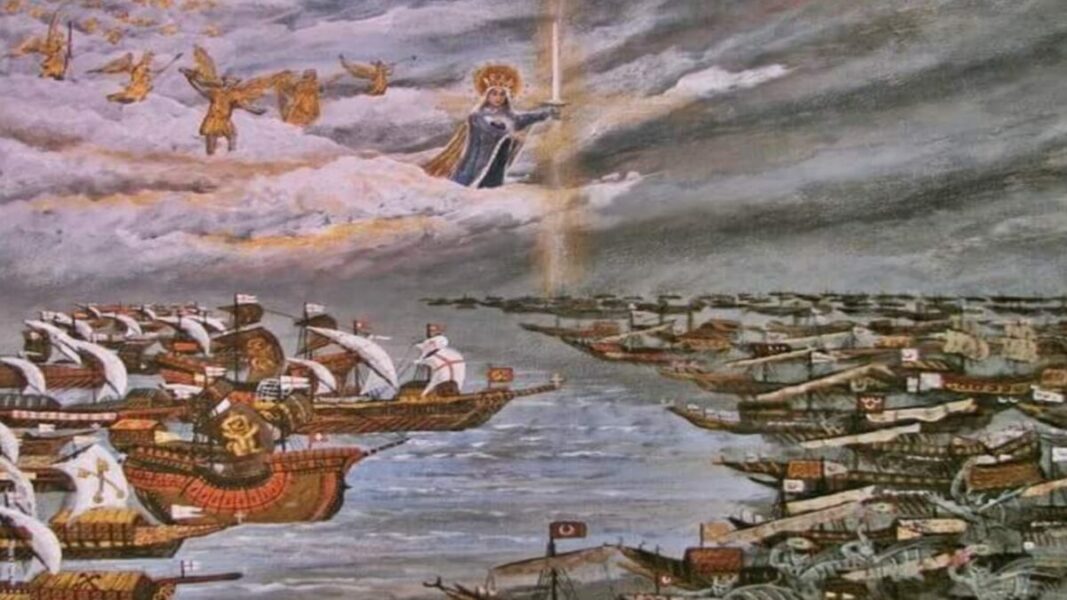
Every October 7, the Church honors Our Lady of the Rosary and recalls one of those days when the history of Christendom became inseparably linked to prayer. The origin of the feast goes back to the year 1571, when the Ottoman advance through the Mediterranean gravely threatened Christian Europe and Pope Saint Pius V called the faithful to implore the help of the Blessed Virgin through the recitation of the Rosary.
While the fleet of the Holy League sailed toward its encounter with the Ottoman navy, in Rome and elsewhere in Christendom people were praying. On Sunday, October 7, the clash finally took place in Greek waters, near Lepanto, and the Christian victory was received as a grace obtained through the intercession of Our Lady.
Saint Pius V wanted that help not to be forgotten once the immediate danger had passed. From his thanksgiving was born a celebration initially dedicated to Our Lady of Victory, which was soon linked to the Rosary and which the Church continues to celebrate more than four centuries later.
Lepanto belongs to the military history of Europe, but for a Catholic its memory does not end with the galleys, the commanders, and the strategies. That October 7 also recalls a truth deeply rooted in the life of the Church: prayer can truly intervene in history and the intercession of the Mother of God is not a pious ornament of the Christian faith.
When Christendom turned to the Virgin
The Europe of 1571 had for more than a century watched the advance of the Ottoman Empire. Constantinople had fallen in 1453, and in the following decades the Turks extended their domains across the Balkans and the eastern Mediterranean, while their naval power increasingly threatened Christian positions.
The offensive against Cyprus, then under Venetian rule, worsened the situation in 1570. Nicosia fell and Famagusta was subjected to a long siege. Saint Pius V understood that the Christian powers could hardly respond separately, but uniting them was an especially difficult task. Political rivalries, commercial interests, and old conflicts stood in the way of any alliance.
The Pope persevered until, in May 1571, the Holy League was formed, composed mainly of the Spanish Monarchy, the Republic of Venice, and the Papal States, along with other participants. Command of the fleet was entrusted to Don Juan of Austria, son of Emperor Charles V and half-brother of Philip II.
Pius V, a Dominican and deeply devoted to the Virgin, knew, however, that the defense of Christendom could not rest solely on the number of ships and soldiers. That is why he accompanied diplomatic and military efforts with an insistent call to prayer and particularly requested the recitation of the Rosary.
The connection between this prayer and Lepanto was not a legend added later to the story. More than three centuries afterward, Leo XIII recalled in Supremi Apostolatus Officio how, while the Christian soldiers prepared to fight, the faithful who remained far from the battle invoked Mary through the Rosary and asked for her protection for those who were about to face the Ottoman fleet.
Christendom thus fought in two different ways: some wielded weapons and others prayed. Saint Pius V had asked both of those to whom it pertained.
The Sunday of Lepanto
The two fleets met on October 7, 1571, a Sunday, in the Gulf of Patras. On the ships of the Holy League sailed Spaniards, Venetians, Genoese, men from the Papal States, and others from various Christian territories who had temporarily set aside their differences to face a common danger.
The religious dimension accompanied the combatants before the engagement. Chaplains attended to the troops and prayers were offered aboard the ships before a battle that would last for hours and become one of the greatest naval encounters of the era.
By the end of the day, the Ottoman fleet had suffered a defeat of enormous significance. Numerous galleys had been captured or destroyed, and thousands of Christians who had remained captive on them regained their freedom. The news spread across Europe and dispelled the impression that the Ottoman naval advance was unstoppable.
Lepanto did not destroy the Ottoman Empire or end all the dangers threatening Christian Europe. Wars would continue and Turkish power would remain formidable for generations. Yet the victory altered the psychological and political balance of the Mediterranean and immediately became one of the great events of its time.
For Saint Pius V, moreover, the victory demanded more than human celebrations: it demanded thanksgiving.
The Church wished to remember who had aided the Christians
Leo XIII would later recall that Pius V, eager to perpetuate the memory of the grace received, established a commemoration in honor of Our Lady of Victory. His successor, Gregory XIII, would link that celebration to the title of Our Lady of the Rosary.
In this way, the victory of Lepanto began to be incorporated into the liturgical life of the Church. The feast gradually spread and for centuries was celebrated on the first Sunday of October. Finally, the reform of the Breviary carried out by Saint Pius X in 1911 fixed its celebration on October 7, once again aligning the Marian feast with the exact anniversary of the battle.
The ancient Roman liturgy also expressly preserved the memory of Lepanto. For generations, those who prayed the Divine Office on the feast of the Rosary found there the remembrance of the victory obtained during the pontificate of Saint Pius V through the help of the Blessed Virgin.
This was no minor detail. The liturgy thus taught people to view history with Christian eyes: men act, fight, govern, and make real decisions, but above human action remains the Providence of God. Recognizing this does not diminish the valor of those who fought at Lepanto; it places their efforts within a greater reality.
That is why the celebration that survived the battle does not bear the name of Don Juan of Austria, nor that of Spain, Venice, or the Papal States. The Church preferred to preserve that day under the name of the Virgin.
The Rosary in difficult hours
The lesson of Lepanto was not confined to the sixteenth century. When Leo XIII wished to restore a central place to the Rosary in the life of Catholics, he turned precisely to the example of Saint Pius V.
In Supremi Apostolatus Officio, published in 1883, he recalled the victory of 1571 while again urging the Church to seek the Virgin’s help through this prayer. In the years that followed he would dedicate numerous documents to the Rosary and would decisively help to establish October as the month especially consecrated to this devotion.
It was not historical nostalgia. Leo XIII was convinced that what the Church had done in the face of the dangers of the sixteenth century remained valid amid the trials of his own time. The threats and circumstances changed, but not the need for divine help nor the power of Mary’s intercession.
Other pontiffs continued to recommend the same practice. Pius XI, for example, asked in 1937 that during October the Rosary be prayed with particular fervor in churches and in Christian homes.
Thus Lepanto became linked to a teaching that transcends any battle: when difficult times come, the Catholic does not despise human means nor renounce the fulfillment of duties, but knows that these do not exhaust reality. He also prays, asks for God’s help, and turns to the intercession of his Mother.
A victory turned into thanksgiving
455 years have passed since that Sunday. The world of Saint Pius V and Don Juan of Austria disappeared long ago; the powers that fought at Lepanto changed, borders were redrawn countless times, and the galleys ended up as museum pieces.
Our Lady of the Rosary, by contrast, continues to have her feast every October 7.
The permanence of this celebration says much about the Catholic way of preserving memory. Lepanto was a great military victory, but the Church did not wish to limit its remembrance to the courage of the combatants or the skill of their commanders. She also saw the prayers raised far from the battlefield and recognized the help received through the intercession of the Virgin.
That is why, centuries later, Catholics on October 7 still do what their ancestors did while the outcome of Lepanto was still uncertain: take the beads of the Rosary in their hands and, together with Mary, contemplate the mysteries of the life of her Son.
There lies the deepest legacy of that day. A victory that changed the history of Europe was ultimately transformed by the Church into a feast of gratitude to the Mother of God: Our Lady of the Rosary.