


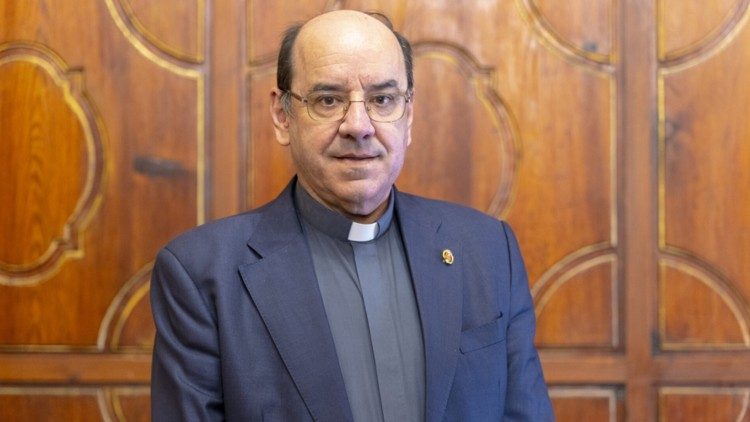
The Archbishop of Pamplona and Bishop of Tudela, Monsignor Florencio Roselló, has placed a Church that is “more horizontal than vertical” among the key elements of the new Diocesan Pastoral Plan 2026-2029 and has announced that his first step will be to meet with the parish pastoral councils to promote spaces where “not only the priest decides,” but where laypeople and consecrated persons can “voice opinions and help make decisions.”
Roselló explained his priorities in a letter titled The Archbishop’s Dream Is Set in Motion!, published after the event held on September 26 at the Diocesan Seminary of Pamplona, where the plan Get Moving! was presented with the participation of Cardinal José Cobo, Archbishop of Madrid. The gathering brought together more than 400 people in the main hall, according to information released by the archdiocese itself, while Roselló puts the total number of participants at more than 500 and notes that an adjacent room had to be opened.
The new plan aims to develop over the next three years a Church defined by three concepts that Roselló has been using as the pillars of his pastoral project: “communion, participation, and mission.”
A Church “More Horizontal Than Vertical”
In his letter, Roselló pays special attention to the intervention given that day by Cardinal Cobo.
The Archbishop of Madrid maintained that “synodality is not a trend, but belongs to the very essence of the Church” and defended a transformation of ecclesial relationships in which “the pastor recognizes himself within the people and the layperson ceases to be a mere recipient.”
“No one is superfluous and no one is sufficient,” Cobo stated.
The information published by the archdiocese presents a similar approach. Cobo affirmed that the Church is going through a moment in which it continues to draw consequences from the Second Vatican Council and explained that the Navarrese Pastoral Plan constitutes a concrete way of developing “that ecclesiology, that way of understanding the Church that the Council gave us.”
Roselló goes a step further in explaining how he interprets that proposal: “A Church more horizontal than vertical, a path that still has a long way to go.”
The expression is particularly significant because it does not appear as a quote attributed to Cobo, but within the assessment that the Archbishop of Pamplona himself makes of the Madrid cardinal’s intervention.
For Roselló, the September 26 meeting marked the effective beginning of a project he had announced since his arrival in the diocese and which he now presents as his “dream” for the Church in Navarre.
“We Are Living in New Times”
The Archbishop maintains that the Church cannot face the current situation by simply using previous pastoral models.
“We are living in new times to which we cannot respond with the same models as in earlier periods,” he states.
During the opening day, attendees were allowed to submit in writing issues they consider pending in diocesan pastoral work. Roselló identifies among them “the issue of women and their greater protagonism in the Church,” the situation of rural pastoral care, the need for formation, and the welcome of immigrants in communities.
On this last point, he calls for a welcome “free from all ideology.”
The Archbishop wants these matters to continue to be addressed during the development of the plan, although he places mission as the overall horizon of the initiative.
“I dream of a missionary Church that goes out to meet all diocesan realities, and I mean all, even those that are far from the Church,” he writes.
Roselló also recalls some words that, according to his account, Cardinal Juan José Omella addressed to him during his episcopal ordination: “You are bishop of all, of those who come and of those who do not come.”
From these words he presents his conception of a “Church going forth”: not simply waiting for those who already come to the parishes, but finding a way to reach out to those who have drifted away.
“Listen Before Speaking”
The 2026-2029 Pastoral Plan had previously been presented by the diocese as a project aimed at deepening the participation of priests, laypeople, and consecrated persons and moving toward a Church that is “more open, synodal, and participatory.”
Roselló now insists that Get Moving! does not mean acting hastily.
“It means walking with others. It means listening before speaking. It means looking at reality with the eyes of Jesus. It means recovering the joy of proclaiming the Gospel,” he explains.
The Archbishop wants his project to be embraced by parishes, religious communities, movements, schools, the seminary, families, priests, and laypeople. He also explicitly mentions immigrants, for whom he desires a Church in which “they feel welcomed, not rejected,” and “so many forgotten and marginalized poor.”
The goal, according to Roselló, is for the Church in Navarre to become “missionary, participatory, synodal, and close.”
First Objective: The Pastoral Councils
The most concrete aspect of the letter appears at the end.
Roselló announces that the “first dream” he wants to turn into reality consists of meeting with all the parish pastoral councils of each deanery.
His intention is to learn about the situation of these bodies and turn them into “spaces of communion, participation, and mission.”
But the Archbishop also specifies what consequences he expects from that transformation.
He wants them to be “spaces of listening and discernment, where not only the priest decides, but where all laypeople and consecrated persons can voice opinions and help make decisions.”
The pastoral councils will thus be “the first stop” on the new diocesan path.
This commitment aligns with the explanation offered by Cobo during the presentation of the plan. The cardinal maintained that synodality implies “making decisions together” and that the priest must recognize himself within the people while the layperson ceases to play the role of a mere recipient.
The project also has the support expressed by Leo XIV. During the September 26 gathering, a message sent by the Secretary of State, Cardinal Pietro Parolin, on behalf of the Pope was read, in which the Pontiff encouraged the diocese to set out “with faith and hope,” rooted in Christ and docile to the Holy Spirit.
Roselló, for his part, makes it clear that he intends to translate that “path” into concrete changes in diocesan life. The first will affect precisely the parish participatory bodies: listening to the pastoral councils and moving toward a model in which, in the Archbishop’s own words, “not only the priest decides.”