


By: Msgr. Alberto José González Chaves
A barren wasteland at the end of the road
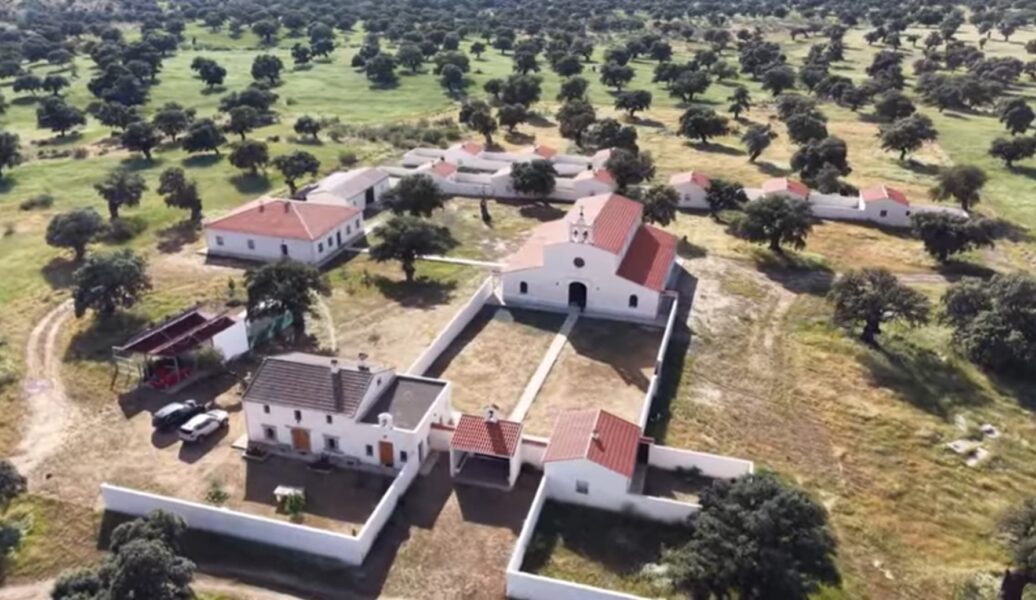
On the feast of Saint Michael, as a long, scorching summer was already bidding farewell, I went to a hidden corner of the province of Córdoba to speak about John of the Cross to some men who knew him far better than I. The place is called the Camaldolese Hermitage of the Immaculate Conception and is located in the municipal district of Hinojosa del Duque, on the El Jardal estate, between Fuente la Lancha and Villaralto, where Los Pedroches begin to resemble Extremadura, the landscape spreading out into a broad, solemn, and silent dehesa.
It is not reached suddenly. One must seek it out, and this is already deeply significant. Leaving behind the small road that connects Fuente la Lancha with Villaralto, one must venture down a rugged path that winds between holm oaks, fences, and cattle. For a third of a league, nothing appears to announce a monastery; only fields and dust, livestock, holm oaks… horizon. The visitor gradually sheds the world left behind until, amid that harshness, the Hermitage suddenly appears, clean and luminous, as if Someone had placed a divine farmhouse in the middle of the dehesa.
The foundation is recent. The first Camaldolese monks settled there in 2023, coming from the Rioja Hermitage of Our Lady of Herrera, and everything one sees has the freshness of things newly born. Of the twelve cells planned, ten have already been built. Everything is white, simple, and new, without monumentality, cheerful in the midst of a land that, at the end of the dry season, shamelessly reveals its extreme bareness. The contrast is beautiful: white lime over scorched grass, dark holm oaks beneath an enormous, crushingly blue sky, and men also dressed in white who have gone to seek God in a place where it would seem there is nothing left to seek. They are the Camaldolese Hermits of Monte Corona, heirs of Saint Romualdo and of the reform promoted in the sixteenth century by Blessed Paolo Giustiniani.
Invited by the prior, I was to give them, in six hours, three lectures on the Mystical Doctor, but it would be I who left having learned a lesson difficult to explain. I was going to speak of detachment, of the nakedness of the spirit, of the night, of silence, of the secret departure of the soul that John of the Cross sings of… to men who had turned those words into walls, schedules, paths, food, clothing, solitude, and destiny. There, renunciation ceased to be a concept and became the architecture of life.
A land fertilized by blood
El Jardal is an estate that belonged to the Blesseds Isidoro Fernández Rubio and Isidra Fernández Palomero, from Villaralto—he a farmer, she president of the local Catholic Action. Married in 1918, they had three children. In the terrible summer of 1936, amid the religious persecution that accompanied the Spanish Civil War, they left their children in the care of relatives in Dos Torres while seeking refuge; when they tried to return, they were arrested and murdered. The Church would recognize that they died in odium fidei and included them among the 127 martyrs beatified in Córdoba on October 16, 2021.
Those children, deprived as youngsters of their father and mother, preserved not only their memory but something deeper than memory. Two of them, Francisco and Isidra Fernández Fernández, stipulated in their wills that these lands should pass to the Diocese of Córdoba. From the El Jardal estate, of 181 hectares, a portion has been reserved for the new Camaldolese Hermitage.
Almost a century later, the blood of those spouses continues to bear fruit. I thought this as I walked among those cork oaks. A man and a woman violently lose their lives; their children grow up with the memory of those parents who were taken from them, for being Catholic; decades pass, they too grow old, and one day the land they received ends up transformed into a place of prayer. On the soil worked by a farmer murdered for his faith, hermit cells now rise; where orphaned children were left, one now hears, before dawn, the chanting of men who have voluntarily renounced everything. Sanguis martyrum, semen eremitarum…
Ten cells, ten solitudes
Each cell constitutes a small world. Adjacent yet separate from the others, it has its own little garden, a tiny piece of creation tended by the hermit, that man who, having voluntarily reduced his external horizon, discovers a new immensity in the smallest things: turning a bit of soil, sowing, watering, awaiting a flower, gathering a fruit… He who has renounced traveling the world learns to look at a plant; he who has abandoned conversations learns to listen to the grass growing.
The Camaldolese tradition carries the vocation to solitude to an extreme difficult for our mentality to comprehend. The monk lives in his cell, works in it, and eats there alone as well. The common refectory is used little more than half a dozen times a year, on the occasion of great solemnities: Christmas, Easter, the Immaculate Conception… I was struck by that dining hall, almost always empty. Today ecclesiastical life demands constant chatter, endless meetings, dialogues, covenants, synodalities of synods that are synodal and synodalizing and must be applauded at the risk of exclusion; in the Camaldolese tradition one learns that a silent fraternity is possible and probably much more real, for the absence of theatricality. Each one is alone, yet none lives for himself.
The isolation proclaims everything: the separate cells, the solitary meals, the almost perpetual silence, the beards grown with the sovereign neglect of one who no longer needs to consult the ungrateful and implacable mirror. Yet none of this produces sadness. The faces are serious—not performing a pastoral comedy—but the gazes transmit a clean joy so uncomplicated that it needs no noise to prove it exists.
The paths that always lead to the same place
Between the cells and the church runs a narrow path along which much of these men’s lives unfolds. At three in the morning the silent movement begins. Under the icy winter night or in the already warm dawns of the Cordoban summer, the monks leave their hermitages, pull on their hoods, and wrapped in the white cloak of the habit, advance toward the church. Matins. Then they return to the cell. And Lauds. Hours later they will walk the same path again. Mass, Terce… And so again and again, day after day, year after year.
That small path is a parable of life. We need to change scenery, try new routes, seek new experiences, as if only the extraordinary could justify our existence. Fidelity, on the other hand, often consists in walking the same hundred meters for fifty years. Cell and church; church and cell. Go to God and return to work; return to God and then return to solitude. Do it with fervor and also when fervor has disappeared, walk under the beautiful sky and under the ungrateful sky, when one understands and when one understands nothing. Work and family. Family and work…
John of the Cross would have recognized those paths well. The spiritual life does not consist in advancing by changing scenery, but in deepening while repeating the same steps, knowing that we never step twice on exactly the same path, because we are being transformed. Perseverance is walking so many times a prosaic path that it ends up becoming poetry that promises.
A church without spectators
All those little paths lead to the church, spacious, very white, ascetic. There the solitaries become a community again, before no one to watch them, without faithful, without assembly, without audience. Because the liturgy is not celebrated to be seen.
The Divine Office proceeds with extreme sobriety. The monks recite and sing in a very slow recto tono, stripped of melody, so that nothing distracts from contemplation. There is no search for effect nor need to make it attractive. The word falls slowly into the silence… I thought that the Opus Dei has been, for fifteen centuries, the soul of monasticism: while the world sleeps, negotiates, fights, amuses itself, sins, loves, suffers, or agonizes, the monks praise God, able to say: “Our place is under the clear night, weapon in hand, and above, the stars. Let the others continue with their feasts. We, in tense, fervent, and sure vigilance, already feel the dawn in the joy of our entrails.”
Our age finds it difficult to understand an action that does not need spectators. There one prays even if no one knows or applauds, even if there are no photographs or chronicles. And it is precisely that which gives that prayer its terrible purity: God alone suffices.
Sola omni careat…
The Immaculate, Lady of the Hermitage, presides over the church. Above her image, a Latin inscription that powerfully caught my attention:
SOLA OMNI CAREAT
QUOM ANTIQUA
AB ORIGINE LABE.
Quom? Insolently, I pointed out the error: was it not quam? Timidly, I was told that, “as we have been told,” it was an archaic form of cum, which lent the sentence an ancient gravity. Rather than forcing a school translation of a deliberately lapidary construction, its mariological sense was transparent: “May she alone be free of every stain, even that ancient one which comes from the origin”; or, more simply, “She alone, free of every stain from the origin.”
That antiphon explained the entire building. Mary, all pure, presiding over a white and hidden monastery. The Immaculate, a creature entirely beautiful for God, looking with the eyes of a Child at men determined to strip their lives of attachments, noises, curiosities, and possessions in order to make themselves a free space where only He reigns. The white of the walls, of the bell gables, of the habits, was a parable of a program: to cleanse, simplify, empty, detach, so that God may have room.
The dehesa also has its dark night
The sturdy and rugged countryside was parched, exhausted but undefeated, already at the end of the sowing season. Months of merciless sun had scorched the grass, and only cork oaks, holm oaks, and gall oaks retained their greenish, almost grayish, gravity of old silver over that yellowish and arid expanse. But, they told me, in spring everything changes: the field is covered with grass, rockrose, rosemary, Spanish lavender, and thyme and flowers, and the summer austerity turns into exuberance.
It was impossible not to read this also in a Sanjuanist key. The nature around the Hermitage almost visibly represents the states of the soul. There are interior seasons in which everything seems parched, when God allows consolations to disappear, satisfactions to dry up, and securities to fall. It is the night, the stripping, the scorched earth. But dryness does not mean death: beneath the apparently sterile soil remain invisible roots and seeds awaiting their hour.
These men have chosen that stripping. They have buried themselves in a dehesa so that others may flourish, with a form of existence in which solitude reaches an extraordinary radicality. Who knows how many unknown springs they are preparing with it. Grace has a surprising botany: it may happen that a prayer said at four in the morning in an empty church produces, hundreds of kilometers away, a fruit whose connection with that prayer which struggled with sleep will only be known in heaven.
O beata solitudo!
The ancient monks liked to repeat: O beata solitudo, o sola beatitudo: “O happy solitude, only happiness!” It is not the praise of a Christianized misanthropy. The hermit does not abandon men because he despises them, but because he has been called to serve them from a mysterious place where they will probably never know they are being served.
As I left, I understood that paradox better. I had come to speak to those men about John of the Cross and returned thinking that the small paths, the isolated cells with their enclosed gardens, the almost always deserted refectory, the slow chanting, and those virile, unkempt, grave, and transparent faces had explained the Mystical Doctor to me as I could never have done.
They gave me two volumes of letters and small eucharistic treatises by Blessed Paolo Giustiniani, the great reformer who, wishing to drink again from the source of Saint Romualdo, restored to the Camaldolese tradition a particular eremitic rigor. His thought possesses a spiritual richness that deserves to be better known and that intellectually prolongs what those men say with their existence.
And I left with a desire. That God may send to El Jardal strong men, capable of accepting the incalculable grace of being forgotten; men who place the world beneath their feet, burying themselves there in life precisely to serve it; men who do not need continually to verify that they exist because others look at them, listen to them, or remember them. May the twelve cells come to be filled and may along that narrow and solitary path continue to pass, when night is still deep, the luminous figures of the hermits.
Perhaps many years from now another traveler, from the road between Fuente la Lancha and Villaralto, will venture down that rugged path among cattle and oak groves and, after a third of a league, see the whiteness of the Hermitage emerge. If it is spring, he will see the dehesa covered with flowers. He will not know how many nights, how many dawns, how many renunciations, how much martyrial blood, how much hidden prayer, how many glances of the Immaculate Child will have made that flowering possible. And he will remain thinking, as happened to me, those words of the poet:
What do we know of where the war
is being won each day, if this war is of faith?
Will it be won by that girl gathering flowers
or by that friar praying beside the tall cypress?
What do we know of which wins more battles,
the mother who stays or the son who leaves?
What do we know of the weight of things
that God measures in His high scales of crystal…?