


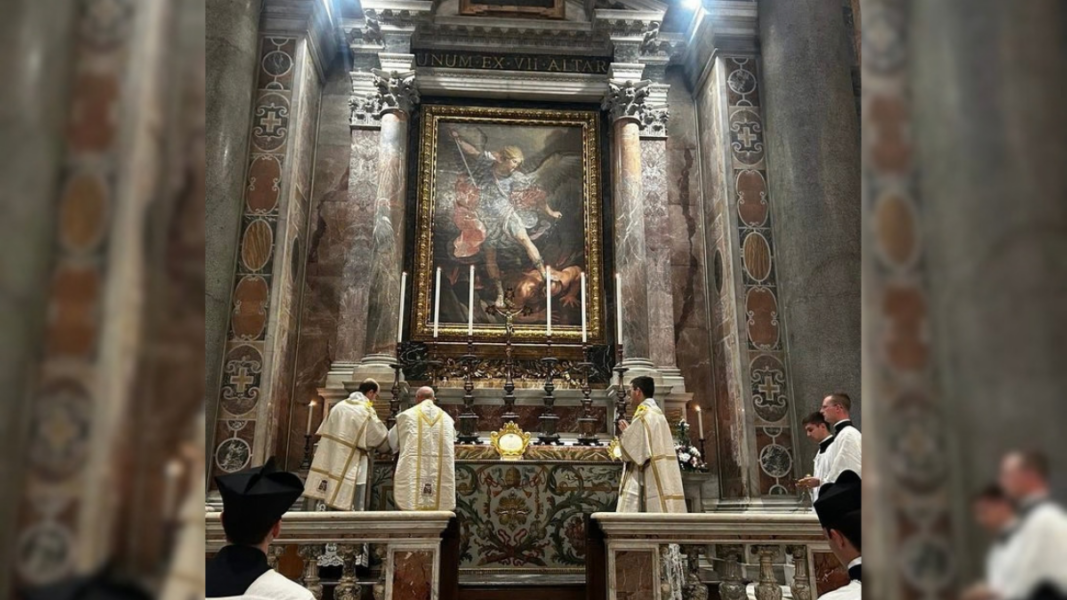
A Solemn Mass according to the traditional Roman rite was celebrated this Tuesday, September 29, at St. Peter’s Basilica, before the altar of St. Michael the Archangel, on the occasion of the feast of the prince of the heavenly host.
The celebration was confirmed by Rorate Caeli, which also published the homily delivered by the American priest Richard Cipolla, from Connecticut. Before the altar dedicated to the Archangel, the priest centered his preaching on spiritual combat, true Christian freedom, the Real Presence of Christ in the Eucharist, and the need to recover a sense of reverence before the Holy Sacrifice of the Mass.
«Non serviam»
Drawing from the passage in the Book of Revelation that presents St. Michael and his angels battling the dragon, Father Cipolla recalled that the battle led by the Archangel expresses the radical confrontation between fidelity to God and rebellion against Him.
The priest evoked the Non serviam —“I will not serve”— attributed to Lucifer’s rebellion to draw a parallel with a contemporary culture that conceives freedom as the individual’s capacity to determine for himself what is good.
In contrast to this conception, he recalled that for the Christian, true freedom is that won by Christ on the Cross: freedom from sin and from death.
“Catholics define freedom in terms of the decision to love, and not love in general, but the love of God for us in the person of Jesus Christ,” he stated. It is, he added, a sacrificial love “that is celebrated here, in the Mass.”
Reverence and the Real Presence
Cipolla also issued a stern warning about the loss of faith among Catholics themselves and pointed directly to the relationship between the manner of celebrating the liturgy and the understanding of what takes place at the altar.
After recalling the well-known surveys that show the confusion among many Catholics regarding the Real Presence of Christ in the Eucharist, he maintained that the problem cannot be separated from decades of deficient formation in the fundamentals of the faith.
“The foundation of our faith is Jesus Christ, true God and true man,” he affirmed.
And he added: “When the Mass is celebrated in a way that denies that this act is an encounter between heaven and earth that demands holy fear and reverence, then Catholicism becomes mere religion; and if that is the case, why bother? Many Catholics no longer bother.”
St. Michael and Spiritual Combat
The homily also affirmed the relevance of a feast that may seem strange to a secularized society, yet possesses a profound foundation in Sacred Scripture and recalls the reality of spiritual combat.
“Today we celebrate the great feast of St. Michael the Archangel,” Cipolla noted. However, he maintained that figures such as St. Michael are uncomfortable for contemporary culture “because they are too masculine, too strong” and because they recall “the reality of spiritual warfare” and the demanding words of the Gospel concerning “sin and death, light and darkness,” and the eternal consequences of human decisions.
The priest finally recalled the prayer to St. Michael the Archangel associated with Leo XIII, which for decades formed part of the prayers recited after Low Mass and which ceased to be part of that liturgical practice after the reforms of the twentieth century.
Cipolla highlighted that in recent years the prayer has spontaneously returned to numerous parishes in light of the awareness of spiritual combat and of “the dangers of the present age.”
“The prayer to the great champion of God, whose name means ‘Who is like God?’, is healthy and necessary in today’s world, a world that in so many ways has forgotten God, as if He no longer existed,” he affirmed.
At the conclusion of the Mass in St. Peter’s, those present once again recited the prayer to St. Michael.
Tuesday’s celebration adds to the traditional Masses celebrated discreetly in recent years before the same altar of St. Peter’s Basilica. In the midst of the Archangel’s feast, the prayers and chant of the ancient Roman liturgy once again resounded in the heart of Christendom.