


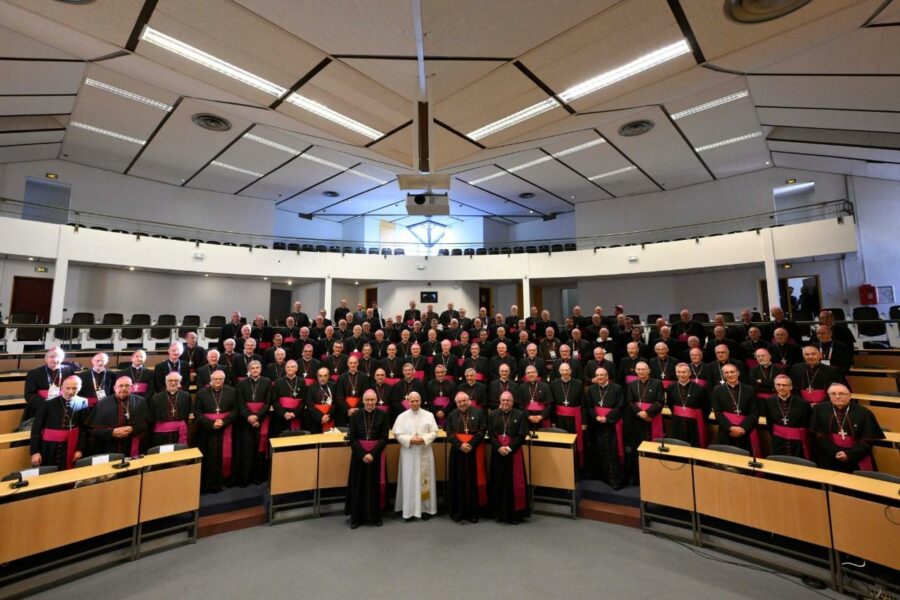
Pope Leo XIV urged French bishops this Sunday, September 27, not to renounce the Church’s public presence before a regime of secularism whose balance, he warned, could once again be called into question. During the meeting held in the Sainte-Bernadette auditorium of the Lourdes Shrine, the Pope also defended the distinctive character of Catholic education, called for solid doctrinal formation for new converts, and pointed to the Christian family as one of the keys to addressing the crisis of vocations.
The Pontiff left at 8:50 a.m. for the Sainte-Bernadette auditorium, where he was received by Cardinal Jean-Marc Aveline, Archbishop of Marseille and President of the French Episcopal Conference. After the cardinal’s welcoming remarks, Leo XIV delivered his address to the episcopate and, once the meeting concluded, moved at 10:00 a.m. to the sanctuary meadow for the Mass scheduled at 11:00 a.m.
The Church “has its full place” in public debate
Leo XIV drew on France’s Christian history to affirm that the Church still forms part of its culture, identity, and vocation in the world. He recalled the country’s ancient bond with the Virgin Mary, the consecration of France in 1638, and its historic title of “Kingdom of Mary,” before urging the bishops to act with “courage, boldness, and missionary creativity.”
In one of the central passages of his address, the Pope stated that the Church’s voice has its full place in French public debate and possesses, by its very nature, a prophetic authority. Even when it is not heard or followed on matters affecting the foundations of civilization, he maintained, its voice remains necessary.
Leo XIV specifically mentioned the bishops’ action during recent debates on end-of-life issues and encouraged them to persevere alongside those who defend the same values. His intervention thus extended the position he expressed on Friday at the Élysée Palace, where the Pontiff called for a form of secularism that does not exclude religion from the public sphere.
Vigilance before a secularism that could limit the Church’s mission
The Pope referred directly to the French model of secularism, the fruit of a history he described as turbulent yet now pacified. He warned, however, that the balance achieved could once again be questioned, as is happening, he noted, in other parts of the Western world.
In light of that possibility, he asked the bishops to remain vigilant in defending the Church’s freedom and rights to evangelize, to educate in true freedom, to practice public worship, and to exercise visible charity in the name of Jesus Christ.
Leo XIV also recalled Pope Francis’s appeal to French Catholics to reclaim their heritage of faith. He recalled the holiness, cultural patrimony, and missionary impetus born of French Catholicism and affirmed that he believes the time has come when many contemporaries once again await the message of hope contained in the Gospel.
Solid doctrinal formation for new converts
The growth of the catechumenate once again occupied a prominent place in the address. Leo XIV highlighted that the phenomenon especially affects young adults and asked the bishops to accompany this grace through living communities, the practice of charity, and a “solid doctrinal teaching” rooted in the Word of God, capable of preparing new faithful to face objections and doubts.
The Pontiff had devoted his Saturday meeting at the Catholic Institute of Paris precisely to this question, through biblical, theological, doctrinal, moral, and liturgical formation.
“Making Jesus Christ known and loved” constitutes, he affirmed this Sunday before the bishops, the only roadmap for the new missionary impetus he desires for France.
Catholic schools cannot renounce their identity
Leo XIV then addressed one of the debates affecting the French Church: the distinctive character of Catholic educational institutions. The Pope acknowledged as positive their openness to students who do not share the faith, always respecting freedom of conscience, but he set a clear limit.
Catholic education, he maintained, cannot renounce its educational project centered on Christ and oriented toward the integral development of the person in spiritual, cultural, intellectual, moral, and social dimensions. Therefore, he considered it natural that in a Catholic institution there should be opportunities to encounter Jesus Christ and hear his Word.
The Pontiff added that no student should feel marginalized within their own class simply for believing in Jesus.
Abuses, priesthood, and the crisis of consecrated life
The Pope also referred to abuses committed against minors by members of the clergy or in ecclesial contexts. He acknowledged the measures adopted by the French episcopate through listening to victims, seeking truth, justice, reparation, and prevention, and called for maintaining “the greatest vigilance.” At the same time, he noted that the clergy need support and encouragement from their bishops.
On vocations, Leo XIV stated that for new priestly vocations to arise, the priest must be awaited, welcomed, and loved, and his identity configured with Christ must appear clearly before the People of God.
He also expressed concern over the decline in vocations to consecrated life, particularly contemplative life, and said he had learned “with sorrow” of the recent or imminent closure of ancient monastic communities that had exerted significant historical influence.
The family, a “key” against the Church’s crises
Leo XIV directly linked the vocational question to the vitality of Christian families. A faith deeply rooted within the family, he noted, constitutes one of the keys capable of responding to many crises affecting both the Church and society.
In the home, he recalled, one learns coexistence, respect, acceptance of differences, mutual assistance, generosity, and the spirit of sacrifice. The fundamental challenge, therefore, would be for Jesus Christ to live fully once again in French Catholic families.
Against ideological divisions in the Church
In the final part of his address, the Pope also called for unity within the French Church. He described it as a “little flock” that needs to gather its strength for mission and warned that ideological divisions would render its witness sterile.
Leo XIV clarified that ecclesial unity does not mean flat uniformity. According to him, it must allow every authentically Catholic sensibility to converge in a common profession of faith, through obedience to legitimate pastors and especially to the Successor of Peter. This unity, he added, is nourished by the Church’s Tradition, from the Fathers to the Second Vatican Council and subsequent magisterium, and is enriched through reciprocal dialogue from faith.
The Pope concluded by assuring the bishops that the Church in France is “precious” to the Pontiff and expressed his hope for a missionary renewal sustained by communities, young people, and the Christian heritage received over the centuries.
ADDRESS OF LEO XIV TO THE FRENCH
Your Eminence,
Your Excellencies,
I am happy to meet with you, dear brothers in the episcopate, in this place blessed by heaven, near the grotto where the Virgin Mary appeared to Saint Bernadette and where you regularly gather for your plenary assemblies. By this choice you clearly manifest your desire to place the Church in France under the protection of the Mother of God, the Immaculate Virgin, so that she may guide it more securely according to the Lord’s will. Indeed, there is no better way to reach Jesus than through Mary. Everything in her leads us to her Son.
In this way, you perpetuate the legacy you have received from your fathers in the faith, from the dawn of the evangelization of this country. The cult of the Mother of God took root here so deeply that France was soon called the “Kingdom of Mary” (Pius XI, Ap. Letter Galliam, Ecclesiae filiam primogenitam, 2 March 1922). This privileged bond between your nation and the Blessed Virgin was manifested in a singular way when France was solemnly consecrated on 10 February 1638, as I was able to see the day before yesterday in a beautiful representation in the cathedral of Notre-Dame in Paris. And my predecessor Pius XI, referring to that vow, declared Our Lady of the Assumption Patroness of France (cf. ibid.).
This long journey with Mary, full of trust and tenderness, marked by so many devotions and places that bear her name, by so many prayers heard—often amid tears—by so many shrines and pilgrimages, by so many cathedrals, continues today, against wind and tide, and bears witness to the living faith of the People of God entrusted to you. In the face of the immense challenges of our time, I urge you, dear brothers, to show courage, boldness, and missionary creativity. Do not be discouraged by the errors, inconsistencies, or even the falls that have marked the history of this people on the way. Always have the courage to acknowledge errors in love of the truth and the determination to heal wounds with the charity of the Good Shepherd, who knows his sheep and calls each one by name. Rise up, then, with hope, and do not tire of proclaiming the Gospel!
The history of the Church in France is rich, immensely rich. It is beautiful and fruitful; and it is important to draw upon it to build the future of your communities, as well as that of your country. The Church has been a witness, and has even contributed to the gradual building of this nation; today it still, to a large extent, forms part of its culture, its identity, and its vocation for the world. That is why the Church’s voice has its place in public debate in France; it possesses, by its very nature, a prophetic authority. Even when it is not always heard, it is awaited. Even when it is not followed, especially on essential questions affecting the foundations of civilization, it is necessary; do not doubt it! I know the determination and courage you possess—you have clearly demonstrated it in the recent debates on end-of-life issues—and I invite you to persevere, together with all people of good will who defend the same values.
You currently live under a very particular regime of secularism, the fruit of a turbulent history, now pacified, but one that must allow the Church to fulfill its mission. The fact that the balance, achieved with so much effort, is gradually being called into question, as is happening in other parts of the Western world, should not lead you to resignation. I invite you to remain vigilant in defending the Church’s freedom and rights to evangelize, to educate in true freedom, and to practice public worship, so that charity may visibly be exercised in the name of Jesus Christ.
Pope Francis, in his message on the occasion of the reopening of the cathedral of Notre-Dame in Paris, wrote: “I invite all the baptized who will joyfully enter this cathedral to feel a legitimate pride and to claim their heritage of faith. […] This dwelling, which our heavenly Father inhabits, is yours; you are its living stones. Those who preceded you in the faith built it for you” (Message on the occasion of the reopening of Notre-Dame de Paris, 21 November 2024). Encouraging the baptized to “reclaim their heritage of faith” today forms part of your mission as pastors, with a view to a renewal of the Church in France.
What the Lord has granted you, Catholics of France, Eldest Daughter of the Church, is indeed reason for thanksgiving: an uninterrupted succession of holiness that reaches our own day; the flourishing of the arts, letters, and sciences under the impulse of faith and the action of the Holy Spirit; an irreversible maturation of the consciousness of the inalienable value of the human person, of his dignity, and of the need to protect his rights and freedoms; not to mention that formidable missionary impetus that has borne fruit to the ends of the earth. Yes, Jesus has given you much, and in his love he wishes to give you even more.
That is why, looking to the future, Pope Francis added to his already cited words: “May the rebirth of this admirable Church, therefore, be a prophetic sign of the renewal of the Church in France” (ibid.). I too believe that the time has come when many of our contemporaries expect to hear the message full of hope of the Gospel and to see the light of the risen Christ shine in their eyes. The message of peace that has its origin in Jesus is all the more awaited when one considers that, both in France and in the rest of the West, there is an alarming polarization, a retreat in fraternity, cordiality, and quality of life within society, as well as a resurgence of violence, inequalities, and poverty. In the face of such challenges, disillusionment and disorientation follow the false promises of a world in which God would be absent, relegated to private life, where the help of his grace would be considered useless for the building of the earthly city. That is why Jesus clearly warned his disciples: “Apart from me you can do nothing” (Jn 15:5).
Young people, in particular, harbor great aspirations. Concerned about the world they have received, troubled about the future, they are ready to work with courage and generosity for all that is beautiful, true, and good. Show them the way of the Gospel, the only sure direction—though demanding—which has already borne so much fruit in this land of France. Yesterday, in Paris, we mentioned the encouraging sign of the catechumenate, which largely concerns young adults. It is a grace and a joy for the whole People of God. It is important that you take care to accompany this grace, especially through welcome in living communities that practice charity and live in solidarity; and through solid doctrinal teaching rooted in the Word of God that enables them to face objections and doubts.
To carry out this renewal of hope, within the framework of a new missionary impetus in France, which I so desire, there is only one “roadmap,” always the same: to make Jesus Christ known and loved, authentically, with passion, again and again. In the current context, you face some important challenges. That of education, which is of paramount importance. It is very praiseworthy that your Assemblies are delving into this theme. Education is an especially broad mission that encompasses multiple areas of life. I would simply like to mention that of Catholic education, whose “distinctive character” is being questioned in these times. It is a joy that Catholic educational centers are widely open to those who do not share our faith. This generous welcome, respectful of each person’s freedom of conscience, promises great fruitfulness for all, for society, and for the Church itself. However, Catholic education cannot, in any way, renounce its educational project, a project centered on Christ that aims at the integral development of the human person in all its dimensions: spiritual, cultural, intellectual, moral, and social. Therefore, no one should be surprised that in any Catholic center opportunities are offered to encounter Jesus Christ and hear his Word. Still less should any student feel marginalized in their class simply for believing in Jesus.
In recent years, you have faced with determination the painful scourge of abuses against minors committed by members of the clergy or in an ecclesial context. You have adopted courageous measures to confront it, through listening, the search for truth, justice, forgiveness, reparation, and a firm commitment to a culture of prevention and protection against these crimes. I thank you for what you have done, and I know that some moments have been very difficult for your Conference. It is necessary to continue along the path undertaken, maintaining the utmost vigilance. At the same time, your clergy needs support and encouragement; I know that they are the object of your paternal solicitude. For priestly vocations to arise, the priest must be awaited, welcomed, and loved, and his identity—configured in Christ—must be clear and well understood within the People of God, for the joy of the Gospel and the service of his mission.
I also consider it important to mention the regrettable decline in vocations to consecrated life, particularly to contemplative life. I have received with sorrow the news of the recent or imminent closure of ancient and prestigious monastic communities that have had great influence throughout history. To give one’s life to following Jesus along such a narrow path requires, in addition to the work of grace, a special generosity, a solid rooting in faith, a sustained interior life, and a privileged closeness to him. These conditions are found more frequently in Christian families, which deserve the greatest attention and the greatest support. Without doubt, the deepening and consolidation of the life of faith within families is a key that will make it possible to resolve many of the crises affecting the Church and our societies. Indeed, it is within families that one learns to live together, to respect others, to accept diversity, to support one another, to be generous, to give oneself disinterestedly, and to have a spirit of sacrifice. Perhaps this is the main challenge we must face: May Jesus live fully in the Catholic families of France and enlighten them with his presence!
To these challenges is added another that may cause some concern for the future: that of unity. In this regard, allow me to recall how essential it is that the disciples of Jesus be united in charity, just as he asked his Father: “That they may all be one […], so that the world may believe that you have sent me” (Jn 17:21). The Church in France is a small flock that must unite its strength for mission. Ideological divisions would render its witness vain. There have always been tensions in the history of the Church, but when they manifest themselves, it is then that we can better appreciate the gift of unity. This unity is not a simple uniformity, but allows every authentically Catholic sensibility to converge naturally in a common profession of faith, through obedience to legitimate pastors and, in particular, to the Successor of Peter, “the perpetual and visible source and foundation of the unity of faith and communion” (LG, 18). It is a dynamic unity that is nourished by the Tradition of the Church—from the Fathers to the Second Vatican Council—and by the post-conciliar Magisterium. Moreover, it is enriched in reciprocal dialogue, starting from faith, according to a synodal style that we have been trying to deepen in recent times.
Dear brothers, the Church in France occupies a very special place in the Pope’s heart. How I would like to convey to you the feelings of enthusiasm and hope that fill me when I think of you! The Church in France, rich in living, fraternal communities open to the world; rich in a passionate youth committed to multiple initiatives; rich also in a legacy that sustains it, yet at the same time commits it. I am certain that the People of God who are pilgrims in France will continue with fervor their mission of proclaiming and making Jesus Christ loved, so that the world may have life.
Entrusting to the maternal protection of Our Lady of Lourdes your Assembly, your diocesan communities, and your country, I joyfully impart to you the Apostolic Blessing. Thank you.