


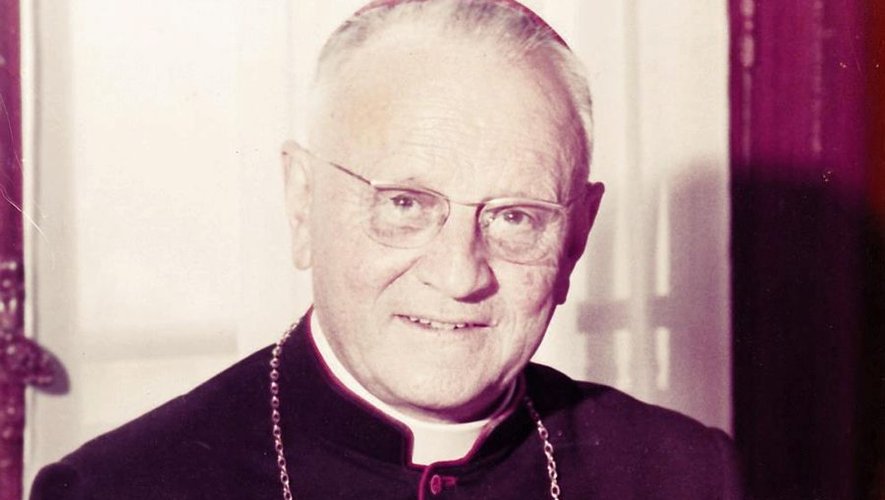
The French diocese of Tarbes and Lourdes has made public an accusation of sexual violence against Pierre-Marie Théas, bishop of Montauban between 1940 and 1947 and of Tarbes and Lourdes between 1947 and 1970. The complaint was filed by a former student of the Notre-Dame de Bétharram institution and concerns a prelate who died in 1977, so there is no possibility that he can respond to the facts attributed to him or that they can be clarified through a judicial process.
The current bishop of Tarbes and Lourdes, Jean-Marc Micas, communicated the case and explained that the former student approached the National Independent Recognition and Reparation Authority (INIRR) some months ago and claims to have been sexually assaulted by Théas when the latter was 75 years old and already bishop emeritus.
After leaving the governance of the diocese in 1970, Théas, a native of the region, had a small apartment in Bétharram at his disposal until his death.
The diocese sought elements that could corroborate the complaint
Micas learned of the accusation in July 2026. Within the usual INIRR procedure, the body asked the diocese to check whether it had elements that could “support the plausibility” of the account presented by the former student.
The search did not find them.
“An exhaustive search in the archives did not allow a positive response to this request from the INIRR,” the episcopal communiqué states.
The diocese does not therefore maintain that the accusation is false. The problem pointed out by Micas is precisely the impossibility of establishing what happened: the documentation examined has not provided elements that could corroborate the account and Théas died almost half a century ago.
“Msgr. Théas is no longer here to confirm or deny the facts reported. Therefore, there can be no investigation and trial that establish the truth while respecting the provisions of the law,” Micas wrote to the faithful.
An accusation without possibility of contradiction
The bishop openly acknowledges the difficult situation posed by an accusation of this nature against a deceased person.
“As always in this situation, doubt will remain in the minds of some and others,” he states. Micas describes that uncertainty as “terrible” both for those who report having been victims, whose word runs the risk of not being believed and whose suffering may go unrecognized, and for the relatives of the accused.
Regarding the latter, he notes that “they do not know what to think,” they may reproach “the disclosure of information without possibility of contradiction” and will have to live with it.
Micas directs his “first thought” to the complainant and, more broadly, to those who have suffered sexual violence. He also recalls the special gravity that abuses acquire when committed by priests or bishops, as they can affect the victims’ relationship with the Church and with God.
Théas, “Righteous Among the Nations”
The accusation concerns a well-known figure of the French episcopate of the 20th century. Pierre-Marie Théas was recognized in 1969 as “Righteous Among the Nations” for his public opposition to the anti-Semitic measures adopted by the Vichy regime.
In 1942, when he was bishop of Montauban, he publicly protested against the persecution of Jews. Micas recalls that, although he left the diocese more than half a century ago, his memory continues to be present inside and outside the Church, particularly among the French Jewish community for his actions during the Second World War.
The current bishop acknowledges that the accusation may put “a little more to the test” the confidence of some people in the Church.
Micas reaffirms the diocese’s commitment against abuses
In his communiqué, Micas places the news within the process undertaken by the Church in France following the publication of the report of the Independent Commission on Sexual Abuses in the Church (CIASE).
The bishop assures that since then commitments have been made to recognize and accompany victims, prevent sexual violence and advance in the ecclesial “transformation” he considers necessary, including a review of the ways in which authority is exercised by clerics and laypeople.
“Much has been done and much remains to be done,” he acknowledges.
The publication of the case also comes just days before the arrival of Leo XIV in Lourdes. Micas concludes his communiqué by recalling a request from the Pontiff: “It is urgent to root in the whole Church a culture of prevention that tolerates no form of abuse: neither of power or authority, nor of conscience, nor spiritual or sexual.”
The accusation against Théas is thus marked by a circumstance that runs through the entire communiqué of the bishop of Lourdes: there is a complainant who claims to have suffered a sexual assault, but the search carried out in the archives has not provided elements that could corroborate his account and the man accused died in 1977, without possibility of responding to the accusation.