


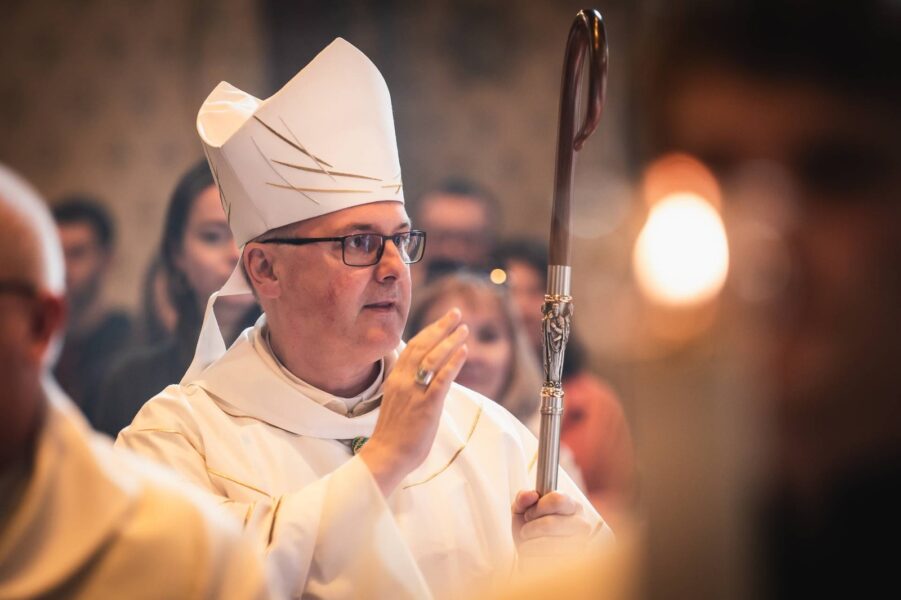
Stanislav Přibyl, one of the most significant episcopal appointments made by Leo XIV and a prelate who has described the Synod as “a great inspiration,” will lead a penitential pilgrimage on October 5 to ask for forgiveness and offer reparation for sins committed within the Church. The new Archbishop of Prague has called on the faithful following several cases that have shaken the archdiocese and acknowledges the “pain, frustration, and shame” caused by the accusations.
“First of all, because I too am a sinner,” Přibyl wrote when announcing the pilgrimage in his first pastoral letter since assuming leadership of the archdiocese. The journey will conclude at the Marian shrine of Hájek with a Mass and a penitential rite.
Read also: The four appointments that anticipate the model of cardinal of the new pontificate
“Trust has been damaged”
The penitential call comes after several cases that have affected the Archdiocese of Prague. In his pastoral letter of September 6, Přibyl refers to “serious suspicions of moral and patrimonial offenses, including violence,” as well as a case of abuse committed by a priest.
The archbishop states that, since his arrival, he has sought to act “immediately and firmly” and maintains that it is now up to the competent authorities and institutions to investigate the accusations and determine responsibilities.
In July, the archdiocese announced an internal review of its financial management with the assistance of external lawyers. Among other matters, contracts and patrimonial operations are being examined to determine whether they may have caused economic harm to the local Church.
Přibyl explained at the time that some of the cases were already in the hands of the authorities and assured that the archdiocese was providing “full cooperation” to the police.
Investigations into alleged sexual and financial crimes
Among the matters forming part of the context is the case of Antonín Juriga, a permanent deacon and former executive director of the Archdiocese of Prague.
Czech police opened a criminal investigation against Juriga in early August for alleged sexual offenses and other violent acts. Authorities are also investigating possible financial crimes related to real estate transactions and asset management.
Some of the conduct under investigation is alleged to have occurred in the archbishopric’s own premises. The investigation remains open, and responsibilities will be determined by judicial authorities.
Přibyl does not name Juriga in the pastoral letter but openly acknowledges the damage the various cases have caused to the Church in Prague.
“I know that many of you feel pain, frustration, and shame for what has happened,” the archbishop writes, before admitting that “trust has been damaged.”
“First of all, because I too am a sinner”
Přibyl maintains that the response cannot be limited to civil investigations, administrative measures, or the review of the archdiocese’s management.
For this reason, he has called on priests, deacons, religious, and laity to participate on October 5 in a penitential pilgrimage from Hostivice to Hájek, a historic Marian pilgrimage site located west of Prague.
The march will begin at 4:00 p.m. at the Church of St. James in Hostivice. At 6:00 p.m., a Mass is scheduled at Hájek, accompanied by a penitential rite.
“We will also offer reparation for the sins committed within the Church, which have rightly scandalized so many people,” the archbishop explains.
Přibyl does not exclude his own personal responsibility from the call to penance: “First of all, because I too am a sinner.”
The pilgrimage will conclude with a prayer for conversion, the healing of the wounds caused by the scandals, and the beginning of a new chapter in the Archdiocese of Prague.