


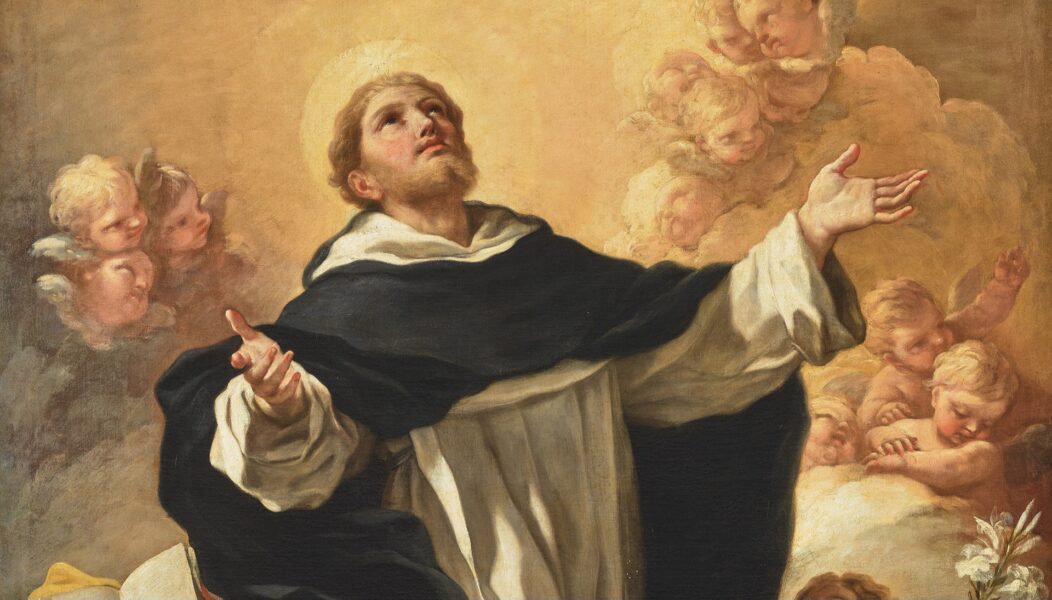
Three European towns marked by the life and legacy of Saint Dominic of Guzmán will strengthen their ties through a new joint project. Caleruega, in Burgos, where the founder of the Order of Preachers was born; Fanjeaux, in France, the setting of his preaching years; and Rieti, in Italy, where Gregory IX signed his canonization, will take part in an initiative that seeks to keep alive the historical and spiritual heritage that unites them.
The project, called DOMINICUS, will be presented on 26 September in Caleruega and will develop meetings and exchanges among the three towns until May 2027.
From Caleruega to Fanjeaux
The choice of the three towns allows visitors to trace some of the main places in the life of Saint Dominic.
Caleruega preserves the memory of his origins. There Dominic of Guzmán was born around 1170, into the family of Félix de Guzmán and Juana de Aza. The Burgalese town remains closely linked to the Order of Preachers and houses, among other sites, the monastery of the Dominican Mothers and the convent of the Dominican friars.
From Castile, the route leads to Fanjeaux, in the French Languedoc. Saint Dominic arrived in this region at the beginning of the thirteenth century and there carried out a decisive stage of his preaching against the spread of Cathar heresy.
Very near Fanjeaux lies Prouilhe, where in 1206 Dominic gathered a group of women converted from Cathar heresy and established a religious community. This women’s monastery preceded the formal foundation of the Order of Preachers, later confirmed by Pope Honorius III.
Fanjeaux thus became linked to the years in which the mission that would characterize the Dominicans took shape: preaching for the salvation of souls, sustained by study, prayer and community life.
Rieti and the canonization of Saint Dominic
The third city included in the project leads to the end of the saint’s earthly story and to the recognition of his cult by the Church.
Dominic died in Bologna on 6 August 1221. Only thirteen years later, Pope Gregory IX inscribed him in the catalogue of saints through the bull of canonization promulgated in Rieti on 3 July 1234.
Gregory IX had known Dominic personally and, in canonizing him, expressed the esteem he held for the founder of the Preachers. Rieti’s historical connection with that act explains its inclusion in this itinerary alongside Caleruega and Fanjeaux.
The three towns thus represent three different moments of the same story: Caleruega, the birth; Fanjeaux, the preaching; and Rieti, the canonization.
A shared Dominican heritage
The links among these towns predate the new project. Caleruega has been twinned with Fanjeaux since 2003 and with Rieti since 1999, the latter renewed in 2019.
DOMINICUS now aims to strengthen that relationship through trips, meetings and activities involving residents and associations from the three towns. The initiative has received €50,745 in funding through the European CERV programme.
The presentation will take place on Saturday, 26 September, at 13:00, in the auditorium of the Dominican convent in Caleruega. There the programme to be developed until May 2027 will be unveiled, centred on a common heritage that began more than eight centuries ago with the life of Saint Dominic of Guzmán.