


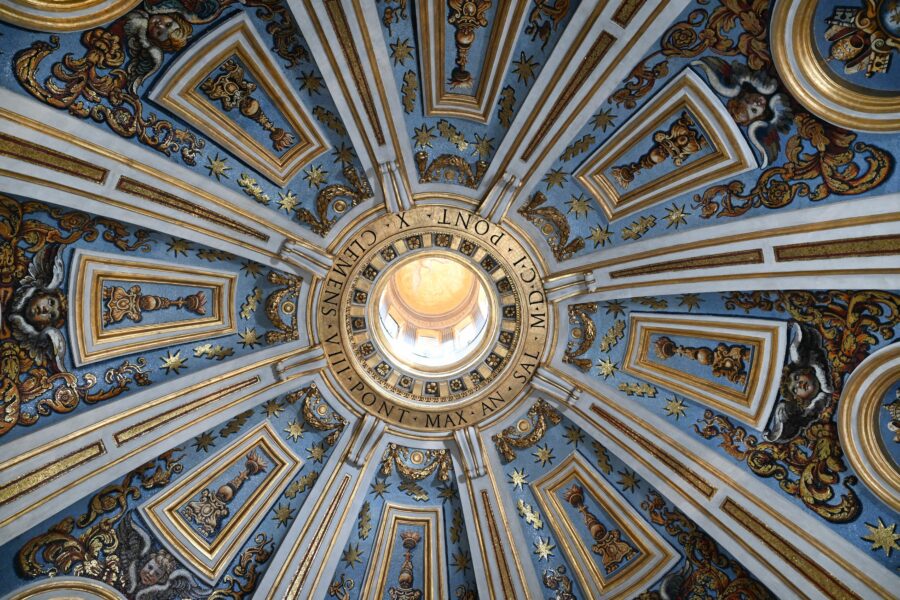
The Basilica of Saint Peter has completed the restoration of the dome of the Clementine Chapel, one of the great decorative works from the early 17th century. The works, begun in May 2025, have allowed intervention on 371 square meters of mosaics created between 1601 and 1604 and on the accompanying stucco decorations.
The completion of the works has been announced by the Fabric of Saint Peter, the body responsible for the conservation and maintenance of the Vatican basilica, coinciding with the year marking the 400th anniversary of the consecration of the current church.
371 square meters of mosaics
The restoration has affected the mosaics created between 1601 and 1604 based on the cartoons by the painter Cristofano Roncalli, known as Il Pomarancio.
Periodic surveillance work carried out by the Fabric of Saint Peter had detected the need to intervene on the mosaic decoration. The installation of scaffolding in January 2025 allowed close examination of the surfaces and identification of problems related both to the natural aging of the materials and to interventions carried out over time.
The inspections led to extending the works to the stucco decorations from the same period, with the aim of ensuring the stability of the ensemble.
A detailed study before intervening
Before beginning the actual restoration, a diagnostic campaign was carried out that included photographic documentation, laboratory analysis of the materials, digital mapping of the deteriorated areas, and endoscopic investigations.
The Fabric of Saint Peter also used BIM technology (Building Information Modeling) to create a three-dimensional model of the dome, incorporating data on its state of conservation and the interventions performed.
The result is a digital archive that can be updated and used in future surveillance and maintenance work.
The intervention included the removal of accumulated dust and dirt, the consolidation of tesserae showing stability problems, the treatment of efflorescences, and the removal of elements considered incompatible with the original work.
Supports at risk of detachment were also consolidated, and existing lacunae were treated to recover the formal and chromatic reading of the ensemble.
A chapel linked to Clement VIII
The Clementine Chapel takes its name from Pope Clement VIII, Ippolito Aldobrandini, who governed the Church between 1592 and 1605 and promoted its decoration.
The chapel had been designed by Michelangelo Buonarroti and was completed by Giacomo della Porta in 1580 as a symmetrical counterpart to the Gregorian Chapel. It forms part of the complex of spaces surrounding the Confession of Saint Peter.
Its iconographic program was developed in the context of the Counter-Reformation and counted on the decisive participation of Cardinal Cesare Baronio, one of the most important intellectual figures of the late 16th-century Church.
The four Doctors of the Church are represented in the pendentives of the dome, while the lunettes contain biblical scenes. The ensemble is completed with abundant decoration of putti, garlands, and heraldic symbols of the Aldobrandini family.
A work from the early 17th century
The execution of the mosaics was entrusted to a team of approximately ten masters, including Marcello Provenzale, Paolo Rossetti, and Ranuccio Semprevivo.
The use of mosaic acquired special importance in the decoration of the new Basilica of Saint Peter due to its resistance and durability compared to other pictorial techniques. The Clementine Chapel preserves one of the first great examples of this decorative program developed during the construction of the church.
The works conclude as Saint Peter commemorates the four centuries since the consecration of the current basilica, celebrated by Urban VIII on November 18, 1626.
The restoration allows the recovery of one of the ensembles that testify to the final stage of construction and ornamentation of the church built over the tomb of the apostle Peter.