


By: A (former) perplexed Catholic
Let us begin with some important considerations that will situate us in the subject we intend to address.
On the one hand, Leo XIV has already revealed himself to be a disastrous pope. Surpassing Bergoglio seemed impossible, but in just one year, if he has not surpassed him, he has at least equalled him. He deceived us by appearing on the loggia wearing the mozzetta and stole on the day of his election, yet he has not abrogated any heterodox text of the previous pope, has not removed any heretical prefect, has continued to reinforce the gender quota in the curia, persists with synodality, and celebrates the month of care for our common home. Moreover, when he celebrates outside the Vatican, there are usually teenage altar girls in the sanctuary; furthermore, he had no time to meet with the FSSPX, did nothing to prevent a rupture, but did find the opportunity to meet with ladies dressed as bishops and to tell the Lutherans that Catholics and they, heretics, have a “common mission.” He may have it, perhaps, judging by appearances, but not the Catholic Apostolic Church. Finally, a matter not to be overlooked is that, after asking the curia at the beginning of his pontificate to help him restore law in the Church, he blatantly disregards it. See, for example, the grave case of the former priest Lute in Peru and how it has been left unresolved.
Secondly, although it is true that diocesan boundaries in Spain do not correspond to autonomous communities, much less to provinces, I find it somehow inevitable to focus preferentially on the Church in Catalonia, with its ten dioceses.
And finally, we know that there were periods in the Church when, composed in its earthly part by sinful men, mitres were bestowed on individuals whose only merit was being members of illustrious families. In that sense, that this continues to happen, although regrettable, is nothing new.
But that the priest Jordi Bertomeu could become bishop of Barcelona is already another level. And with that news we woke up at the beginning of September; and not once, but twice: in InfoVaticana and in Germinans, which commented on the former. The unease is at its peak.
This would merely confirm that the synodal church has discarded everything good that the Church possesses, which is a great deal, and has retained only the most despicable vices, such as, among others, political bossism, episcopal appointments by fiat, and rewards for highly dubious merits.
Certainly, in Catalonia today there exists a collection of bishops who are generally quite or very poor. Mute dogs, politically correct, servile before the world, and so on. Among the most recent appointments, Planellas (not so recent) in Tarragona and Palau in Lérida were at least parish priests and professors at the Faculty of Theology of Catalonia.
For his part, the merit of the Dominican Gómez de Sant Feliu was being a friend of Cardinal Cobo, with whom he worked in the migration section of the Spanish Episcopal Conference. But, in addition, he has pastoral experience, having served as parish priest in various parishes of the diocese of San Sebastián and as prior of a convent of his order for a three-year term.
Yet among the appointments to Catalan episcopal sees there is a precedent for Bertomeu’s scant or nonexistent pastoral experience. For it is known of Bertomeu that he was born in 1968 and was ordained a priest in the diocese of Tortosa in 1995. That in 2002 he became judicial vicar and professor of canon law at the Higher Institute of Religious Sciences of the same diocese, and that in 2012 he was appointed an official of the Disciplinary Section of the Congregation for the Doctrine of the Faith. We may imagine that, between his ordination in 1995 and 2012, when he joined the staff of the CDF, he served as vicar and/or parish priest in his diocese, but this information is not found on the most common search sites on the web. In other words, pastoral experience is assumed, but it does not appear among his published biographical data.
However, should he lack such pastoral experience, his possible episcopal appointment would not be an unprecedented case in the Church in Catalonia; another already exists among recent appointments: that of Serrano Pentinat in the diocese of Urgel. Appointed bishop at the age of 47, Serrano was a nunciature official with twenty years of diplomatic career but minimal pastoral experience in his early years of ordination in small rural parishes of Tortosa, his diocese of origin (the same as Bertomeu). Personal secretary to Edgar Peña Parra at the time of his appointment, who was then (2024) substitute of the Secretariat of State (that is, number 3 in the Vatican organizational chart).
Serrano received the mitre of Urgel—which means that of Andorra—it is not known whether as a reward for his dealings with the London real-estate scam, because the Vatican has accounts in Andorra, or because he knows too much about the foregoing through his proximity to Peña Parra and, as a consequence of the Andorran co-principality entailed by the see of Urgel, the appointment guaranteed him diplomatic immunity. Whatever the reason among these, or a bit of all of them, Serrano was given a mitre with practically no pastoral experience in a very specific diocese that carries political responsibility. In that sense, the chosen candidate’s background did not cause so much surprise at the time, since it was assumed he was appointed exclusively for the Andorran question and the government’s intentions to decriminalize abortion, and not to be a shepherd of souls.
It is not that I know much about this, but it seems quite evident to me that Serrano, unconnected to pastoral tasks and to the Church in Catalonia, should not have appeared on any list proposed by the nuncio in Spain, but rather has every appearance of having been an appointment by fiat. Exactly as the hypothetical appointment of Bertomeu to Barcelona would be. In this regard, at the time, the portal Germinans Germinabit explained how the appointment of Serrano as coadjutor and successor took the now-emeritus of Urgel, Archbishop Joan Enric Vives, completely by surprise.
It would not be far-fetched, then, that the priest Jordi Bertomeu Farnós, appointed by Pope Francis Prelate of Honor of His Holiness “for his role in the persecution of pedophilia in the Church,” be given the mitre of Barcelona. An appointment that would immediately catapult him to the cardinalate and make him papabile! One must be aware of the danger this poses for the Church and for souls.
Bertomeu’s merits for receiving a mitre? As the cripple of Calanda concluded in his article in Germinans Germinabit on 3 September last, knowing too much. And to keep him content and quiet, they would give him an important mitre. The Cripple insists: Bertomeu’s appointment to Barcelona would be “definitive proof that in Rome there is no one left willing to say ‘no’ to the one who knows too much.” Too much about certain Vatican sewers that should not exist.
Since we are speaking of merits, let us briefly consider whether this is an appropriate concept in the question of the selection of bishops, before continuing with the account of Bertomeu. For perhaps, rather than merits, it would be more fitting to speak of suitability for the office: despite how much the manner of electing bishops has varied throughout the history of the Church (from the primitive election by the people to election by civil rulers and, finally, by the pope in most cases), it has always been necessary to investigate, examine, and certify the suitability of candidates for the episcopate.
Perhaps, at this point, some may think we are merely talking for the sake of talking. And it is possible that this is so. But we already know the saying “where there’s smoke, there’s fire,” and two reliable outlets such as InfoVaticana and Germinans (which was right about Omella’s appointment when no one thought it possible) have presented Bertomeu as a possible candidate for the see of San Paciano. So, is Bertomeu a suitable candidate for the episcopate?
To summarize, if there is one thing for which the figure has become known internationally, it is for embodying a manner of operating more typical of a mafia than of the Catholic Church. In an article dated 15 April 2025 in InfoVaticana signed by Erwin Scheuch, member of the Sodalitium, the accusations that have subsequently multiplied regarding Bertomeu’s way of acting were set forth: ambition, economic interests, conflict of interest, threatening interviews, manipulation, breach of secrecy, defamation, self-promotion: under the pretext of his offices, which ought to be discreet, he charges for trips where he seeks to appear as the Pope’s envoy before thousands of people, whether in the Philippines, Ecuador, or Bolivia (through certain media outlets that are always the same, the most rancid heterodox progressivism). But above all, what is most striking, in the case of a doctor in canon law, is the utter lack of canonical guarantees in everything that passes through his hands, abusing his power in the Bugnini style (“the pope has said so” or “the Holy Father agrees,” without proof). In the case of the Sodalitium, according to Scheuch, in a 4,500-page report resulting from Bertomeu’s investigations, most of the facts alleged by him were proven false, and those that did occur or caused scandal decades ago had already prescribed and had been repaired. According to witnesses, Bertomeu acted outside the law, played judge and executioner when he had been designated merely as investigator, and, having heard only one interested party, arrived in Peru with the decision already made to liquidate the Sodalitium.
The article concluded with the following reflection: “In his wake, he leaves a host of lost faithful, Catholics harmed in their rights, priests without parishes, pecuniary promises made to journalists and activists. A veritable scandal for the Church of mercy. This is Jordi Bertomeu Farnós, the all-powerful Vatican functionary. After Chile and Peru, where will his boundless ambition take him now?” Will it take him to Barcelona?
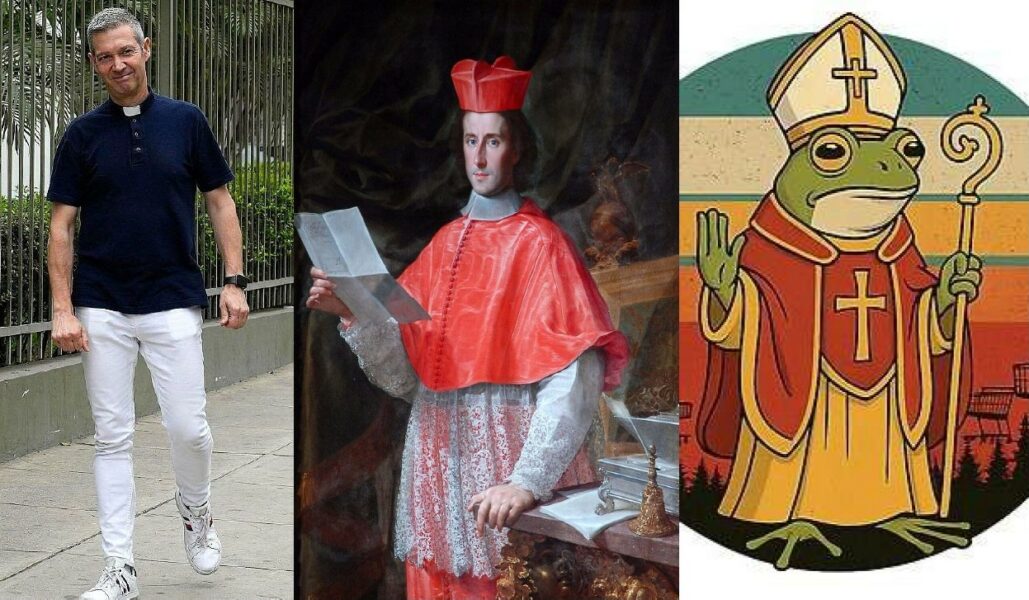
Should it happen, the Pope could not be exonerated from the sorry appointment of a priest of nearly sixty who wears immodest elastic jeans. The pope could not hide behind the usual suspects Trucho and Roche. Because he knows Bertomeu, has not ceased to entrust him with special missions, and his closeness is indisputable; unless Bertomeu continues to lie in the Bugnini style in his recent book “Parishes Led by Laity,” in which he congratulates himself on his closeness to the Pontiff, speaking at all times of Francis / Leo XIV regarding his missions for the Holy See, in a total continuity that he presents as an extension or fusion.
In fact, during a very recent visit to his diocese of origin, Tortosa, under the pretext that it is his diocese and of the book he has recently published, the unspeakable “Catholic” communications agency Flama highlighted Bertomeu’s harangue to that local Church: “Do we want to be archaeology of the past or shall we reinvent ourselves?” I think it is unquestionable that he is in full electoral campaign, in addition to the fact that it is truly curious how rancid some people are when they try to provoke with “innovative” ideas. That reinvention was already carried out by Luther and was attempted again in the 1960s, in case Bertomeu is weak on Church history.
Joking aside, it would be truly dramatic for the diocese of Barcelona (and for any diocese, in reality) if such a character were appointed bishop. A bishop is a successor of the Apostles. Let us not forget that. That a mitre should become a prize or reward not only despite the candidate’s lack of suitability, but as payment for his lack of scruples and his low moral character, would confirm that we are even worse off than we wish to believe.
Note: Articles published as Opinion express the views of their authors and do not necessarily represent the editorial line of Infovaticana, which offers this space as a forum for reflection and dialogue.