


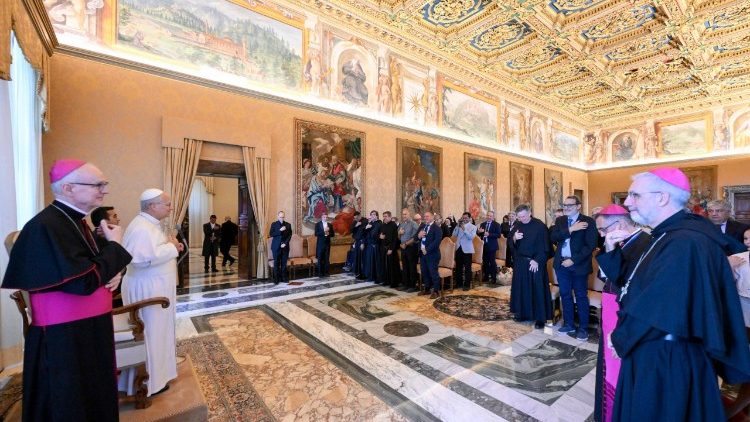
Pope Leo XIV received the members of the International Center Pope Leo XIV this Friday, September 18, at the Vatican Apostolic Palace, an initiative promoted by the Order of Saint Augustine to foster reflection and critical thinking in light of the Social Doctrine of the Church.
In his address, the Pontiff highlighted as one of the new center’s missions the formation for public and political life, which must be understood as “service to the common good, responsibility toward the community, and the building of relationships founded on solidarity, justice, and peace.” Leo XIV also defended collaboration between the baptized and the Magisterium, citizens and experts, the people and institutions, and urged those present to combat “distrust and resignation.”
Below is the full text of the Holy Father’s address:
Dear brothers and sisters:
I am pleased to meet with you and, in this way, to accompany the first steps of the initiative of the Order of Saint Augustine to promote an International Center of Studies bearing my name. I am particularly grateful for this, given the importance of the attitude of reflection and critical thinking in building a civilization of love, to whose service the Social Doctrine of the Church has much to offer.
From the outset, I have appreciated the Center’s willingness to engage in broad dialogue with universities, academic institutions, public bodies, civil society organizations, ecclesial realities, and associative networks, fostering collaborative and dialogical relationships at both national and international levels. A sign of this disposition is the collaboration with the Theological Faculty of Central Italy and the Pontifical Patristic Institute Augustinianum, also mentioned in the decree of erection of the Center. The secret lies in always walking together, without closing ourselves off from encounter even with those who are different and seem to think, speak, or act differently.
The choice of Florence as the seat of this new reality is highly evocative: it is, in fact, an invitation to be inspired by the values of Humanism, a vision open to the Creator and, for that very reason, a builder of fraternal relationships. It is not wars, but the building of peace and just balances that produce civilization, with the active participation of all social and cultural components of an open society.
Likewise, “the contribution of the Social Doctrine of the Church has within itself this popular root that must not be forgotten: it would be unimaginable to reread Christian Revelation within modern social, labor, economic, and cultural circumstances without Christian laypeople confronting the challenges of their time. Alongside them, religious sisters and brothers acted, witnesses of a Church that goes out from the paths already traveled. The change of epoch we are facing makes the continuous interaction between the baptized and the Magisterium, between citizens and experts, between the people and institutions even more necessary today” (Apostolic Exhortation Dilexi te, 82). May your Center of Studies foster this exercise, which needs pioneers and facilitators, especially when forms of distrust and resignation risk prevailing.
Even at the cost of going against the current, may your mission of hope consist in promoting, in Italy and throughout the world, a formation for public and political life understood as service to the common good, responsibility toward the community, and the building of relationships founded on solidarity, justice, and peace. Therefore, the opposite of resignation! On the other hand, as Pope Francis wished to emphasize precisely when speaking in Florence, “there is no authentic humanism that does not contemplate love as the bond between human beings, whether interpersonal, intimate, social, political, or intellectual in nature” (Address to the V National Congress of the Italian Church, November 10, 2015). Augustinian reflection, which underlies your initiative, has much to offer in this sense within the current international horizon, for an understanding of love as a principle of renewal of personal, economic, and political life. Love binds in order to set free, unites in order to generate, commits in order to build.
Dear friends, “we contemplate history in the light of the Risen Crucified One […]. We do not interpret the present as a closed destiny, but as a field open to personal and collective conversion. And we believe in the power of the Kingdom, which develops from the smallness of a mustard seed […]. With the words of the prophet: ‘Behold, I am doing a new thing; now it springs forth, do you not perceive it?’ (Is 43:19)” (Encyclical Letter Magnifica humanitas, 210).
Yes, be experts in the new things of God: not those that dazzle by their speed and efficiency, but those that He works silently, freeing the old world from its dead ends and opening paths along which to advance together toward His city.
May the Lord reward your commitment with abundant fruits and may the Apostolic Blessing that I impart to all of you from my heart accompany you. Thank you.