


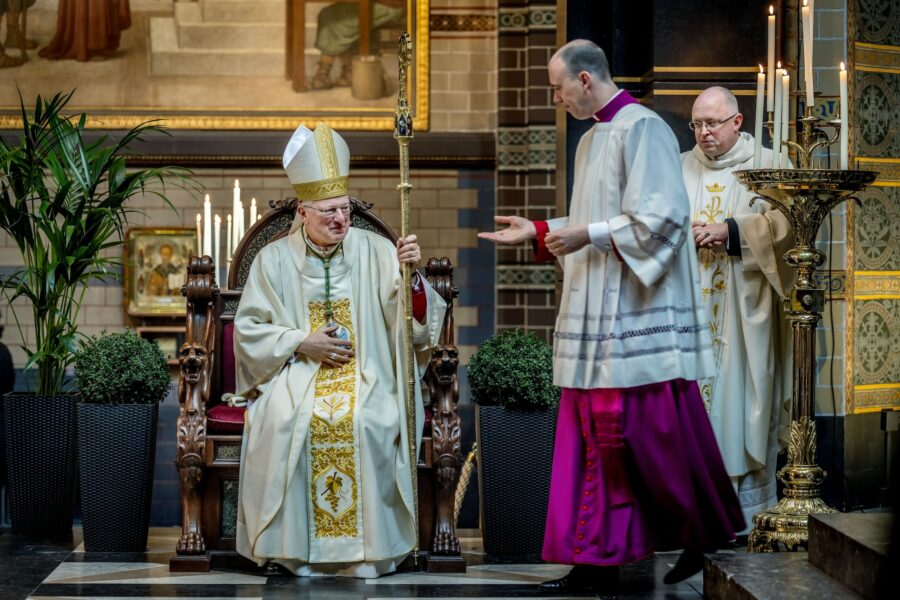
Amsterdam (Netherlands). The Bishop of Haarlem-Amsterdam, Msgr. Jan Hendriks, will celebrate a pontifical Mass according to the 1962 liturgical books next Sunday, September 20, at the Church of Saint Agnes in Amsterdam, on the occasion of the twentieth anniversary of the apostolate of the Priestly Fraternity of Saint Peter (FSSP) in the church.
The celebration will take place at 11:00 a.m. and will be accompanied by the administration of the sacrament of Confirmation according to the traditional rite. The liturgical calendar of Saint Agnes announces for that day a “solemn pontifical Mass,” the confirmations, and the feast marking twenty years of the FSSP’s apostolate.
Twenty years of the traditional Mass at Saint Agnes
The presence of the Priestly Fraternity of Saint Peter at Saint Agnes dates back to September 2006. The parish historical archive confirms that the traditional liturgy has been celebrated there regularly since then and that the community has consolidated around the church.
The parish itself recalled this month that September 17 marks exactly twenty years since the arrival of the FSSP in the Netherlands and the beginning of the apostolate that continues today at Saint Agnes.
The situation was canonically stabilized on January 20, 2013, when the Diocese of Haarlem-Amsterdam erected at Saint Agnes a personal parish for the faithful attached to the traditional liturgy. The episcopal decree expressly recalled that the liturgy according to the 1962 Missal had been celebrated regularly in the church since September 2006 and that a stable community had formed around it.
Pastoral and sacramental care is currently entrusted to the FSSP, and the personal parish of Saint Joseph is directed by Father Martin Kromann Knudsen, FSSP. Saint Agnes maintains daily celebration of the Mass according to the 1962 Missal, and on Sundays offers a low Mass at 9:45 a.m., a sung Mass at 11:00 a.m., and another low Mass at 12:45 p.m.
Hendriks has administered confirmations there since 2013
Msgr. Hendriks’s relationship with this community did not begin now. While still auxiliary bishop of Haarlem-Amsterdam, on November 9, 2013, he went to Saint Agnes to administer Baptism to two adults and Confirmation to five faithful using the traditional liturgical books.
Hendriks himself explained at the time that it was the first time he had administered those sacraments according to what was then called the “extraordinary form of the Roman rite.” After the celebration, he noted that although Latin could make it difficult for some faithful to understand certain elements, the ceremony had inspired devotion in him.
Since then, the current bishop has continued to administer confirmations according to the 1962 books at Saint Agnes. However, next Sunday’s celebration marks a different step: it will be the first time Hendriks celebrates a pontifical Mass there according to the traditional rite.
The FSSP maintains its apostolate after Traditionis custodes
The celebration takes on particular significance in the context of the restrictions introduced by Traditionis custodes. The Priestly Fraternity of Saint Peter is a society of apostolic life of pontifical right founded in 1988 and dedicated specifically to the celebration of the liturgy according to the books in force in 1962.
Following the publication of Pope Francis’s motu proprio in 2021, the situation of traditional institutes was subjected to new restrictions. In February 2022, however, Francis expressly granted the FSSP the faculty to continue using the 1962 liturgical books in its churches, oratories, and proper activities, a faculty that was later reaffirmed.
The Diocese of Haarlem-Amsterdam continues to officially include Saint Agnes among the places where the traditional liturgy is regularly celebrated. The diocesan website currently lists its schedules and indicates the Sunday and daily celebrations according to the Tridentine form.
Thus, the Mass on September 20 will coincide with a date of special significance for a community that has evolved from an apostolate begun in 2006 to a stable personal parish and that, twenty years later, will welcome the diocesan bishop himself to celebrate the Holy Sacrifice and administer confirmations according to the same liturgical books around which it was born.