


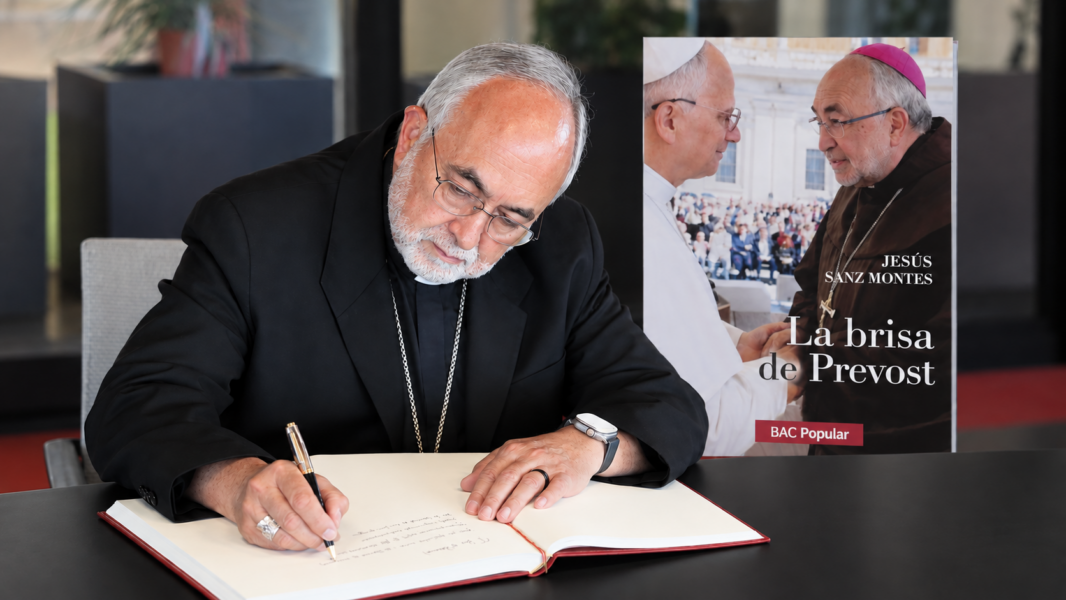
The Archbishop of Oviedo, Monsignor Jesús Sanz Montes, has just published in the Biblioteca de Autores Cristianos (BAC) The Breeze of Prevost, a book that gathers, in chronicle form, his personal memoirs as companion to the Holy Father during the apostolic journey that Leo XIV made to Spain last June, with stops in Madrid, Barcelona, and the Canary Islands.
The title plays on the Pontiff’s birth surname, Robert Francis Prevost, and on the biblical image of the gentle breeze in which Elijah recognizes the passage of God (1 Kgs 19:12), an allusion that fits the serene and unassuming tone that has characterized the early stages of this pontificate.
Prologue by Argüello
The prologue is written by Monsignor Luis Argüello, Archbishop of Valladolid and President of the Spanish Episcopal Conference, who served as the institutional host of the visit. Argüello describes the work as a diary that “allows us to approach his gaze, but above all is an invitation to read the texts of the Pope’s various addresses and to revisit in the heart so many images, faces, and gestures that speak to us of a new awakening of the Church in souls.”
According to the note released by the Archdiocese of Oviedo through Iglesia Actualidad, the archbishop unpacks each moment the Pope experienced with the Spanish people, describes his gestures, quotes fragments of his speeches, and above all analyzes them, situating each word in its time and place so that the reader can relive those days “with the depth they require.”
A Franciscan before an Augustinian
Sanz Montes, a Franciscan, is one of the Spanish prelates with the most clearly defined public voice and a steady written output, both in his weekly column and in works of spirituality. His perspective on an Augustinian Pope, formed in the tradition of interiority and the search for truth, promises a theological reading of the journey and not merely a circumstantial account.
The June journey was Leo XIV’s first to Spain and one of the first of his pontificate outside Italy. His addresses in the Congress of Deputies, where he called for safeguarding life “until its natural end,” and his meetings with young people and families continue to be discussed in a Spanish context of growing tension between public institutions and Catholic teaching on life and family.
The book therefore arrives at an opportune moment to calmly reread words that current political events have turned into a matter of debate.