


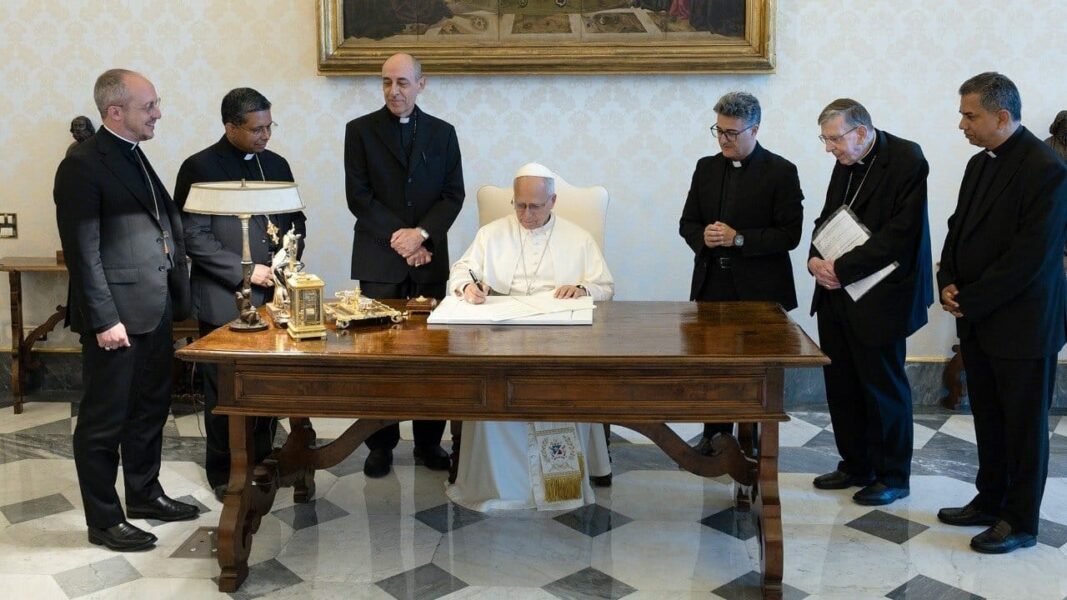
The Vatican has published this Wednesday, September 16, an extensive note on the occasion of the 60th anniversary of Nostra aetate, the declaration of the Second Vatican Council on the Church’s relations with non-Christian religions. The document reviews six decades of interreligious dialogue and proposes guidelines for its development in the coming years.
The note, titled A Path of Hope. Sixty Years of Dialogue and Interreligious Fraternity in Light of the Conciliar Declaration Nostra aetate, has been jointly prepared by the Dicastery for the Doctrine of the Faith, the Dicastery for the Promotion of Christian Unity, and the Dicastery for Interreligious Dialogue. Leo XIV approved the text during an audience granted to the prefects and secretaries of the three bodies on June 22 and ordered its publication.
Sixty Years of Nostra aetate
The document begins with the promulgation of Nostra aetate on October 28, 1965, and recalls that the declaration initially arose from reflection on the Church’s relationship with the Jewish people after the Holocaust, before expanding its scope to other religions.
The three dicasteries describe the conciliar document as a «profound change» in the way the Church understands and expresses its relationship with believers of other religions and recall the conciliar affirmation that the Church «rejects nothing that is true and holy in these religions.»
The new note also links interreligious dialogue with the defense of religious freedom. In this context, it expressly states that this requirement leads to demanding «the same freedom for Christians in countries where they are a minority.»
The Relationship with Judaism and the Uniqueness of Christ
A significant part of the document is dedicated to relations between Christians and Jews. The note recalls the Jewish roots of Christianity and maintains that Jewish-Christian dialogue cannot be reduced to diplomatic relations or mutual knowledge.
The text reaffirms that «God’s covenant with the Jewish people is irrevocable,» but immediately clarifies that this does not mean that for Christians there are «two paths of salvation» nor that the covenant with the Jewish people constitutes a path of salvation parallel to the Christian one.
«The Church teaches that Christ is the only redeemer,» the document states.
The note also recalls the condemnation of antisemitism contained in Nostra aetate and acknowledges that conflicts in recent years in the Middle East have tested some of the bridges built over the last six decades between Jews and Christians.
Dialogue and Evangelization
The document dedicates another section to the relationship between interreligious dialogue and the Church’s evangelizing mission. Reviewing the magisterium of Saint John Paul II, it recalls that dialogue with other religious traditions «is part of the Church’s evangelizing mission.»
At the same time, it warns against an interpretation that would lead to relativizing Christian identity and recalls fidelity to Jesus Christ as «the way, the truth, and the life.»
For this reason, the note maintains that dialogue must avoid both «relativism» and «syncretism» and develop from a clear awareness of one’s own religious identity.
The document also affirms that dialogue does not imply «renouncing the truth,» but rather proclaiming it «in an evangelical way: with esteem, listening, and charity,» and places it as a dimension of the Church’s evangelizing mission.
Islam, Religious Freedom, and the Persecution of Christians
Addressing relations with Islam, the dicasteries note a growing awareness of manifestations of Islamophobia and distinguish between cases of fundamentalism and violence and Muslims who «integrate and work in the countries that welcome them.»
The document also recalls the words of Francis in Evangelii gaudium, in which he called for welcoming «with affection and respect» Muslim immigrants arriving in countries of Christian tradition, but at the same time demanded reciprocity in matters of religious freedom and asked countries of Islamic tradition to allow Christians to «celebrate their worship and live their faith.»
The note also mentions the persecutions suffered by Christians in various parts of the world at the hands of extremist religious groups and describes all persecution for religious reasons as a violation of human dignity.
More Formation on Other Religions in Seminaries
Among the concrete proposals for the future, the three dicasteries call for deeper formation on interreligious dialogue in seminaries, theological institutes, and pastoral pathways.
The document proposes fostering knowledge of religions and the history of interreligious relations, developing guidelines for dialogue, and promoting so-called «religious literacy.» It also suggests integrating into Christian formation a greater understanding of contemporary cultural and geopolitical issues.
Likewise, it encourages continuing the initiatives of local Churches through dialogue commissions, joint projects, educational and humanitarian actions, and other forms of encounter.
«It Is Not About Founding a Great World Religion»
In its final guidelines, the document expressly rules out that interreligious dialogue aims to create a common religion in which differences disappear.
«It is not about founding a great world religion in which all beliefs are leveled,» the note states, affirming that this possibility must be ruled out «out of respect for oneself and for others.»
The goal, the text maintains, is to build a society capable of accepting differences and fostering peaceful coexistence among believers of different traditions.
In conclusion, the three dicasteries consider that Nostra aetate has transformed interreligious relations over the last 60 years and call for continuing this path through dialogue, education, and cooperation.
The note concludes by recalling an expression of Leo XIV inviting believers to become «builders of bridges, not of walls,» and maintains that the dialogue initiated after the Council remains an «open path of hope» for the Church and for other religious traditions.