


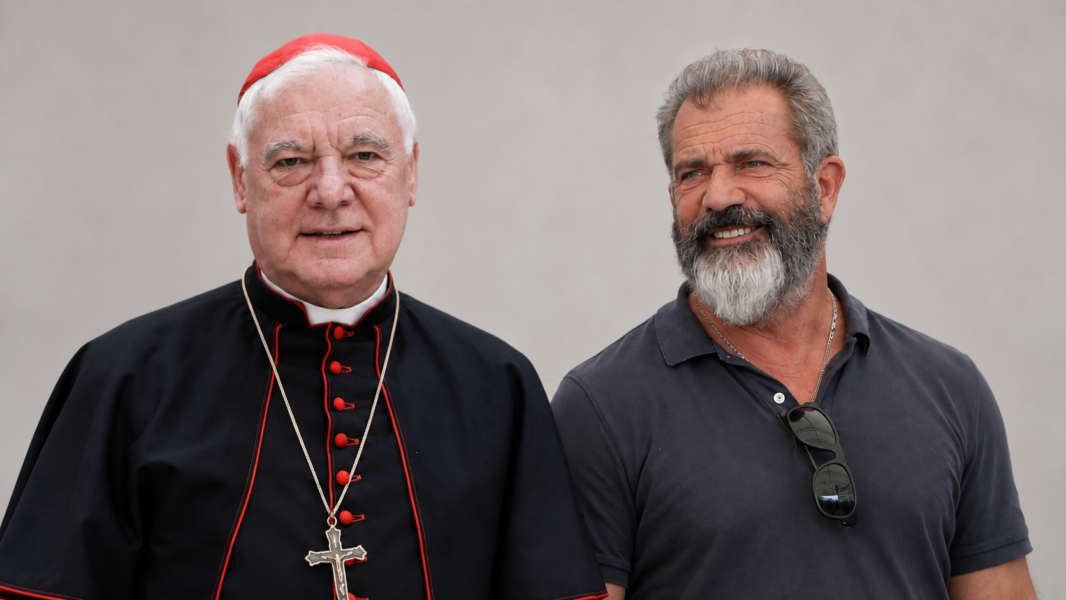
Cardinal Gerhard Ludwig Müller, prefecto of the Congregation for the Doctrine of the Faith from 2012 to 2017, has revealed that he spent an entire day on the set of The Resurrection of Christ: Part One, the highly anticipated sequel to The Passion of the Christ that Mel Gibson has filmed in Italy, discussing the theology of the Resurrection with the filmmaker. He shared this in an interview given in Rome to OSV News, signed by its Vatican correspondent Courtney Mares.
«We talked for several hours. We spent the whole day together», explained the German prelate, aged 78. The conversation revolved around the theological and biblical meaning of the Resurrection and «the situation of Christianity, of the Christian faith, in today’s world».
Burke, Franklin Graham and Samuel Rodriguez, also on set
Müller was not the only Church figure to visit the filming. He was joined by American Cardinal Raymond Leo Burke, evangelical preacher Franklin Graham, son of Billy Graham, and Hispanic pastor Samuel Rodriguez, president of the National Hispanic Christian Leadership Conference. Burke described the 2004 film as a «truly monumental work, a story that deeply touched the hearts of many».
The presence of two of the most prominent cardinals from the doctrinal wing of the College of Cardinals alongside leading figures of American Protestantism speaks volumes about the audience Gibson is targeting and the cross-denominational appeal that The Passion achieved twenty-two years ago among Catholics and evangelicals.
Müller downplayed the unusual nature of his visit. The Church teaches that bishops and cardinals are successors of the apostles who appear in the film, he recalled, and «the film is not only about a historical event from two thousand years ago, but about the present Jesus Christ, the risen Lord, present as head of the Church for all believers».
«Death is not the last word about us»
The former prefect is confident that the film will help bring the central mystery of the Christian faith closer to the general public in an era when cinema and mass media shape minds. «We live in the time of mass communication, the internet, films and theatre; these modern media can be a help for everyone to approach this event, the greatest in history», he stated.
Regarding The Passion, Müller highlighted its power as «a great help for the imagination» and its personal challenge to the viewer: «What it means that Jesus suffered so much, the cross, the scourging and all those circumstances, so much for you, for you personally. He died for me».
And on the mystery that gives the new film its title: «The Resurrection is the culmination of the Christian faith. It is not just another philosophy or worldview, but a real event. The author of this real event is God the Father, who raised Jesus, his Son, who was crucified, from the dead. And this is the Resurrection, and this is a hope for all. Death is not the last word about us».
Release on Ascension Day 2027
The Resurrection of Christ: Part One will premiere on May 6, 2027, the feast of the Ascension of the Lord. It is the second installment of a planned trilogy; the third, The Resurrection of Christ: Part Two, is scheduled for release on May 25, 2028.
Unlike its predecessor, filmed in Aramaic, Hebrew and Latin, the new film will be in English. Finnish actor Jaakko Ohtonen plays Jesus, replacing Jim Caviezel, and Mariela Garriga portrays Mary Magdalene. Filming lasted 134 days over more than seven months in Rome, Bari, Ginosa, Craco, Brindisi and Matera, the Basilicata city that already served as Jerusalem in 2004. Gibson has described the film, in an interview with Joe Rogan, as a «mind-blowing journey», because Jesus will descend after his death «to another realm», alluding to the descent into hell in the Creed.
As a preview, The Passion of the Christ returned to U.S. theaters between September 10 and 17 in a 4K remastered version with Dolby Atmos sound, accompanied by a first trailer of the new film and footage from the set. The original film received three Oscar nominations and grossed over $612 million worldwide, remaining for two decades as the highest-grossing R-rated film in U.S. history.
That Gibson chose to have his script reviewed by a theologian of Müller’s caliber, author of a reference dogmatic treatise and a trusted figure of Benedict XVI, is a guarantee that many faithful will appreciate in a project whose subject matter, the paschal event, allows little room for artistic license.