


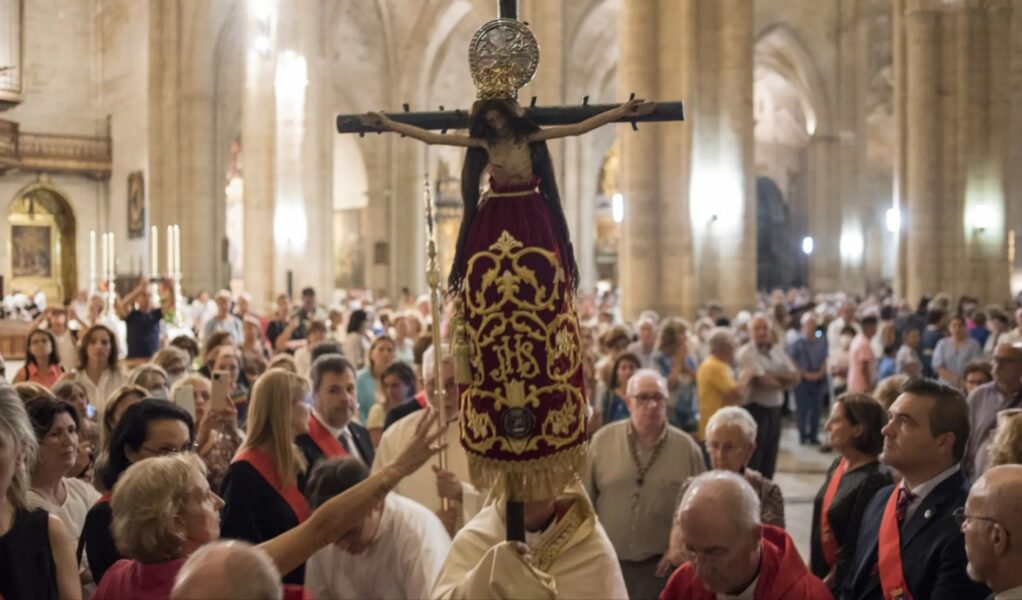
The Cathedral of Huesca, in Aragon, celebrates this Saturday, September 12, the solemnity of the Santo Cristo de los Milagros, one of the historical devotions of the diocese, whose origin dates back to a plague epidemic that devastated the city in 1497.
According to the tradition documented in Huesca, the faithful then carried the image of the Crucified in procession through the cathedral to ask for the end of the disease. During the procession, the carving began to sweat drops of water and subsequently the epidemic subsided. More than five centuries later, pilgrims from the capital and from various towns in Huesca continue to come every September 12 to venerate the image.
This year’s celebration will be presided over by Pedro Aguado Cuesta, Bishop of Huesca and Jaca, and will conclude the novena that has been taking place in the cathedral since September 4.
A devotion born during the plague of 1497
The origin of the devotion to the Holy Christ is linked to one of the most remembered religious episodes in the history of Huesca. In 1497, in the midst of a plague epidemic, the city turned to the image preserved in the cathedral and carried it in procession through the nave of the temple to implore the cessation of the disease.
It was then that, according to the documentation preserved about the event, the image of the Crucified began to sweat. The plague subsided and the event was interpreted as a miracle, giving rise to a devotion that has endured for more than five centuries.
The episode also has a contemporary testimony. The Municipal Archive of Huesca has recalled that the cathedral notary recorded that the image had sweated during that procession. The diocese itself continues to present the event as the origin of the veneration of the Santo Cristo de los Milagros.
The memory of that event is preserved every September 12. Pilgrims from Huesca and from various towns in the diocese arrive from early morning at the cathedral to participate in the celebrations.
Pilgrims from early morning
The program for this Saturday begins at 8:00 a.m. with the reception of pilgrims at the door of the Cathedral and the transfer of the image from its chapel to the main altar.
Next, the first Eucharist is celebrated, presided over by Pedro Aguado. Throughout the morning, two other Masses are scheduled, at 10:00 a.m. and 12:00 p.m..
The day will conclude at 7:00 p.m. with the solemn Eucharist, again presided over by the Bishop of Huesca and Jaca. Once the celebration is over, the Holy Christ will be transferred back to his chapel.
The solemnity closes the nine days of prayer of the traditional novena, which began on September 4, during which the faithful have gathered daily before the Crucified.
Human dignity in the face of artificial intelligence, the guiding thread of the novena
This year’s novena has taken as its guiding thread Magnifica Humanitas, the first encyclical of Leo XIV, dedicated to «the safeguarding of the human person in the time of artificial intelligence».
The meditations have addressed during these days issues such as the value of human life, the social doctrine of the Church, work, freedom, and the ethical challenges posed by technological development. Pedro Aguado has participated in several of the novena days and also presides over the main celebrations this Saturday.
The Confraternity of the Santo Cristo de los Milagros and San Lorenzo Mártir also maintains a close connection with the main religious celebrations in Huesca. Last August, it participated in the events dedicated to Saint Lawrence, patron saint of the city.
Read also: Huesca celebrates Saint Lawrence: procession, pontifical Mass, and veneration of his relics
This Saturday’s celebration once again brings the faithful of Huesca before the same image to which the city turned during the plague of 1497, the origin of a devotion that remains alive 529 years later in the Cathedral of Huesca.