


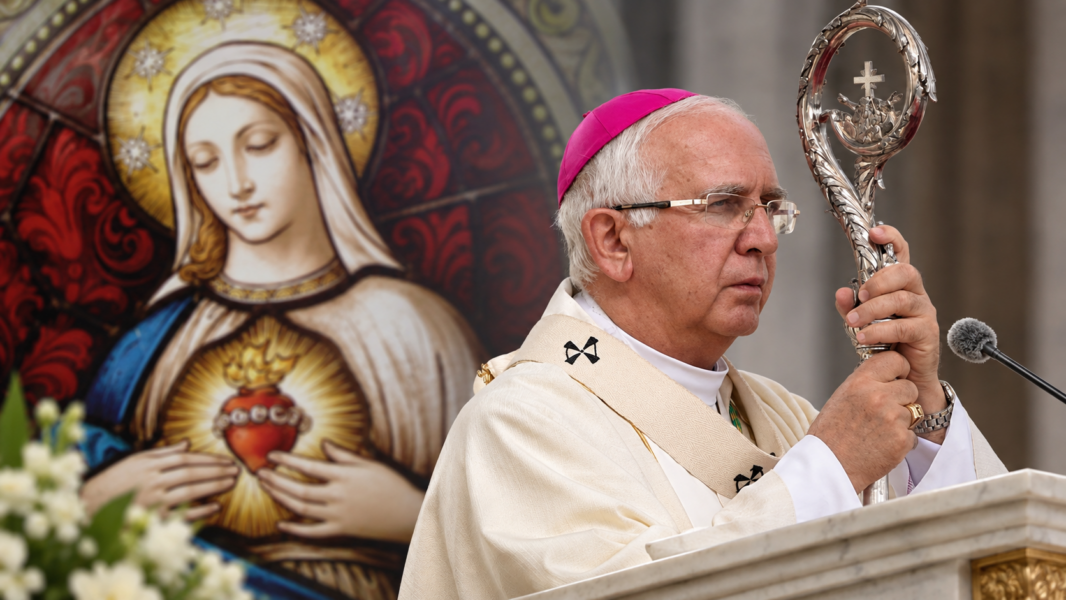
In Poland, the archbishop of Częstochowa, Wacław Depo, has warned of an “accelerated course of progressive apostasy” and assured that, in the face of advancing secularization, “Poland will remain faithful to Christ and His Mother.” He made these remarks on Tuesday at the Jasna Góra shrine during the renewal of the consecration of the Polish nation to the Immaculate Heart of Mary, first performed 80 years ago.
The ceremony took place on September 8, the feast of the Nativity of the Virgin Mary and one of the main celebrations at the Marian shrine of Częstochowa. In 1946, shortly after the end of World War II and as the communist regime began to take hold, the Polish Episcopate, presided over by the then primate, Cardinal August Hlond, solemnly entrusted the country to the Immaculate Heart of Mary.
A consecration that cannot remain in the past
Recalling that event, Depo maintained that both the 1946 act and the subsequent consecrations promoted by Cardinal Stefan Wyszyński and Saint John Paul II cannot be reduced to a mere chapter in Poland’s religious history.
“They must become a living and personal consecration of each one of us and of the entire nation to the love of God,” he stated.
For the archbishop, this trust in the Virgin must take on a concrete dimension in daily life through fidelity to grace, daily recitation of the Rosary, confession, Holy Communion, the practice of the first Saturdays of the month, and the entrustment of families and their future to the Immaculate Heart of Mary.
The prior of Jasna Góra, Father Grzegorz Prus, also emphasized this dimension by inviting the faithful to find in the Heart of the Virgin “protection and a program for life.” Marking the bicentenary of the Living Rosary, he further urged that this prayer, offered for the homeland, the Church, and the conversion of hearts, help strengthen the unity of the Polish people.
An “accelerated course of progressive apostasy”
From this historical remembrance, Depo turned his homily to the current religious situation in the country. The archbishop lamented that the faith of the Polish people is increasingly presented as a reality belonging to the past.
In his view, this was first promoted by “communist atheist propaganda” and is now driven by an “accelerated course of progressive apostasy.” In a context marked by secularization processes and doubts about God’s presence, he acknowledged that it is more difficult to maintain a trust like that of Mary.
“But let us say it clearly: the Marian path to Christ was never easy. From Nazareth to Calvary,” he affirmed, before recalling that it has also not been easy throughout the upheavals and tragedies of Polish history.
“Poland will remain faithful to Christ and His Mother”
Depo then evoked the teachings of Saint John Paul II on the impossibility of fully understanding man without Christ and, in particular, of understanding Poland’s history without its connection to Christianity.
“If in Christ God entered this world through Mary’s obedience of faith, then there is no basis for permanent uncertainty about whether God exists, whether life and the world have meaning, and whether there is any path. Because Christ became for us the way to God,” he noted.
The archbishop defined this truth as a reality that “disturbs” and, at the same time, presents a task to believers. In the face of the process of secularization he had described, he concluded by reaffirming the continuity of the country’s Christian identity.
“And those who do not recognize Christ and His Mother, or are ashamed of Him, let them not be afraid, because Poland will remain faithful to Christ and His Mother. Then there will certainly be more truth, morality, and social justice in her, and therefore more love and hope for all,” he concluded.