


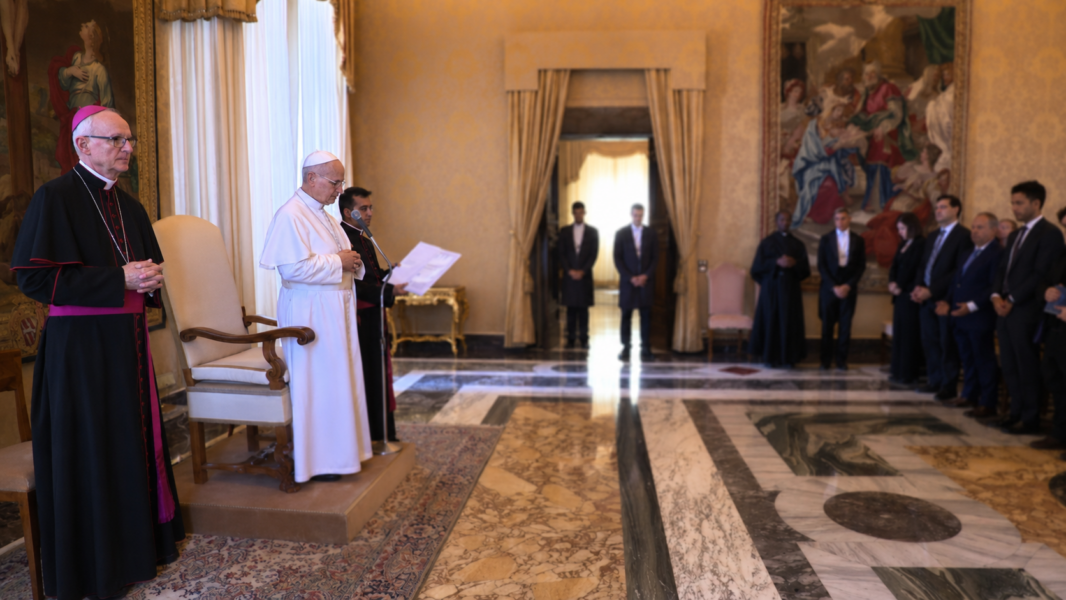
Pope Leo XIV received this Thursday, August 27, in the Consistory Hall the participants in the meeting on addiction situations in Latin America promoted by the Pontifical Commission for Latin America. During his address, delivered in Spanish, he referred to the prevention of addictions, the criminal recruitment of young people, collaboration between the Church, science and international organizations, and the role of the family.
The meeting was held at the Vatican from August 25 to 27 under the title “Faith-based response to drugs and the criminal recruitment of young people: a dialogue from Latin America and the Caribbean to the world”. It brought together representatives from Latin America and the Caribbean and from centers for the accompaniment, prevention, recovery and integration of young people from Asia, Africa, Europe and America. Among the participating institutions are CELAM and the Organization of American States (OAS).
In his intervention, Leo XIV defined addictions as “a complex phenomenon that reveals the failure of a dehumanized world” and called for responses that combine “community prevention, scientific care, justice with a human face and close pastoral accompaniment.” Referring to the family, he recalled its condition as a “domestic church” and stated: “There is no better prevention against drugs than a good family.”
Below, we offer the complete address of the Holy Father:
In the name of the Father, and of the Son, and of the Holy Spirit.
Peace be with you.
Good morning to all of you and welcome!
I greet each one of you with fraternal affection. I thank in a particular way the Latin American and Caribbean Episcopal Council (CELAM) and the Organization of American States (OAS) for having made this meeting possible, as well as the Pontifical Commission for Latin America and the Pontifical Academy for Life.
I also greet the brothers and sisters from the centers of accompaniment, prevention, recovery and integration for young people based on faith, who come from Asia, Africa, Europe and America, and whose presence reminds us that suffering and hope have no borders.
The theme that brings us together is to reflect from faith on the problem of drugs and their impact on our young people. Addictions are a complex phenomenon that reveals the failure of a dehumanized world. The suffering of young people calls us to integral responses: community prevention, scientific care, justice with a human face and close pastoral accompaniment. Our contribution must be directed toward care, presence and the rebuilding of the community fabric.
I am pleased to note how, in this meeting, four bridges converge that represent as many paths of collaboration in this field.
The first bridge is between the Church and international organizations, since no one can face the problem of drugs alone. For this reason, the ongoing collaboration between the Organization of American States and the Latin American and Caribbean Episcopal Council deserves special mention; they coordinate training for faith-based community organizations, weave networks of accompaniment and have even enabled CELAM to present the Manual of the Latin American Pastoral Care for the Accompaniment and Prevention of Addictions.
The second bridge is between science and faith. The Church does not intervene in the issue of drugs with the intention of competing with or taking the place of neuroscience, psychiatry or public health; rather, it seeks to illuminate it from the Gospel with an integral understanding of the human person.
The third bridge is within the Church that journeys on the different continents. In these days, people from America, Asia, Africa and Europe have come here to share their pains, hopes and pastoral enthusiasms.
The fourth bridge is ecumenical. The Catholic Church and the other ecclesial communities, in the practice of concrete love for those who suffer, find a very eloquent common language from faith to accompany and integrate young people in their needs and dreams.
But allow me to pause for a moment on an institution that runs transversally through our work: the family. The family, which the Second Vatican Council rightly called the “domestic church” (cf. Lumen gentium, 11), is the place where life is cultivated, cared for and projected. There is no better prevention against drugs than a good family.
At present, we witness the pain of many broken families, whether because of drug use, violence, the criminal recruitment of a son, poverty or the lack of opportunities that push people to the margins. Saint John Paul II asked us to make the Church “the home and the school of communion” (Apostolic Letter Novo millennio ineunte, 43). And Pope Francis reminded us that Jesus wants us “to touch human misery, to touch the suffering flesh of others” (Apostolic Exhortation Evangelii gaudium, 270). Here is expressed the core of the mission you carry forward: that the Church be a family, especially including those who suffer.
Finally, I would like to express a desire: that the Church be the family of all those who have been left on the side of the road. Like the Samaritan, who became neighbor to the fallen man, let us not pass by; let us build a Church that stops, draws near, is moved, anoints wounds, nourishes and becomes a home.
Thank you for your work. May God bless you.
I impart to you the Lord’s blessing. May the grace of God always accompany all of you, your families and your labors. The work you do in different parts of the world is very important.