


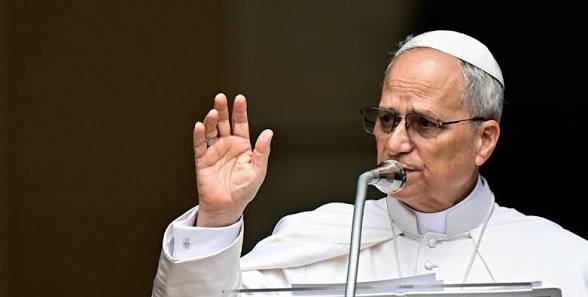
Pope Leo XIV warned this Sunday, August 23, against the risk of turning faith into a habit and settling for a Christian experience based on what has been “heard said.” During his reflection before the Angelus prayer, before the faithful gathered in Saint Peter’s Square at the Vatican, the Pope commented on Christ’s question to his disciples—“But who do you say that I am?” (Mt 16:15)—and stated that every Christian needs to continually rediscover the face of Christ, deepen their understanding of his Gospel, and renew their decisions to make them consistent with the faith they profess.
The Pontiff extended this reflection “to the path of the Church and to pastoral decisions”, where he warned that sometimes people think “it is enough to proceed as we have always done,” and called for remaining open to new paths and decisions. After the Angelus, Pope Leo XIV requested a response from the international community to the spread of Ebola in the Democratic Republic of the Congo, remembered the victims of a mine collapse in Zamboyé, in the Central African Republic, and prayed for those who died and were affected by the earthquake that struck central Italy ten years ago.
Following are the words of Pope Leo XIV:
Dear brothers and sisters, happy Sunday!
This Sunday’s Gospel (Mt 16:13-20) presents us with a question that challenges each of us on our journey of faith: who is Jesus really for me?
From the Gospel account, we understand how decisive this question is for the experience of discipleship. Indeed, although the twelve apostles had already shared much of the Master’s life and ministry, Jesus did not want to take for granted that they truly knew him and had understood the mystery of the Kingdom of God. Therefore, after asking what people thought about him, he turns directly to them: “But who do you say that I am?” (Mt 16:15).
Brothers and sisters, this is a fundamental step for disciples of all times, for each one of us. Faith, in fact, is not given to us once and for all; on the contrary, we always need to rediscover the face of Christ and his Gospel, to deepen his message and renew the decisions of our lives, so that they may be consistent with what we profess, overcoming the temptation to think we already know everything and to make faith a habit.
The question that is posed to us each day—who Jesus is for me and what his presence means in my life—arises especially in prayer and when we meditate on the Gospel; but also when we encounter the wounds and needs of our brothers and sisters, or in relationships and situations that most challenge our conscience. In the field of our life, ultimately, we can verify whether for us the Lord Jesus is merely a great figure in history who said and did important things, or the Christ of God, the One who was sent to bring us into the love of the Father and to transform our life and the world in which we live.
Dear friends, let us learn not to close ourselves off in our religious convictions and certainties, so as to remain open to an authentic relationship with Christ. Sometimes, with regard to the Christian faith, we settle for what we have “heard said,” with commonplaces, with what has been handed down to us perhaps even with good intentions; but Jesus calls us to a personal response, to know him closely, to allow ourselves to be penetrated by friendship with him, in an ever-new encounter that may even ask us to take unfamiliar paths and make decisions different from those we had imagined.
This applies both to our personal journey and to the journey of the Church and to pastoral decisions, where sometimes we think it is enough to proceed as we have always done. It is important, instead, to ask ourselves frequently: who is the Lord for me? Do I truly know him? What does his Gospel ask of me today? What steps and what decisions should I take?
Let us invoke the Virgin Mary, who in her heart sought the will of God through her Son, that she may always guide us on the path of faith.
After the Angelus
Dear brothers and sisters:
In my prayer I often remember the Democratic Republic of the Congo, especially because of the spread of the Ebola epidemic which, unfortunately, is claiming many victims. I encourage a response from the international community that also involves local communities in prevention efforts, to save many human lives.
I am also close to the people of the Central African Republic, who mourn the victims of the collapse that occurred in a mine in Zamboyé. May the Lord welcome those who have lost their lives and support efforts to ensure the safety and legality of mining sites.
Tomorrow marks the tenth anniversary of the earthquake that struck central Italy, between Lazio, Umbria, and the Marches. I pray for the deceased and their families, and for all the affected communities. May faith and solidarity continue to support the work of reconstruction.
I greet with affection all of you, Romans and pilgrims from different countries.
In particular, I welcome the Primatial Choir of the Cathedral of Gniezno, in Poland; as well as the seminarians and superiors of the Pontifical North American College; and the young people from Bormio and Valfurva, in Lombardy (Italy).
I wish you all a happy Sunday!