


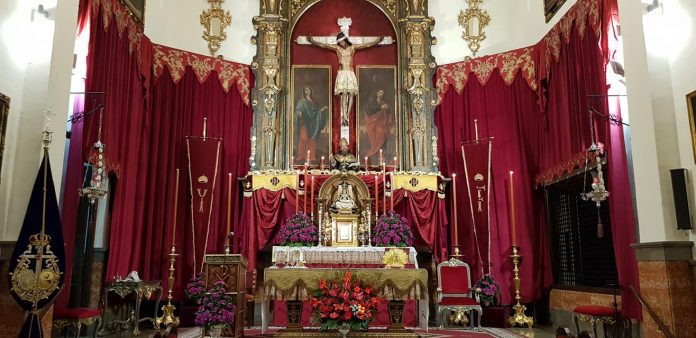
The Archdiocese of Granada, in Andalusia, announced this Friday the celebration next September of a procession of rogations with the Most Holy Christ of San Agustín, Sacred Protector of the City, to pray for those affected and for the protection of Granada from the earthquakes recorded in recent days. The call was made by the archbishop, Msgr. José María Gil Tamayo, although the exact date has yet to be determined.
The procession will depart from Granada Cathedral, where the image is currently located due to the Kerygma exhibition, and will proceed to the Basilica of Our Lady of Sorrows, according to the Archdiocese itself.
The call comes after several days of seismic activity in Granada and its metropolitan area, which forced the adoption of preventive measures in some of the city’s main religious buildings. The Archdiocese ordered the temporary closure of the Cathedral, the Tabernacle, the Royal Chapel, the Charterhouse, and the Abbey of Sacromonte to carry out the corresponding inspections following the earthquakes.
Read also: Earthquakes in Granada: the Archdiocese temporarily closes five major temples
Granada already turned to the Christ of San Agustín for earthquakes in 1755
The September procession will revive a centuries-old tradition linked precisely to the calamities suffered by Granada. Historical documentation collected by the Archdiocese records rogations to the Christ of San Agustín for the droughts of 1587 and 1635 and, later, in 1750 for another drought. In 1755 the image was again invoked on the occasion of a locust plague and the earthquakes.
One of the fundamental episodes of this devotion dates back to 1679, when a severe epidemic that had spread through the Spanish Levant and Andalusia caused numerous victims in Granada. In response, the city turned to the Christ of San Agustín through a procession of rogations.
The epidemic began to subside on August 5, 1679 and disappeared a few days later. From that event onward, the Christ of San Agustín became linked to the protection of Granada and an annual Vow of thanksgiving was established. The celebration, originally held in August, now takes place each September 14, the feast of the Exaltation of the Holy Cross.
The city again turned to the Christ in other moments of particular gravity. Among them was the cholera epidemic of 1834, during which rogations were once more held before the image.
A five-century devotion
The Most Holy Christ of San Agustín is a 16th-century sculpture attributed to the Italian sculptor and painter Jacobo Florentino —Jacopo Torni—. It is usually venerated in the Monastery of the Holy Guardian Angel, located on San Antón Street, and every Holy Monday it processes through the streets of Granada.
Its history has been closely tied to rogations, a traditional form of public prayer through which the faithful implore God’s help in the face of calamities and grave needs. Droughts, epidemics, and earthquakes have at various times led the people of Granada to carry the Christ of San Agustín through the city’s streets.
The procession announced for September will once again have that character. The Archdiocese has explained that with this call it seeks to place under the intercession of Christ and the Virgin of Sorrows those affected by the earthquakes and to pray for the protection of Granada amid the situation the city is facing.