


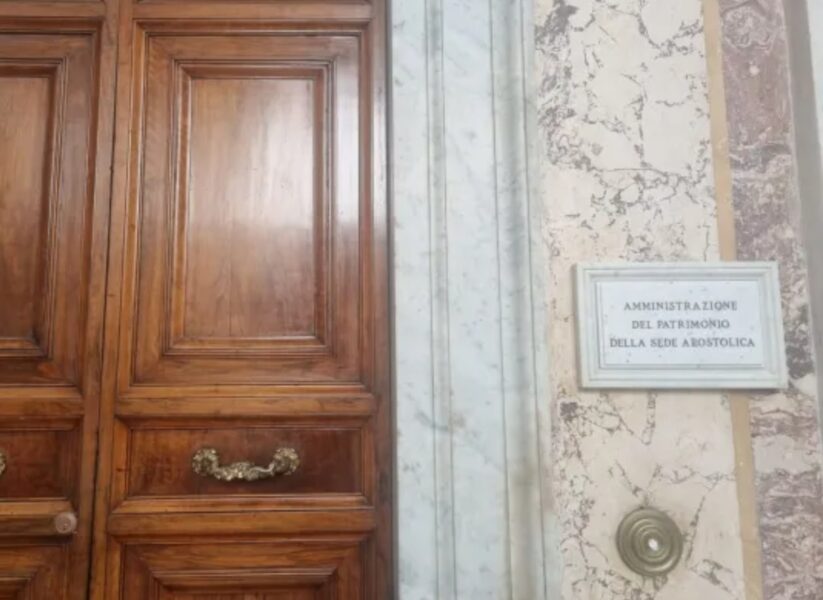
The private dinner that Leo XIV held on July 29 at the Borgo Laudato Si’ in Castel Gandolfo with high-net-worth donors, mostly Americans—first reported by the Nederlands Dagblad and later expanded by InfoVaticana with the identification of sponsorship from the Banvelca Foundation and the Herrera Velutini family—has been interpreted by some as a sign of opacity: a public prayer for peace that served as a prelude to a private meeting with major benefactors, organized by Father Manuel Dorantes outside the Dicastery for Communication. Yet there is another, complementary reading that better explains the underlying logic of this pontificate in economic matters: Leo XIV is rapidly rebuilding the American financial axis so as not to depend on the richest—and most problematic—Church in world Catholicism: the German one.
A structurally poor Holy See
The Holy See carries a structural deficit of between 50 and 60 million euros per year, and the Pension Fund has accumulated an imbalance that independent analyses estimated at around one billion euros, to the point that Francis, in his November 2024 letter, acknowledged that “the current system is unable to guarantee the fulfillment of pension obligations in the medium term” and appointed Cardinal Farrell as sole administrator. The Peter’s Pence collection raised 58 million euros in 2024, but the expenses it was meant to cover exceeded 75 million: the apostolic mission of the Holy See cost 367 million, and Peter’s Pence covered only 17%.
One figure from that same Peter’s Pence report often goes unnoticed: the United States contributed 25.2% of the total; Germany, 2.8%. The German Church, which collected 6.510 billion euros from the Kirchensteuer in 2023 alone—one hundred times the worldwide Peter’s Pence—contributes less to the Successor of Peter’s coffers than France, less than Italy, and less than Brazil. Its money does not sustain Rome: it sustains its own apparatus, its agencies, its structures, and, since 2019, its Synodal Way, whose initial phase of assemblies alone cost 5.5 million euros, as the DBK spokesperson acknowledged.
German power: plenty of money, no vocations
The German paradox has been documented by InfoVaticana for years. It is the hyper-financed Church par excellence: the church tax, guaranteed by the State and anchored in the Weimar Constitution, ensures it billions in revenue regardless of the religious practice of those who pay it. At the same time, it is a barren Church: from an average of 243 priestly ordinations per year in the early 1990s, the number fell to 68; in 2019, 321 priests died and 55 were ordained—six losses for every new presbyter; seminarians have dropped 70% in three decades. The priorities of the Synodal Way (blessing of same-sex unions, ordination of women, lay control of structures) correspond exactly to the incentives of a system whose only real risk is that the taxpayer fills out the withdrawal form: a Church rich in funds and poor in faith that needs to adapt doctrine to the client so that the client keeps paying.
That money, however, buys influence in Rome. Not through Peter’s Pence, but through the funding of projects, dicasteries, synods, and ecclesial structures across the world via its agencies and the Association of German Dioceses. When in 2024 the Holy See yielded ground to the German episcopate in the negotiations over the synodal body, we openly asked: is it because of money? The suspicion was not unfounded: a chronically deficit-ridden Holy See negotiates poorly with those who hold the purse strings.
The timing is no coincidence: the pending recognitio
The financial reading of the Castel Gandolfo dinner makes more sense when viewed against the calendar. The German “Synodal Conference”—heir to the vetoed synodal council—was approved in February 2026 by a razor-thin two-thirds majority, with four bishops (Cologne, Regensburg, Eichstätt, and Passau) abstaining, uncertain funding even within the DBK itself, and Cardinal Marx exclaiming “I don’t want this!” over the mechanism for supervising bishops. The entire project now hinges on a decision from Rome: the recognitio, with or without modifications, or outright rejection.
A Pope who depended economically on the German system would face that decision with his hands tied. A Pope with the American flow restored would not. And the flow has been restored with remarkable speed: the Papal Foundation—whose members Leo XIV received in May, explicitly encouraging them to continue donating—announced this year the addition of 25 new donor families and more than 15 million dollars for 144 projects; the Rector’s Dinner at the North American College was held in April to a full house; the Pope dined on July 4 at Ambassador Burch’s residence; and in January he received the major energy and mineral entrepreneurs of Latin America. Francis had deliberately cooled that relationship—canceling the annual audience with the Papal Foundation after the conflict over the 25-million-dollar check and eliminating private Masses for donors—; Leo XIV has reactivated it in fifteen months.
Added to this is institutional reform: the December 2025 abolition of the Donations Commission created by Francis during his hospitalization and the chirograph Vinculum unitatis et caritatis, which entrusts the Council for the Economy with designing a new fundraising architecture.
Freedom to govern
The thesis, therefore, can be stated as follows: rebuilding the American donor axis is not merely a cash operation to plug the deficit; it is an operation of sovereignty. Whoever finances, conditions, and recent Church history demonstrates this in both directions: the Synodal Way has been able to challenge Rome for six years precisely because it does not need Rome for anything, while Rome has needed—or feared needing—Germany. Diversifying the donor base, and doing so toward a Church like the American one—vocationally alive, doctrinally more aligned with the See of Peter, and enthusiastic about “its” Pope—restores to the Pontiff the freedom to say non possumus to Frankfurt without looking at the balance sheet. That the American reactivation coincides with the decisive months of the German synodal recognitio may be coincidence; in the Vatican, financial coincidences are scarce.
There is also a structural factor working in favor of this strategy: German influence is waning on its own. The Kirchensteuer fell 5% in 2023, and the hemorrhage of formal withdrawals continues; a Church that loses hundreds of thousands of contributors each year and, at the current vocational rate, will close most of its parishes within a generation, is a creditor in liquidation. Leo XIV does not need to confront the DBK head-on: it is enough for him not to need it while time does its work.