


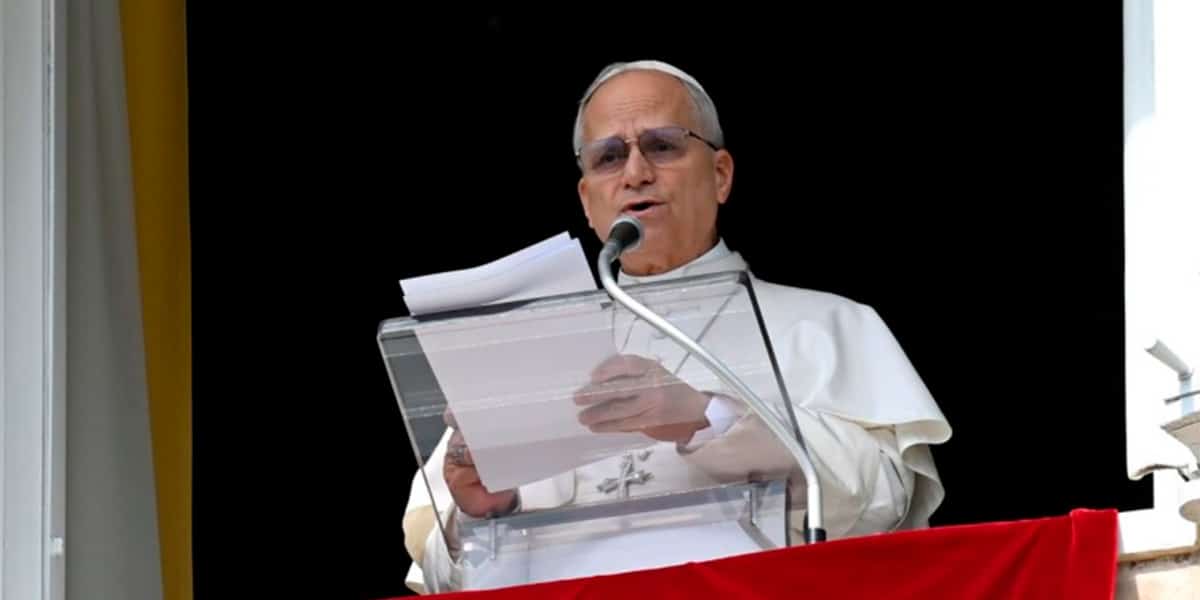
Pope Leo XIV renewed his appeal this Sunday for an end to the «repeated violence against the Palestinian civilian population in the West Bank» and urgently called on the international community to promote the two-state solution as the path toward «a just and lasting peace.» The Pontiff made this appeal after the recitation of the Angelus in the Piazza della Libertà in Castel Gandolfo, where he was accompanied by the faithful and pilgrims.
Previously, commenting on the Gospel of the Canaanite woman, Leo XIV noted that the Church must remain open to God’s action «beyond the already drawn boundaries» and affirmed that the Christian faith makes «intolerable the inequalities, discriminations, and barriers» that violate human dignity. The Pope presented the Canaanite woman as an example of «humility and determination» and recalled that «God’s table is prepared for all.»
The Pope’s Words Before the Angelus
Dear brothers and sisters, happy Sunday!
Yesterday we contemplated the Virgin Mary in her indissoluble relationship with the Son: not even death could interrupt that communion of soul and body, which is eternal life. Every Sunday reminds us that the same fullness is reserved for those who follow Jesus: his resurrection is not a past event, but new life that involves us.
This is demonstrated today by the Canaanite woman, the protagonist of the Gospel proclaimed in the liturgy (Mt 15:21-28). Although she does not belong to his people and lives in a foreign region, she persistently seeks to speak with Jesus, following him like a disciple who already has a bond with him. They were never supposed to meet, but mysteriously faith had already arisen in her. She does not desire something for herself, but peace for her tormented daughter, and she trusts in Jesus, in whom she recognizes the Messiah descended from David (cf. v. 22).
The evangelist does not hide the obstacles this woman must face. The disciples see her as a nuisance, and Jesus himself resists her requests. Indeed, the Master had withdrawn to that region (cf. v. 21) and we can imagine that, as on other occasions, he was seeking a secluded place to pray and form his own. At that moment, however, something unexpected happens. Meditating on this, we can understand Jesus’ obedience, which fulfills his mission by allowing himself to be challenged by what he sees and hears. Finally, he says to her: «Woman, great is your faith! Let it be done for you as you wish» (v. 28).
Today too, the Church can allow itself to be surprised by God’s work and communicate Christ’s peace beyond the already drawn boundaries. Its mission is preceded by divine grace, which acts in the secrecy of consciences, so that in every encounter, even in those that alter our plans, it is necessary to listen, open our eyes, and open our hearts to what God wants to tell us.
From the Canaanite woman we learn humility and determination. Thanks to her faith, we learn that God’s table is prepared for all and that no one is reserved the crumbs (cf. vv. 26-27), because each one, together with the Father, has their own place. In the light of this faith, the inequalities, discriminations, and barriers that trample the dignity of so many sons and daughters of God become intolerable.
Dear brothers and sisters: we are the Church of Jesus Christ in a tormented world, a world that seeks peace. To Mary, our Mother, we ask that she intercede for us. «From her lips flows the strongest and most innovative hymn ever pronounced, the Magnificat» (Magnifica humanitas, 244): it is the song of one who already contemplates reality with God’s gaze and, therefore, does not lose hope and acts in charity.
After the Angelus
Dear brothers and sisters:
I renew my appeal for an end to the repeated violence against the Palestinian civilian population in the West Bank and urgently ask the international community to make it possible to advance the two-state solution, for a just and lasting peace.
This week the Mediterranean Games will begin, to be held in Taranto. Several countries from Africa, Asia, and Europe belonging to the Mediterranean area will participate in them. I hope that this sporting event will be a prophecy of peace and fraternity among the peoples of this region and of the entire world.
And now I welcome all of you who have gathered here in Castel Gandolfo for the Sunday Angelus.
I affectionately receive the pilgrims coming from various countries. In greeting the Poles, I extend my blessing to the numerous participants in the traditional pilgrimage to the Shrine of Piekary Śląskie, in Upper Silesia.
I wish you all a happy Sunday.