


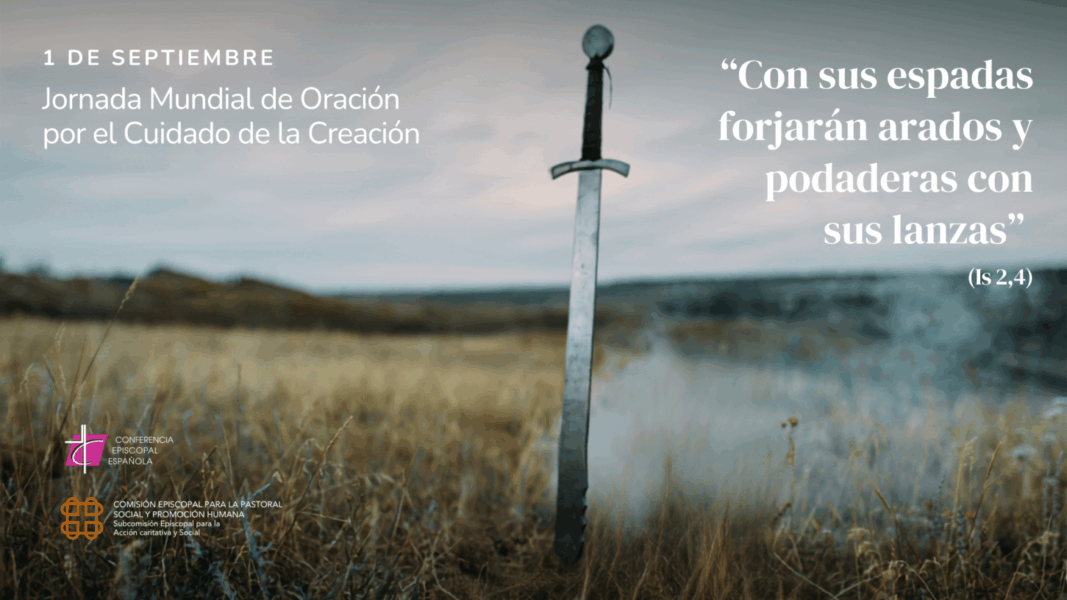
The Episcopal Subcommittee for Charitable and Social Action of the Spanish Episcopal Conference (CEE) has published its message for the World Day of Prayer for the Care of Creation, which will be celebrated on September 1. In the document, the bishops jointly address climate change, the economic model, rural depopulation, war, artificial intelligence, transhumanism, and immigration, and call for an ecological and energy transition that is “truly just and inclusive.”
Under the motto “They shall beat their swords into plowshares, and their spears into pruning hooks,” taken from the prophet Isaiah, the Subcommittee presents the current moment as a “true socio-environmental kairós” and an “inescapable urgency.” The bishops maintain that environmental degradation constitutes “a grave violation of our duty to care for creation” and approach the issue from a perspective that seeks to link ecology, social justice, peace, and Christian doctrine on creation.
A model “obsessed with unlimited growth”
The CEE states that “the theology and pastoral action of the Church cannot develop in a bubble” and defines the current socio-environmental crisis as a phenomenon caused by “a development model obsessed with unlimited growth.”
Applying their diagnosis to Spain, the bishops speak of an “alarming intensification” of heat waves, prolonged droughts, forest fires, and torrential rains, as well as a trend toward desertification that, according to the document, threatens more than half of the national territory.
They also mention the degradation of ecosystems, the depletion of river basins, and the eutrophication of certain bodies of water due to agricultural exploitation of their surroundings.
Following the approach of Laudato si’, they maintain that there are not “two separate crises, one environmental and one social,” but rather “a single and complex socio-environmental crisis.” Its consequences, they add, fall especially on the most vulnerable, citing residential exclusion and energy poverty as examples.
The “Empty Spain” and “empty growth”
The message also introduces economic and territorial considerations. The bishops speak of the paradox of “empty growth,” in which “the economic progress of some is not translated into well-being for all.”
Regarding the so-called Empty Spain, they maintain that “it is not an accident,” but rather “the result of decades of decisions that have concentrated investment” and have left large rural areas immersed in processes of depopulation and “spiritual uprooting.”
In response, the Subcommittee calls for an ecological and energy transition that is “truly just and inclusive” and does not increase territorial inequalities.
The CEE also dedicates a specific reference to water, which it defines as “a common good” whose access constitutes “a basic, fundamental, and universal human right.” “It is a gift from God intended for all humanity, and not a mere commodity subject to the laws of the market,” the document states.
“Definitively overcome” the just war theory
The bishops then extend their reflection to armed conflicts. Drawing on Pope Leo XIV’s encyclical Magnifica Humanitas, they warn about the expansion of a “culture of power” and what they consider the normalization of war as an instrument of international politics.
The message endorses the Pope’s call for a peace that is “unarmed and disarming,” one that does not rest on fear or the balance of armaments, but on “patient dialogue, justice, and diplomacy.”
Based on this approach, the Subcommittee maintains that “it is imperative to definitively overcome the theory of ‘just war,’” although it expressly adds that this must be done “without prejudice to the right to legitimate defense.” The bishops consider that every armed conflict constitutes “a defeat of the capacity to negotiate and of the common conscience of humanity.”
The CEE calls for “disarming artificial intelligence”
The document extends the concept of disarmament to the technological sphere. The bishops echo Pope Leo XIV’s request to “disarm artificial intelligence” in order to remove it from “the logic of monopoly and cognitive domination.”
The CEE questions what it calls “the illusion of an immaterial digital world” and points out that behind new technologies lies an industry that consumes “enormous amounts of water and energy.”
It also denounces a “ruthless neo-extractivism” related to rare earths and their human consequences, specifically mentioning the exploitation of children and adolescents.
Criticism of the technocratic paradigm and transhumanism
Alongside these considerations, the message contains an explicit critique of transhumanism and certain conceptions of technology. The bishops warn against “the deceptive temptations of the technocratic paradigm and transhumanism,” which, they maintain, view “our finitude and human fragility as a defect to be corrected.”
In contrast to this vision, they uphold the limit and the bodily nature of the human person. “As Christians, we know that the human being does not flourish in spite of limits, but often through them,” they state.
The Subcommittee links this conception to mutual dependence, compassion, and love, and concludes that “accepting the body as a gift is the indispensable foundation for accepting the world as our common home.”
“Disarming words”
The message likewise extends the reflection on “disarmament” to the political and social climate. The CEE echoes Pope Leo XIV’s exhortation to “disarm words” and maintains that plurality should not lead to “the permanent disqualification of the adversary.”
“Firmness does not require contempt, and disagreement does not entail humiliation,” the bishops affirm, calling for the renunciation of “hurtful words, immediate judgment, and slander” both in family and work relationships and on social media.
“It should not be confused with mere ecological activism”
In the conclusion, the bishops introduce a clarification regarding the specifically Christian foundation of their proposal. “Care for our common home should not be confused with mere ecological activism or with a secular voluntarism that dispenses with God,” they warn.
The CEE, on the contrary, presents the so-called “ecological conversion” as a religious and communal experience. Among its concrete applications, it mentions “every gesture of sobriety,” efforts toward “energy justice,” welcoming the immigrant, and “words of peace.”
The document concludes by entrusting the Season of Creation to the Virgin Mary, invoked as Stella maris and Mother of Charity, and asks that she teach the faithful “to look at every creature with the eyes of God.”
The World Day of Prayer for the Care of Creation will be celebrated on September 1 and will open the so-called Season of Creation, which will continue until October 4, the feast of Saint Francis of Assisi.