


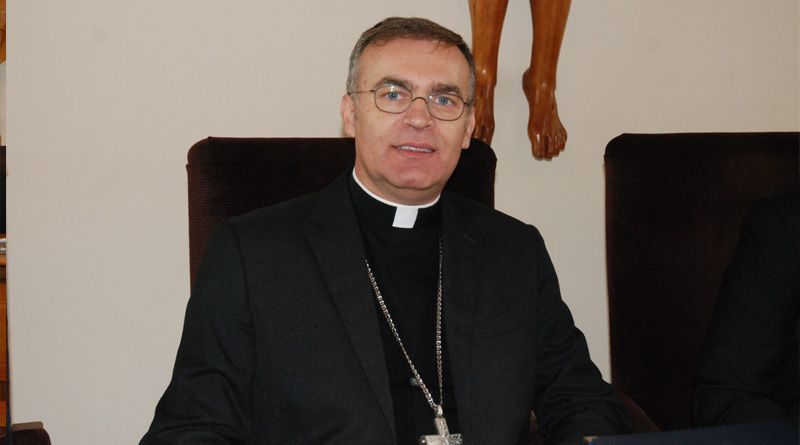
Pope Leo XIV has appointed Msgr. Angelo Accattino as the new apostolic nuncio to Colombia on this 15 August, as announced by the Holy See Press Office. The Italian diplomat, previously nuncio in Tanzania, succeeds Msgr. Paolo Rudelli in Bogotá, who left the nunciature in March to assume one of the most important positions in the Curia: Substitute for General Affairs of the Secretariat of State.
He is not arriving on unfamiliar ground. As the Episcopal Conference of Colombia has highlighted in thanking him for the appointment, Accattino “during his early years in the Diplomatic Service of the Holy See served in this Apostolic Nunciature,” something the episcopate considers “a significant aspect of his new mission, which will unfold in a context of important challenges for Colombian society and for the Church on pilgrimage in the country.”
A diplomat seasoned in Latin America
Born in Asti (Italy) on 31 July 1966, Angelo Accattino was ordained a priest on 25 June 1994, incardinated in the diocese of Casale Monferrato. A Doctor of Canon Law, he entered the diplomatic service of the Holy See on 1 July 1999 and has served in the nunciatures of Trinidad and Tobago, Colombia, Peru, the United States, and Turkey, as well as in the Section for Relations with States of the Secretariat of State.
On 12 September 2017, Francis elevated him to the episcopate as titular archbishop of Sabiona and appointed him apostolic nuncio to Bolivia, where he accompanied the local Church during the political crisis of 2019 and the pandemic. On 2 January 2023 he was transferred to Tanzania, a mission he held until his appointment to Bogotá.
A country that is inaugurating a new Government
Accattino arrives in a Colombia that has just closed a political cycle. On 7 August, the new president, Abelardo de la Espriella, took office after defeating Senator Iván Cepeda in the June runoff, the political heir of Gustavo Petro. He has come to power promising the restoration of order and security and a frontal fight against drug trafficking and armed groups. His inauguration in Cali, with a marked religious tone, symbolized the end of four years of left-wing government in a deeply polarized country where Petro himself has refused to recognize the electoral result.
The change of course directly affects the Church. During the previous four-year term, the bishops acted as facilitators and guarantors of the negotiations for “total peace” with the ELN and other armed groups, with rather meager results. The new president has declared the dialogue option “completely exhausted” and has ordered the Armed Forces to combat “all criminal structures,” which will force the episcopate to redefine its role: from mediator at the negotiating tables to a humanitarian voice in a scenario of open confrontation.
Because violence continues to strike the Church directly: priests threatened, extorted, and murdered; communities confined and displaced in regions such as Catatumbo, Chocó, Arauca, or Cauca; and pastors exercising their ministry in territories effectively controlled by guerrillas and drug-trafficking gangs. In many of these areas, the Church is the only institution that remains alongside the population.
Secularization, abortion, and an episcopate in transition
Beyond the political situation, the Colombian Church is going through a delicate moment. Secularization is advancing at great speed—with sustained growth of evangelical communities and those who declare themselves without religion—and the country’s legal framework has openly moved away from Catholic morality: in 2022 the Constitutional Court decriminalized abortion up to the 24th week of gestation, one of the most permissive regulations in the world, and euthanasia has been decriminalized by judicial precedent for years. It remains to be seen whether the new Government, which has flaunted a providentialist discourse and defense of traditional values, will translate into any real change in these matters or remain mere rhetoric.
The new nuncio will also face an emergency on the table: care for the thousands of victims left by the earthquake on 10 August in several regions of the country, in which the Church is fully engaged.
And in the medium term, an episcopate in full generational transition. The Episcopal Conference, presided over by the Archbishop of Cartagena, Msgr. Francisco Javier Múnera, and with Cardinal Luis José Rueda at the head of the see of Bogotá, will see several dioceses become vacant in the coming years due to age, and it will fall precisely to Msgr. Accattino to conduct the processes and propose candidates to Rome. The direction of the Colombian Church over the next decade will, to a large extent, pass through his office.
The Colombian bishops have expressed “their willingness to receive him soon as the new pontifical representative” and have entrusted to God the beginning of his mission, expressing their desire to “continue strengthening, together with him, the bonds of communion between the Church in Colombia and the Holy See.” As is customary, Accattino will fully assume his duties after presenting his credentials to President De la Espriella; by Concordat and tradition, the nuncio serves in Colombia as dean of the diplomatic corps accredited in Bogotá.