


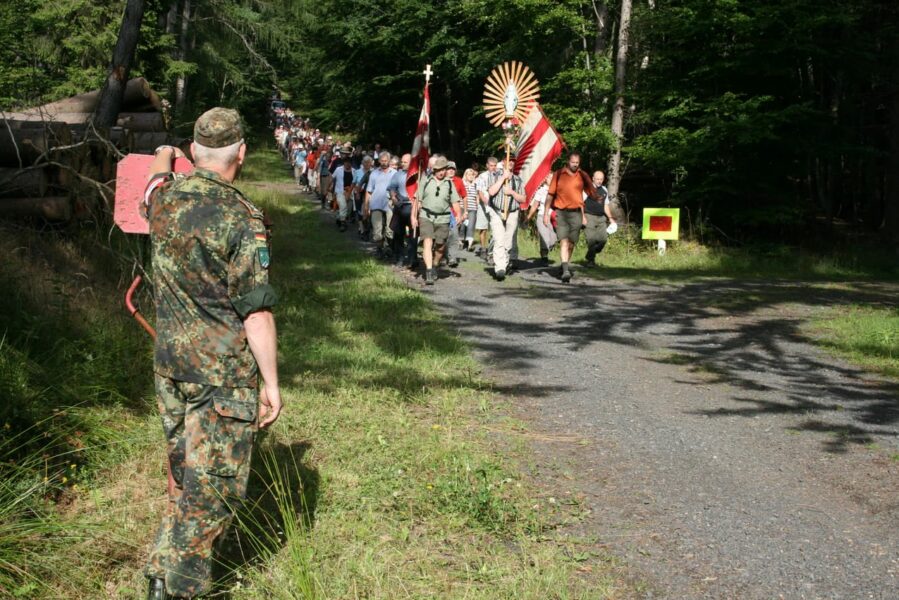
Every eve of the Assumption, a group of German Catholics sets out on an unusual path to Maria Ehrenberg, a historic Marian shrine located in the Rhön region, between Bavaria and Hesse. To reach the church, built at an altitude of 674 meters, the pilgrims cross part of a training ground of the German Armed Forces where civilian access is normally prohibited.
The pilgrimage will depart this August 14 from the Church of Saints Peter and Paul in Wegfurt and cover about 29 kilometers to the shrine, where the late-Gothic image of the “Mother of Mercy” has been venerated for centuries.
A pilgrimage under military surveillance
Access to the training ground requires prior coordination with the Bundeswehr, the German Armed Forces. Before the pilgrims pass, the route is inspected for possible unexploded ordnance, and participants receive precise instructions: no one may leave the designated path.
During the march, soldiers assigned by the Wildflecken command remain close to the procession to ensure compliance with safety measures. Signs warning of the danger from live-fire exercises remind the faithful that they are walking through an active military zone.
The full route takes several hours of walking, but for its organizers physical effort is secondary. Josef Söder, one of the organizers and a pilgrim for nearly two decades, highlights prayer, hymns, devotion to the Virgin, and community life as the true meaning of the journey.
A “Stairway to Heaven” leads to the shrine
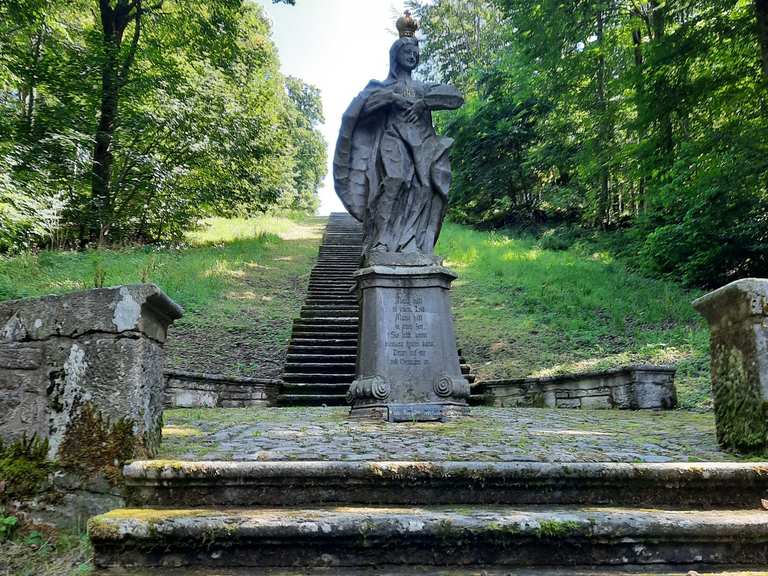
After crossing the restricted area, the final ascent leads to the so-called “Stairway to Heaven”: 254 steps flanked by images of the Virgin that end in front of the Maria Ehrenberg church. Some faithful maintain the custom of climbing while praying the Rosary along the staircase.
At the top awaits the “Mother of Mercy,” a recently restored late-Gothic image that presides over the altar. The existence of Maria Ehrenberg as a pilgrimage site has been documented since 1521, although an ancient tradition attributes its origin to the discovery of a Marian image by a shepherd, who is said to have built the first chapel on the mountain.
An inscription along the path summarizes the trust that has brought generations of pilgrims to this place: “If you seek comfort in times of distress, climb the holy mountain. Where so many have found solace, Mary will also welcome you.”
The Assumption, one of Maria Ehrenberg’s great days
The pilgrims’ arrival coincides with the Assumption celebrations. On the night of August 14, the Rosary is scheduled, followed by a vigil and a candlelight procession around the shrine. On the 15th, several Masses and a blessing of the sick will be celebrated.
Even during these celebrations, the shrine’s unique location is evident. Due to the dryness of the terrain and the risk of fire, the Bundeswehr will provide a fire-extinguishing vehicle as a preventive measure during the nighttime events.
The pilgrimage season currently attracts around 5,000 visitors, according to Deacon Kim J. N. Sell, who is responsible for its organization. This year it is celebrated under the motto “Take courage, rise up, with Mary.”
Thus, on the eve of the Assumption, a scene rarely seen in any other European pilgrimage will once again unfold: the faithful praying and singing to the Virgin as they advance among warnings of live fire and soldiers guarding the path to a Marian shrine with five centuries of history.