


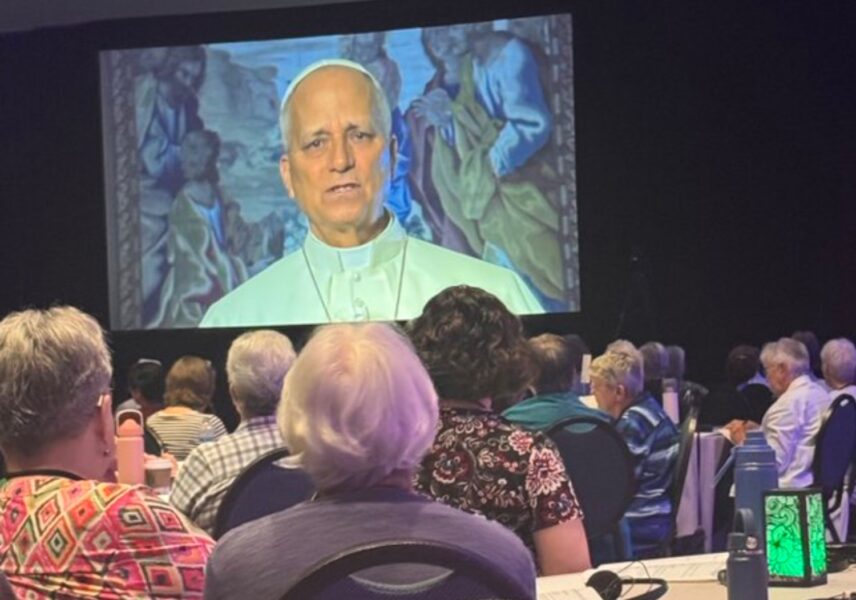
The Leadership Conference of Women Religious (LCWR), which brings together the superiors of approximately two-thirds of the nearly 35,000 religious sisters in the United States, is holding its annual assembly from August 11 to 14 in Orlando (Florida), coinciding with the 70th anniversary of its founding. According to National Catholic Reporter, more than 1,300 superiors and congregational leaders are participating, along with invited religious sisters and brothers from Canada and Latin America, in an expanded format under the theme “Many charisms, one Spirit, one call.”
The central moment of Wednesday’s session was a pre-recorded video message from Leo XIV. The Pope thanked them for “the historic contributions of your institutes in the fields of evangelization, education, and care for the poor and marginalized,” and assured those present that “the Church needs you, with all the diversity and richness of the forms of consecration and ministry you represent, because with your vitality and the witness of a life centered on Jesus you can help awaken the world.”
The Pontiff specifically celebrated that the assembly is being conducted according to the synodal method of “Conversation in the Spirit”—listening, dialogue, and discernment—and offered the phrase that has become the meeting’s headline: “In a special way, those who live the religious life are called to become experts in synodality, because of the opportunities that community life offers for practicing it and because of the very way your congregations are organized.” He concluded by urging them to confront “the globalization of indifference and powerlessness with the remedy of Christ’s love and mercy.”
Following the video message, the assembly heard the keynote address from Xaverian Sister Nathalie Becquart, undersecretary of the Synod of Bishops, devoted—as expected—to synodality. A greeting was also read from Sister Simona Brambilla of the Dicastery for Institutes of Consecrated Life, in which she stated that “if we allow it, consecrated life can truly be a catalyst for social transformation.”
What the photograph shows and the speeches omit
That is the chronicle. But it is enough to look at a single photograph of the Orlando hall to understand what no video message dared to say. Hundreds of white heads before a giant screen. Not a single habit in sight: floral blouses, plaid shirts, colorful thermoses on the tablecloths. A room that could be mistaken for the annual convention of any American retirees’ association, were it not for the fact that on the screen the Vicar of Christ is speaking.
This is not a subjective impression: the numbers confirm it. In 1965 there were 178,740 religious sisters in the United States; in 2025 only 33,135 remain—an 82% collapse. The average age exceeds 80. Fewer than 1% are under 40. Today in the United States there are more sisters over 90 than under 60. In 2025, across the entire country, only 74 women made perpetual profession; 82% of the institutes had none at all. These are the congregations the LCWR represents, and this is the verifiable fruit of sixty years of aggiornamento understood as dissolution: without habit, without recognizable common life, without visible sign of consecration… and without vocations.
Because young people are not fools. No young woman gives her entire life to something that resembles an NGO with memories. The congregations that are growing—in the United States and everywhere—are precisely those the Orlando photograph does not show: those with the full habit, eucharistic adoration, demanding common life, and doctrine without complexes. The Nashville and Ann Arbor Dominicans have waiting lists; the “synodality experts” have retirement homes.
And there lies the mortal wound of the feminine charisms: it is not that these women—many of them, without doubt, dedicated and deserving in hospitals and schools for decades—are going to die, which is the law of life. It is that their charisms die with them, because at some point in the 1970s they decided that the treasure received from their foundresses was a burden from which they needed to be freed. They renounced the sign, and with the sign went the thing signified. What is truly desolate about the Orlando image is not the age of those present: it is that no one in that hall, nor on the screen, seems to feel any urgency to ask why no one is coming after them. They are spoken to about synodality, listening, and social transformation; no one speaks to them about the only thing that generates vocations, which is the radicality of the Gospel lived and shown.
“The Church needs you,” the Pope told them. It is true. But the Church needed, above all, that they had transmitted what they received. A charism that is not transmitted is not a charism: it is nostalgia. And no one follows nostalgias, however synodal they may be.
Sources: Vatican News (12/08/2026), National Catholic Reporter (12/08/2026), National Catholic Register/CNA (12/08/2026 and 11/03/2026), Global Sisters Report, CARA (Georgetown), USCCB/CARA report “Profession Class of 2025”.