


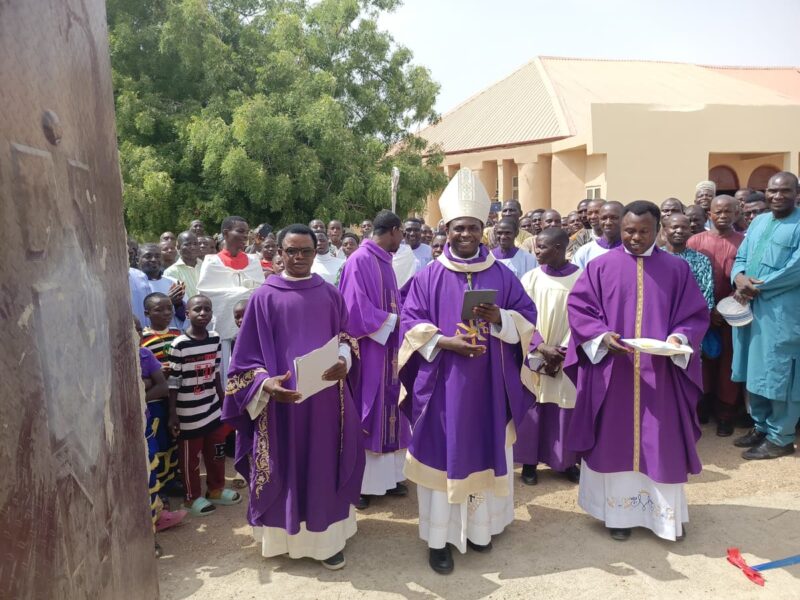
The Diocese of Katsina, established in 2023 in northwestern Nigeria, has grown from 21 seminarians to nearly 40 in less than three years. This vocational growth is taking place in a region where Catholics form a small minority and where violence, kidnappings, and population displacement have been part of the reality the Church has faced for years.
Its first bishop, Bishop Gerald Mamman Musa, believes these difficulties should not define the identity or mission of Catholics. In statements to ACI Africa during the SIGNIS World Congress, held from August 3 to 8 in Kigali (Rwanda), the prelate argued that the diocese must act as a “creative minority” capable of influencing society through faith, education, and Christian witness.
“We can lament that we are very few. We can lament that we are oppressed, persecuted, or discriminated against. We must not focus on all those negative aspects,” he stated.
From 21 to nearly 40 seminarians
Katsina continues to need priests from neighboring dioceses to meet its pastoral needs, but Musa finds the growth of vocations since its creation especially encouraging.
“The good news is that we inherited 21 seminarians and today we have nearly 40,” he explained. For the bishop, this increase shows that the local Church has “great potential” despite its small size.
His long-term goal goes beyond meeting its own needs. Musa hopes Katsina will eventually have enough clergy to send priests to other dioceses: “We hope for a Church that is not only self-sufficient but also willing to offer priests to help others.”
The diocese was erected by Pope Francis in October 2023 and has spent its first years establishing its pastoral structures. During its first general assembly, it adopted a strategic plan for the next ten years.
Education to root the faith
Among the priorities of this project, the formation of children and young people holds a central place. Musa believes that the survival and growth of a minority Catholic community require Christians who are aware of their faith and capable of navigating a predominantly Muslim society.
The bishop used a Sudanese proverb to explain his approach: parents must provide their children with “roots” and “wings.” The former serve “to know where they come from, to know their faith, and to know their values”; the latter, to enable them to become role models within society.
One of his main concerns is facilitating access to education for families without resources. Among the projects Musa wants to launch is a secondary school for girls where, in addition to receiving academic training, they can acquire “a very good formation in the faith.”
“In the midst of all this darkness, God is at work”
The bishop does not deny the gravity of the situation in Katsina. He explicitly acknowledges the existence of banditry, killings, kidnappings, and displacement, and admits that the population is living through “a very difficult time.”
However, he believes that reducing the diocese’s image to violence prevents seeing other events that are also taking place. “In the midst of all this darkness, God is at work in the Diocese of Katsina,” he stated.
Musa points to baptisms and confirmations, educational initiatives, and the increase in priestly vocations as signs of this vitality. The diocese is also working on dialogue between Christians and Muslims and on relations between Catholics and other Christian communities.
For the prelate, being a minority does not mean resigning oneself to irrelevance. The question he poses to his faithful is different: “What can we do in this society? How can we, though so few, positively change society?”
This approach summarizes the “creative minority” Musa wants to build in Katsina: a small community that firmly preserves its Christian identity and, from that identity, can transform the environment in which it lives.
“We are few. We have very few resources, but we must always remember that little is much when God is in it,” the bishop concluded.