


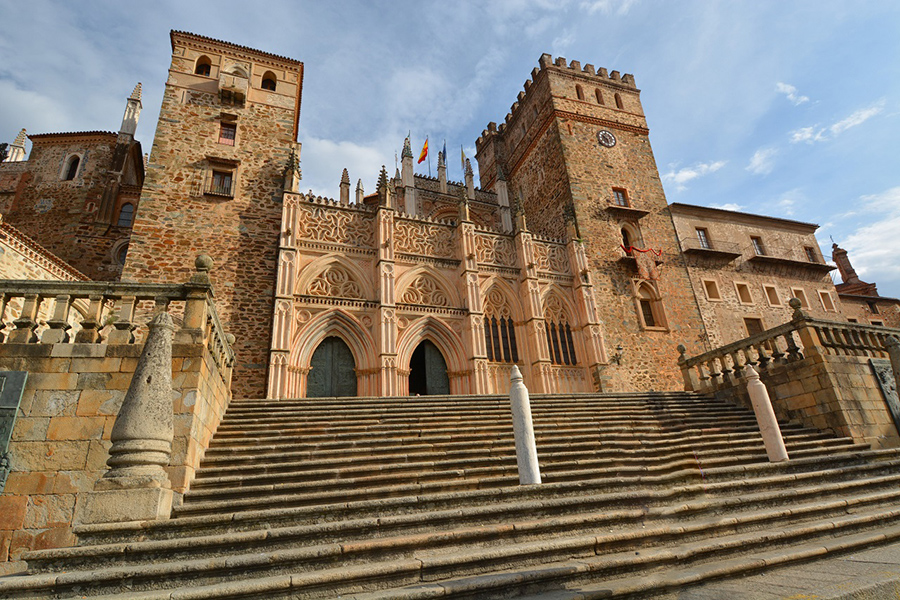
The Royal Monastery of Santa María de Guadalupe (Cáceres) will open its Holy Door next Sunday, August 30, marking the beginning of the Guadalupense Jubilee Year 2026-2027, which will run until September 8, 2027, the solemnity of Santa María de Guadalupe, patroness of Extremadura and Queen of the Hispanic World. The central event will be a solemn Eucharist to be celebrated at 12:00 p.m., as announced by the Archdiocese of Toledo, to which the sanctuary belongs despite being located in Cáceres territory.
The Jubilee Year is a grace granted by the Holy See that allows pilgrims to obtain the indulgences proper to this holy time. In Guadalupe, it is celebrated only when the liturgical feast of the Virgin, September 6, falls on a Sunday, a tradition revived in 2005 after Saint John Paul II established in perpetuum this concession for such years.
“Your Mother is looking for you”
The Jubilee will be celebrated under the motto “Your Mother is looking for you”, taken from the Gospel of Saint Matthew, which also gives its title to the joint pastoral letter signed by the Archbishop of Toledo, his auxiliary bishop, and the bishops of the three dioceses of the ecclesiastical province of Mérida-Badajoz. An expression that, in the words of the organizers, reflects Mary’s loving initiative, the first disciple of Jesus, who goes out to meet her children to lead them to Christ.
The official presentation of the Holy Year took place on July 7 in the Jeronymite Chapter Hall of the monastery itself, presided over by the Archbishop of Toledo and Primate of Spain, Msgr. Francisco Cerro Chaves, together with the Archbishop of Mérida-Badajoz, Msgr. Fray José Rodríguez Carballo, OFM; the Vicar General of Coria-Cáceres, D. Diego Zambrano; and the Guardian of the Royal Monastery, Fray Vidal Rodríguez, OFM, who chairs the interdiocesan organizing commission.
“From Guadalupe, a magnificent work of missionary evangelization has been carried out. The image of the Virgin continues to gather millions of people,” highlighted Msgr. Cerro Chaves, who emphasized the sanctuary’s role as “the heart of Marian devotion in Spain” and its universal outreach, called to continue strengthening the spiritual bonds between Extremadura and the peoples of America.
For his part, Msgr. Rodríguez Carballo stressed the theological meaning of the Jubilee, “a time of grace, reconciliation, and conversion,” deeply spiritual yet with strong social implications: to make a pilgrimage, he said, means “to go out of oneself, to walk in faith, to share hope with others, and to allow oneself to be transformed by God.”
From the Jubilee of the Hispanic World to the Jubilee of Migrants
Throughout the year, a broad calendar of pilgrimages and monthly gatherings will be held, aimed at the different areas of ecclesial life—youth, families, catechesis, education, health pastoral care, consecrated life, clergy, movements, and associations—from the Jubilee of the Hispanic World, in October 2026, to the Jubilee of Migrants, in August 2027.
Among the new features presented are the renewal of the pilgrim’s credential, the creation of a jubilee prayer, and the new logo of the Holy Year, which synthesizes in green and gold the silhouette of the monastery, the image of the Virgin, and the path leading to the heart of the Puebla.
The Jubilee will also include its own social project: the “Hogar Santa María de Guadalupe” project, in collaboration with the Asdivi association, which will allow four to six people with limited abilities to live in a home accompanied by professionals, with the aim of enjoying as autonomous a family life as possible. “People with disabilities are the treasure of the Church and the treasure of humanity,” noted the Archbishop of Toledo.
An open house for the Hispanic world
Fray Vidal Rodríguez explained that the desire of the Franciscan community is for this Holy Year to be a genuine opportunity for evangelization: “We want those who come to Guadalupe to be able to reconcile with the Lord, express their faith, and recover hope.” The Guardian also recalled the universal dimension of Guadalupense devotion, deeply rooted in the American continent and also present in the Philippines, and expressed his hope that tens of thousands of pilgrims will once again find in the sanctuary “an open house where they can experience the closeness of God under the maternal gaze of the Virgin.”
Founded in 1340 and today entrusted to the Franciscan Order, the Royal Monastery of Guadalupe—World Heritage Site since 1993—was for centuries the great sanctuary of Spain of the Reconquest and the Discovery: before its dark Virgin, Christopher Columbus prayed, and from its name the Mexican devotion of Tepeyac took its own. The Jubilee Year now beginning aspires to restore to the Cáceres Puebla its status as a spiritual crossroads of the entire Hispanic world.