


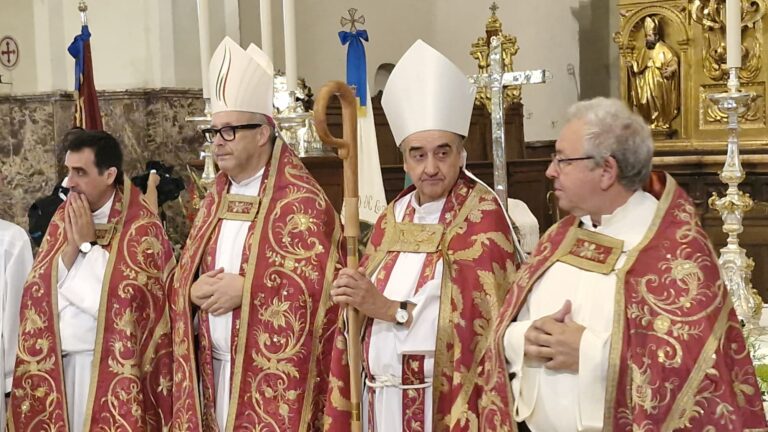
The bishop of Huesca and Jaca, Monsignor Pedro Aguado Cuesta, has called for proclaiming the Gospel, recognizing God above human pretensions, and drawing near to those who suffer poverty, loneliness, illness, or precariousness. He did so this Monday, August 10, during the solemnity of Saint Lawrence, patron of Huesca, whose figure he presented as an example of a faith that unites the proclamation of Christ with concrete service to those in need.
The pontifical Mass was celebrated in the Basilica of Saint Lawrence after the traditional procession through the city streets and was concelebrated by the bishop of Málaga, Monsignor José Antonio Satué Huerto. In his homily, Aguado wondered what the martyr would say today if he returned to his native land. His response was: “Proclaim the Gospel, that is, announce the kingdom of God and his justice.”
“There is a God who bets on each one of us”
Aguado placed the recognition of God at the beginning of his reflection. He spoke of a Father who accompanies, forgives, and offers mercy, justice, and love, and whose face is revealed in Jesus Christ.
Against a conception of man as the ultimate measure of reality, the bishop affirmed that “there is a God who is greater than you and me” and recalled that He also awaits those who live as if He did not exist. Christ, he added, is “the way, the truth, and the life,” and the encounter with Him responds to the “longing for infinity, for fullness, for answers, for meaning” present in the human heart.
The Gospel, however, is not limited for Aguado to the recognition of God. The bishop recalled the twofold commandment to love God with all one’s heart and one’s neighbor as oneself, a demand he defined as “as wonderful as it is committed” and “as peace-bearing as it is unsettling.”
From faith to service of those in need
From that commandment, Aguado devoted a significant part of the homily to the social consequences of faith, taking the life of Saint Lawrence as a reference.
The deacon, martyred in Rome during the persecution of Emperor Valerian in the year 258, had among his responsibilities the administration of the Church’s goods and the care of the poor. According to tradition, when the Roman authorities demanded that he hand over the ecclesiastical riches, Lawrence distributed goods among those in need and later presented the poor, the sick, and the helpless before the prefect.
“These are the true treasures of the Church,” Aguado recalled, evoking the response attributed to the martyr.
The bishop transferred that image directly to the present and pointed out among the realities that must challenge Christians loneliness, economic and labor precariousness, difficulties in accessing housing, illness, and lack of horizons.
“When the person in need ceases to be a number and becomes a someone, the response is different,” he affirmed.
Aguado summarized this dimension of his message with the expression “the poor, treasures of the Church.” For the prelate, remembering Saint Lawrence does not consist simply in preserving a historical or festive tradition, but in allowing his testimony to transform the way of looking at those who suffer.
Saint Lawrence as an element of unity in Huesca
The solemnity also brought together some of the city’s most deeply rooted traditions. The bust of Saint Lawrence traveled through the streets accompanied by the dancers, the clergy, the confraternities, municipal representatives, and numerous faithful before returning to the basilica for the celebration of the Mass.
In the final stretch of his homily, Aguado transferred his reflection to the realm of social coexistence. In a society where there are “so many different ways of thinking,” he presented the patronal feasts as an occasion to meet around what the people of Huesca share.
“There is no doubt that Saint Lawrence is a point of union for all the people of Huesca,” he noted, asking that the celebrations take place with respect, joy, and a spirit of unity.
The bishop also thanked the work of healthcare workers, Civil Protection, Red Cross, Armed Forces, State Security Forces and Corps, firefighters, civil servants, volunteers, and workers from various sectors who provide service during the festivities.
Aguado closed his homily by returning to the religious meaning of the solemnity and making his own the petition of the liturgical prayer dedicated to the martyr: “Grant us through his intercession to love what he loved and to sincerely practice what he taught us.”