


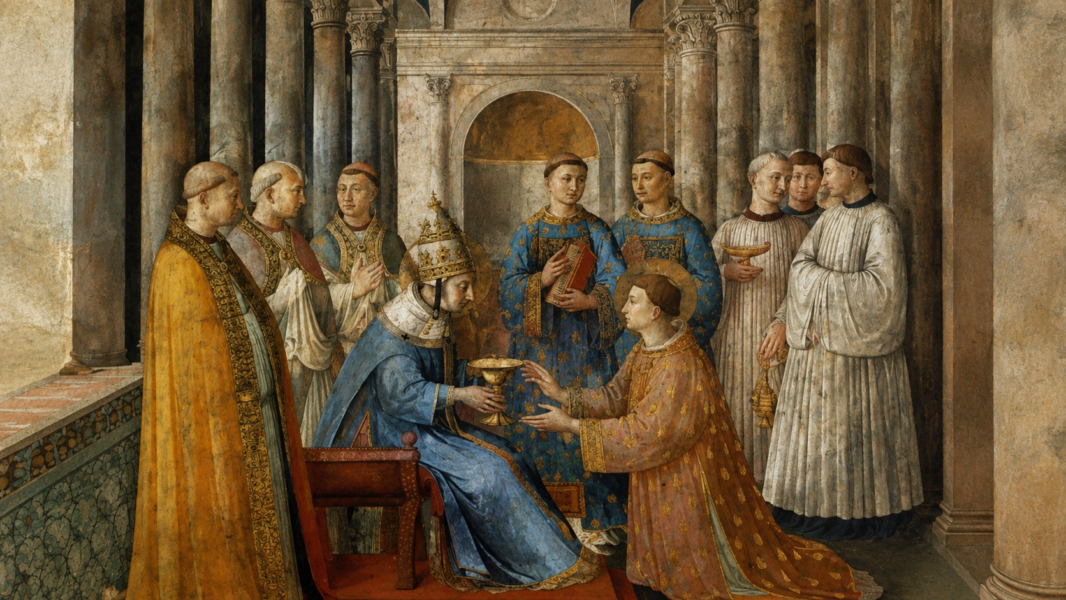
Every August 10, the Church celebrates Saint Lawrence, one of the most venerated martyrs of the ancient Church of Rome. A deacon in the service of Pope Saint Sixtus II, his memory has endured through the centuries, inseparably linked to two testimonies: charity toward the poor and a fidelity to Christ maintained even unto martyrdom.
Little is known about his early years. An ancient tradition places his birth in Hispania and links him particularly with Huesca.
Lea también. Huesca celebra a san Lorenzo: procesión, misa pontifical y veneración de sus reliquias
His known life, however, unfolds mainly in Rome, where he exercised his diaconal ministry and took on responsibilities related to the administration of the community’s goods and the care of those in need.
Alongside Saint Sixtus II during the persecution
In the year 258, the persecution under Emperor Valerian struck directly at the Church’s hierarchy. Pope Sixtus II was arrested while celebrating the liturgy in the cemetery of Callistus and was executed on August 6, together with several deacons.
Lawrence survived initially, though only for four days.
Saint Ambrose later transmitted a well-known tradition according to which Lawrence, upon seeing the Pope being led to martyrdom, lamented not being able to accompany him: “Where are you going, father, without your son? Where are you going, holy priest, without your deacon?” Sixtus would then have announced that he would follow him a few days later.
The scene reflects the close bond that Christian tradition established very early between the two martyrs: the bishop and his deacon would ultimately give their lives during the same persecution, only days apart.
“These are the treasures of the Church”
As a deacon, Lawrence was responsible for administering goods intended to meet the needs of the community and, in particular, of the poor.
After the death of Sixtus II, the Roman authorities reportedly demanded that Lawrence hand over the Church’s riches. Tradition then preserves one of the most celebrated episodes of his life: instead of presenting the goods they expected to find, the deacon gathered the poor, the sick, and the needy, and presented them as the true “treasures of the Church.”
This response expresses a profoundly Christian understanding of wealth. For Lawrence, the poor were not a marginal reality within the community, but persons in whom the disciple of Christ is called to recognize the Lord in a special way.
His service to those in need cannot be separated from his ministry as a deacon. The charity he practiced sprang from the same faith he would soon have to confess before his persecutors.
The martyrdom of Saint Lawrence
On August 10 of the year 258, four days after the death of Sixtus II, Lawrence suffered martyrdom.
The Roman Missal recalls that the saint “confirmed his service of charity with martyrdom under Valerian” and preserves the tradition that he had distributed the community’s goods among the poor.
An ancient tradition, already widely known by the fourth century, also holds that Lawrence was subjected to torture on a gridiron. The scene became deeply embedded in Christian memory and iconography, to the point that the gridiron became the attribute by which the saint is usually recognized in paintings and sculptures.
Even a well-known phenomenon in the August sky is associated with this tradition. The shooting stars visible around these dates are popularly called the “tears of Saint Lawrence,” in memory of the burning coals linked to his martyrdom.
Beyond the specific form of his torment, the Church has above all preserved the memory of his fidelity: Lawrence died as a consequence of his condition as a Christian and of his ministry in the service of the Church of Rome.
“He loved Christ in his life and imitated Him in his death”
Saint Augustine found in the figure of Lawrence a profound continuity between the service of the deacon and the offering of the martyr.
In one of his sermons delivered on the occasion of his feast, the bishop of Hippo recalled: “He exercised the office of deacon. There he administered the sacred blood of Christ, and there he poured out his own for the name of Christ.”
Augustine linked Lawrence’s martyrdom to the words of Saint John: “As Christ laid down his life for us, so we ought to lay down our lives for our brothers” (1 Jn 3:16).
And he summarized the saint’s life with a phrase that explains the Christian meaning of his martyrdom: “He loved Christ in his life and imitated Him in his death”.
Lawrence had served as a deacon before being called to give his life as a martyr. His final sacrifice thus appears not detached from his previous life, but as the culmination of a fidelity already exercised in the service of God and neighbor.
A martyr present at the heart of the Roman liturgy
Veneration of Saint Lawrence spread very early and came to occupy a privileged place in the Church of Rome.
Over the site traditionally identified as his burial place, the basilica of Saint Lawrence Outside the Walls was built, becoming one of the great centers of veneration of the Roman martyrs.
His name was also incorporated into the liturgy. Saint Lawrence is one of the martyrs expressly mentioned in the Roman Canon, now Eucharistic Prayer I, alongside other great witnesses of the first centuries of Christianity.
For generations, therefore, his name has been pronounced at the very heart of the celebration of the Mass. The Church also recognizes him as patron of deacons, the ministry he exercised until he gave his life.
A fidelity that remains as an example
Eighteen centuries later, the Church continues to celebrate Saint Lawrence not for the cruelty of the torment he endured, but for the faith that sustained his life and his death. His service to the poor and his martyrdom sprang from one and the same fidelity to Christ.
Lawrence had learned as a deacon to administer the goods of the Church in the service of those who needed them. When persecution came, that self-giving reached its definitive expression: he no longer had goods to distribute, but his own life to offer.
Saint Augustine summed it up with words that span the centuries: “He loved Christ in his life and imitated Him in his death.” In them remains one of the great teachings of Saint Lawrence: fidelity in the moment of trial is prepared in daily fidelity.