


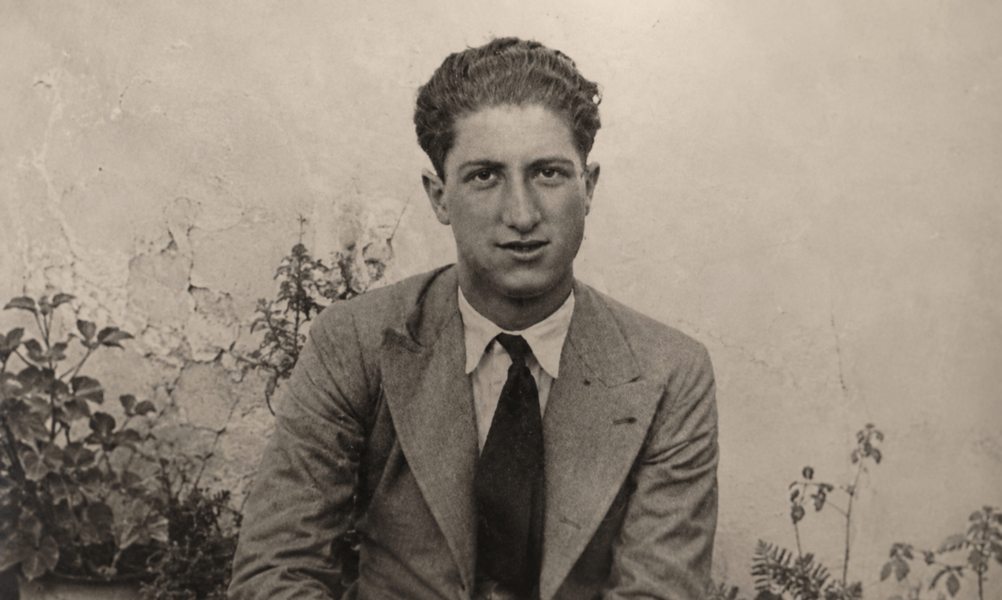
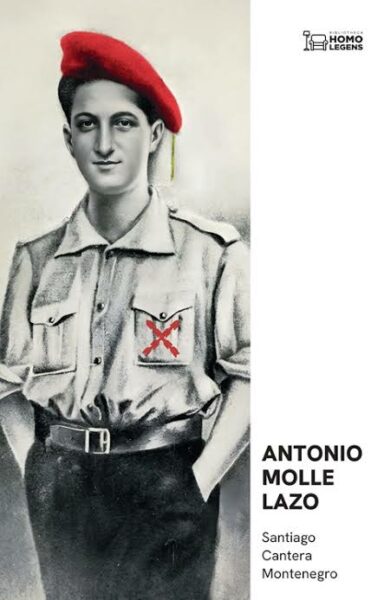
On this 10th of August, 90 years have passed since the martyrdom of Antonio Molle Lazo, the 21-year-old requeté who died in Peñaflor (Seville) during the religious persecution of 1936 after refusing to renounce his faith. His story is told in Antonio Molle Lazo (1915-1936). Youth, Ideals and Martyrdom, the biography written by the Benedictine historian Santiago Cantera Montenegro and published this year by Homo Legens.
From the Convent of the Sisters of the Cross to Martyrdom
Antonio Molle had arrived in Peñaflor on 8 August 1936 together with other requetés and civil guards. Two days later, on the morning of 10 August, he attended Mass and received Communion. Around eleven o’clock, several hundred armed men from the area of Palma del Río and Hornachuelos advanced on the town.
The testimonies gathered by Cantera place Molle near the Convent of the Sisters of the Cross at that moment. Some sources claim he went there from the Town Hall because he wanted to protect the nuns in case they were persecuted; others indicate that he was already at the convent when the attack began.
His capture would lead to the episode that has defined his memory for nine decades. Molle refused to blaspheme and maintained his confession of faith until death. His martyrdom has since been associated with the cry of «¡Viva Cristo Rey!», with which he gave his life at the age of 21.
A Devotion That Quickly Spread Across Spain
The memory of Antonio Molle did not disappear with the end of the war. On 10 August 1937, exactly one year after his death, Peñaflor held a solemn funeral and, through popular subscription, erected a monument at the site of his martyrdom. The tombstone recalled that he had died crying out «¡Viva Cristo Rey!» and «¡Viva España!».
From then on, acts in his memory began to be held every 10 August, especially in Jerez de la Frontera and Peñaflor. The Holy Mass was at the centre of these commemorations, accompanied over the years by lectures and publications dedicated to his figure.
The devotion also spread with extraordinary speed. The Carmelite Hilarión Sánchez promoted the distribution of holy cards of Antonio Molle and claimed that 300,000 copies had been distributed in just a few days. Requests came from different parts of Spain and also from abroad.
His remains were eventually transferred, with the authorisation of the Holy See, to the church—now the basilica—of Our Lady of the Crowned Carmel of Jerez de la Frontera, where they were placed in a tomb on the feast of Christ the King in 1940 and where they have since been visited by numerous faithful.
Santiago Cantera: A Model Especially Aimed at Young People
The biography published by Homo Legens does not seek to present Antonio Molle solely as a figure of the Spanish Civil War. Cantera explains that his purpose is to show him, above all, as a model for young people, highlighting his Christian virtues and his willingness to give his life rather than abandon his faith.
The author does not conceal the young requeté’s Traditionalist militancy, which is necessary to understand his personality and his times, but expressly warns that the book does not intend to be a political apology for Carlism. The centre of the work lies in Molle’s Christian life, his ideals and his martyrial death.
Ninety years after that morning of 10 August 1936, the figure of Antonio Molle remains linked to a radically simple choice: to preserve his life by renouncing what he believed in, or to remain faithful to the very end. He chose the latter.

Antonio Molle Lazo (1915-1936). Youth, Ideals and Martyrdom, by Santiago Cantera Montenegro, O.S.B., published by Bibliotheca Homo Legens in 2026.