


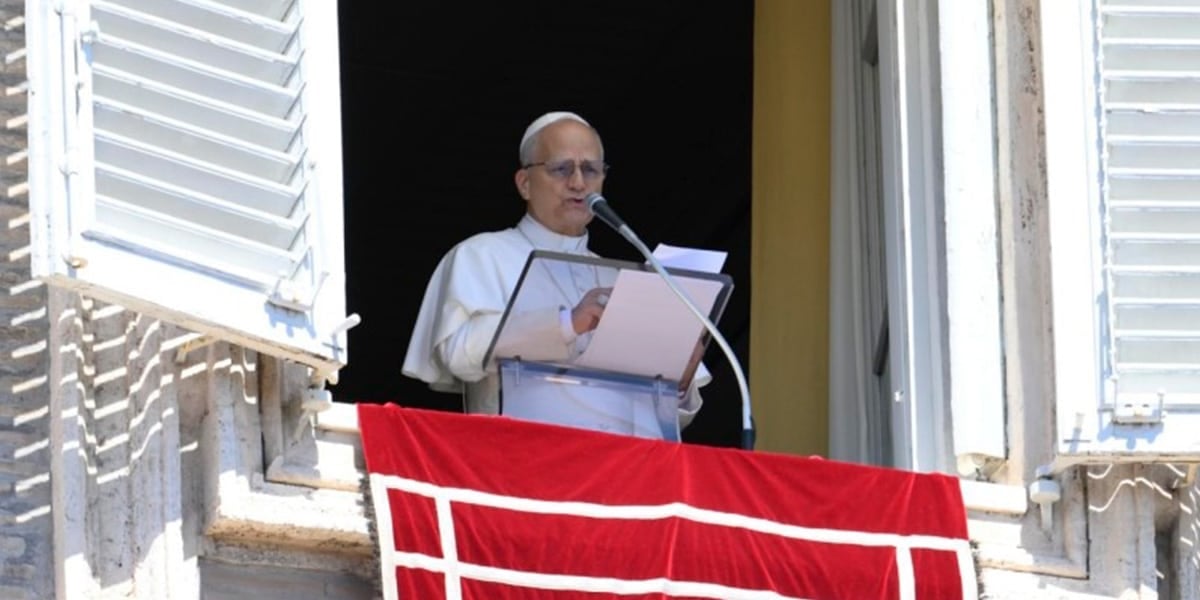
Pope Leo XIV warned this Sunday against the temptation to trust in oneself in the face of success and to fall into despair when facing difficulties. During the Angelus for the Nineteenth Sunday in Ordinary Time, the Pontiff reflected on the Gospel passage in which Christ walks on the waters and recalled that the disciples had to experience their own weakness in order to truly recognize the presence of God. “Jesus does not abandon us,” he affirmed, pointing out that through “prayer, the Sacraments and listening to his Word” the Christian finds in Christ “peace, light and strength” for his journey.
After the Marian prayer, Leo XIV renewed his appeals for peace amid the wars in Sudan and Ukraine. The Pope called for humanitarian corridors for the Sudanese civilian population and an immediate ceasefire, while, in the face of new civilian victims in Ukraine and Russia—including children—he urged both sides to respect humanitarian law and to cease attacks on civilian targets: “War only generates more war.” The Pontiff concluded by asking that “the spiral of violence” be stopped and that space be given to diplomacy and dialogue, before addressing young people in particular and inviting them to know and follow the example of saints such as Saint Dominic, Saint Teresa Benedicta of the Cross, Saint Lawrence and Saint Clare of Assisi.
The Pope’s Words at the Angelus Prayer:
Dear brothers and sisters, happy Sunday!
Today the Gospel speaks to us of Jesus who, on the Sea of Galilee, reaches the disciples in the midst of a storm, walking on the waters (cf. Mt 14:22-33).
After the miracle of the loaves and fishes (cf. Mt 14:13-21), the Master urges his own to get into the boat and put out to sea, while he withdraws to the mountain, alone, to pray. Yet, far from the shore, they find themselves at the mercy of the wind and have difficulty making headway. After an experience of success, in which they had been protagonists of a prodigious sign, they now find themselves powerless and frightened before the threat of the waves and the contrary wind.
At the end of the night, Jesus comes to meet them on the troubled waters and, frightened, they mistake him for a ghost (v. 26). But he says to them: “Take courage, it is I; do not be afraid!” (v. 27). The presence of the Lord changes everything: Peter even manages to take a few steps on the waves toward him; then he becomes frightened, begins to sink, and Jesus saves him. When the Master gets into the boat, the storm calms and then the profession of faith spontaneously rises from the hearts of the disciples: “Truly you are the Son of God” (v. 33).
To reach this point, it was not enough for them to have witnessed a miracle or to have had success before the people: they had to pass through the experience of their own weakness and, in it, recognize the presence of God. Only then could they truly open their eyes and hearts to his nearness, recovering peace even in the midst of the storm.
One day, some time later, Jesus would say to them: “If you have faith and do not doubt […], if you say to this mountain, ‘Move from here and throw yourself into the sea,’ it will be done” (Mt 21:21). And this is precisely what they experienced on the lake: the peace of Christ, who had been on the mountain praying, reached them in the midst of the fury of the waters.
This miracle, therefore, teaches us something important: above all, not to exalt ourselves in the face of success and never to presume on ourselves; and, at the same time, not to despair, even in moments of darkness, when we feel powerless before problems and, despite our efforts, it seems we are going backward instead of forward. In every circumstance, Jesus does not abandon us and, if we humbly welcome him into the boat of our life—with prayer, with the Sacraments, with listening to his Word—we will find in him peace, light and strength for our journey.
May Mary help us to live in this way, with trusting abandonment to God, she who was proclaimed blessed because of her faith (cf. Lk 1:45).
After the Angelus:
Dear brothers and sisters:
I continue to follow with concern the tragic situation in Sudan, especially in the city of El Obeid. While expressing my spiritual closeness to the entire people of the nation, I renew my appeal to the authorities to guarantee humanitarian corridors for the civilian population. At the same time, I urge the international community to support efforts aimed at achieving an immediate ceasefire. Let us pray that the Lord may sustain those who suffer, convert the hearts of those who sow violence, and grant the long-awaited peace.
Painful news continues to arrive of innocent people killed and wounded in Ukraine and in Russia. Tragic episodes follow one after another, indeed multiply, causing ever more civilian victims, including children. I am close to the families of the victims, the wounded, and all those who suffer because of the ongoing conflict. In the face of so much pain, I renew an earnest appeal that humanitarian law be respected and that attacks affecting civilian targets cease on both sides. War only generates more war and causes immense suffering. It is time to stop the spiral of violence and give space to diplomacy and dialogue to open the way to peace.
And now I greet all of you, Romans and pilgrims from various countries.
I greet in particular the young people of the Santa Maria Maddalena Community of the Diocese of Milan, who have walked the Via Francigena from Siena to Rome; as well as the scouts from Enna, who have held their camp in the Roman Hills, and the young people from Pernumia, Diocese of Padua.
The presence of so many youth groups who choose to dedicate some days of their vacation to formative and friendship activities is a sign of hope; as was also the meeting of the young Franciscans, whom I had the joy of meeting last Thursday in Assisi.
To all of you, boys and girls who are listening to me, I wish to remind you that in these days the liturgical calendar proposes to us some splendid figures of saints, whom I invite you to know better: yesterday, the great Saint Dominic, founder of the Order of Preachers; today, Saint Teresa Benedicta of the Cross, Edith Stein, Carmelite martyred in Auschwitz and co-patroness of Europe; tomorrow, Saint Lawrence, deacon of the Church of Rome; the day after tomorrow, Saint Clare of Assisi, who left a comfortable life to follow Jesus poor and humble, following the example of her fellow citizen Saint Francis. Dear young people, let yourselves be enthused by these exemplary witnesses of the Gospel!
Thank you all for your presence and happy Sunday!