


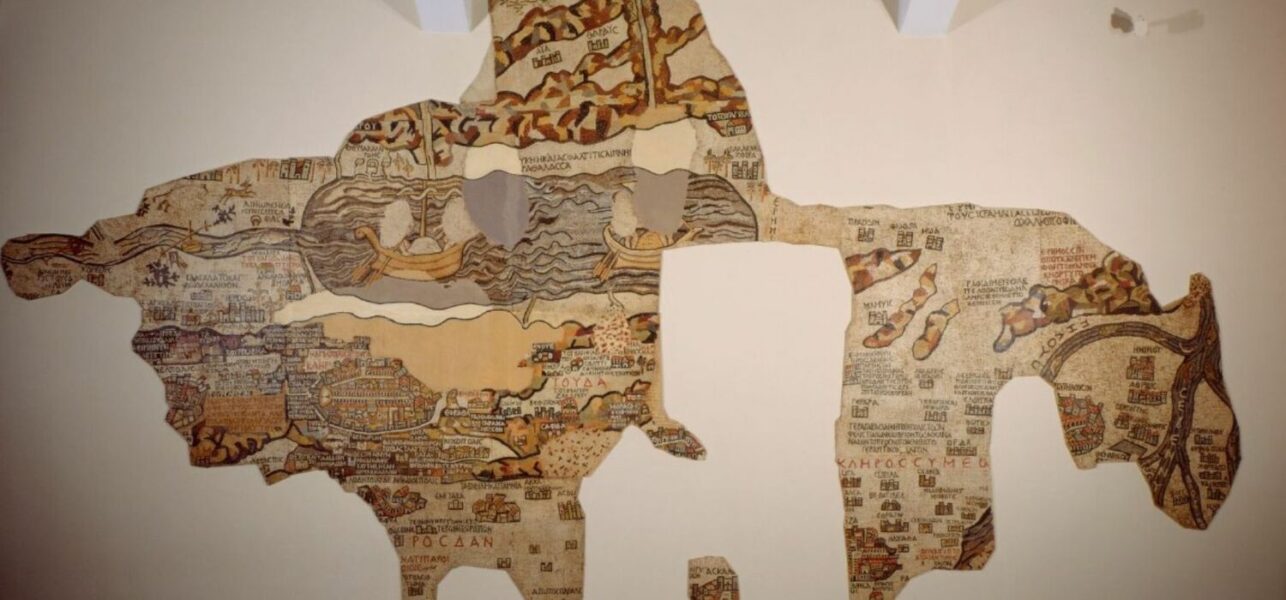
The University of Göttingen, in Germany, has launched a project to bring the famous Madaba Map closer through digital tools, considered the oldest surviving cartographic representation of the Holy Land. Students at the institution are working on various interactive formats that will allow exploration of the mosaic and understanding how Christians in Late Antiquity represented the places linked to biblical history.
The Madaba Map is part of a large floor mosaic created in the sixth century and preserved in the Church of Saint George, in the Jordanian city of Madaba. Composed of thousands of small pieces, it represents cities, landscapes, and pilgrimage sites in a territory that extends from present-day Lebanon to the Nile Delta.
Jerusalem in a sixth-century mosaic
One of the most outstanding elements of the work is the representation of Jerusalem, shown with numerous urban details. It features the walls of the Holy City, its gates, streets, and some of its main buildings.
The value of the mosaic does not lie solely in its antiquity. The work allows us to approach sacred geography as it was conceived by Christians in Late Antiquity, several centuries after the death and Resurrection of Christ.
«In this way, it becomes clear how the biblical landscape was imagined in Late Antiquity», explains Jon C. Cubas Díaz, archaeologist and art historian and head of the project promoted by the University of Göttingen.
The German institution preserves in the collections of its Archaeological Institute a large-scale copy of the Madaba Map. This reproduction was made in the 1970s from molds obtained directly from the original and now forms the basis of the new academic project.
A virtual tour of the church of Madaba
The students are working both on the historical study of this reproduction and on new ways of displaying the mosaic to different audiences. The project is aimed at schoolchildren, visitors, parishes, and specialists.
Among the planned initiatives are interactive stations with high-resolution images and virtual reality elements that will allow a digital visit to the Church of Saint George in Madaba, where the original mosaic remains.
The researchers will also study the materials used in the reproduction preserved in Göttingen, the circumstances under which it was made, and the archival documentation related to it. According to Cubas Díaz, the copy constitutes not only an exhibition piece, but also a testimony to the history of the research carried out on the Madaba Map.
The project, entitled «On the Map to Jerusalem. The Madaba Map in Göttingen: Copy, Context and Dissemination of a Late Antique Mosaic», has received funding of 10,000 euros from the Novus Foundation. The funds will be allocated to exhibition equipment and multimedia technology that will subsequently remain in the university’s collections.