


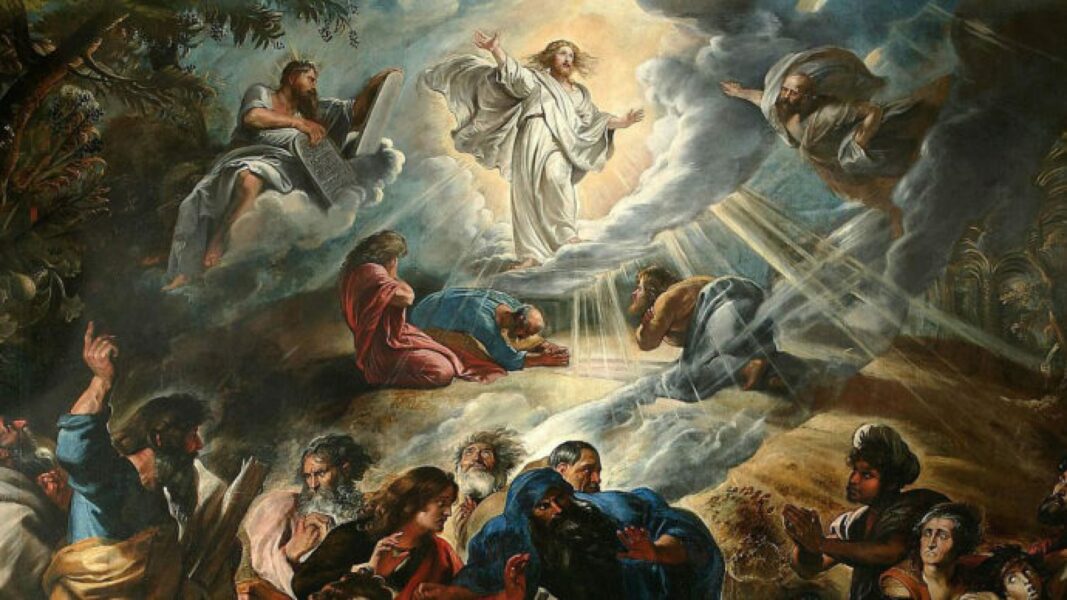
Every August 6, the Church celebrates the feast of the Transfiguration of the Lord. The Gospel of Saint Matthew recounts how Jesus took Peter, James, and John with Him, led them up a high mountain, and before them “His face shone like the sun, and His garments became white as snow” (Mt 17, 1-9). Beside Him appeared Moses and Elijah, while a voice from the cloud proclaimed: “This is my beloved Son; listen to Him.”
The Church’s tradition has always seen in this event a preparation for the Passion. Before ascending to Jerusalem, where He will face suffering and death on the cross, Jesus allows three of His disciples to glimpse for a moment the glory that will culminate in the Resurrection. Among the Church Fathers, Saint Augustine dedicated a sermon to this passage in which he explains how each of its elements illuminates the mystery of Christ and offers a teaching for the Christian life.
Christ gives meaning to all of Scripture
The presence of Moses and Elijah on the mountain is not a secondary detail. From the earliest centuries, the Church has recognized in them the Law and the Prophets—that is, the entire revelation that preceded Christ.
Saint Augustine explains that both appear conversing with Jesus because the entire Old Covenant leads to Him. The Law announced His coming, and the Prophets prepared the people to recognize the Messiah. That is why, when Peter proposes to erect three tents—one for each—He has not yet fully understood what He is contemplating.
The answer comes immediately from heaven. The Father’s voice does not invite them to listen indiscriminately to the three figures, but points solely to Christ: “This is my beloved Son; listen to Him.” In that declaration is summed up the entire economy of salvation: the Law and the Prophets find their definitive fulfillment in the Son of God.
The light of Christ also illuminates His Church
The radiance of Jesus’ face manifests His divine glory, but also reveals who He is for man. Saint Augustine affirms that Christ is to the heart what the sun is to the eyes of the body: the light without which truth cannot be seen.
The white garments likewise possess a profound meaning. The saint sees in them an image of the Church, clothed by the grace of Christ. Just as garments receive their beauty from the one who wears them, so the Church shares in the holiness of her Lord. She does not shine by herself, but because she remains united to Him.
This reading reminds us that holiness does not consist in an exclusively human effort. It is Christ who transforms, purifies, and communicates His own life to those who remain in communion with Him.
Peter discovers that Tabor is not the goal
Peter’s reaction is profoundly human. After beholding that glory, he exclaims: “Lord, how good it would be for us to stay here!”
The Church’s tradition has seen in those words the spontaneous desire to remain where God manifests Himself with clarity. Saint Augustine acknowledges that Peter speaks moved by the joy of contemplation, but also shows that he still does not grasp the full meaning of that experience.
Jesus has not led the three disciples up the mountain so that they might remain there. He has brought them to that place to prepare their hearts for the events that are near. The Transfiguration precedes the Passion because glory must sustain faith when the hour of trial arrives.
Therefore, Tabor cannot be understood apart from Calvary. Both mountains form part of the same redemptive mystery.
“Rise, and do not be afraid”
When the Father’s voice resounds from the cloud, the disciples fall face down to the ground, filled with fear. Then Jesus approaches, touches them, and says: “Rise, and do not be afraid.”
When they lift their eyes, they no longer see Moses or Elijah. Only Christ remains.
Saint Augustine finds in this detail a synthesis of the Christian journey. The Law and the Prophets have fulfilled their mission by leading man to Jesus. Now it is He who remains as the center of faith and hope. All revelation finally converges in His person.
Christ’s gesture also shows that the encounter with God does not end in fear, but in trust. He raises man so that he may continue walking in His footsteps.
“Come down, Peter”
Saint Augustine’s sermon reaches its climax as he focuses on the final words of the Gospel: “As they were coming down from the mountain…”
For the Bishop of Hippo, here lies one of the keys to the Christian life. Peter had wanted to remain on Tabor, but Christ leads him back to the path. The disciple cannot settle in spiritual consolation because his vocation consists in following the Master wherever He goes.
Saint Augustine then places on Christ’s lips an exhortation that spans the centuries: “Come down, Peter”.
Come down to proclaim the Gospel. Come down to serve your brothers. Come down to live charity. Come down to accept the work, the difficulties, and the daily cross.
It is not a matter of abandoning contemplation, but of understanding its purpose. Whoever has contemplated the glory of Christ is called to return to the world with firmer faith and more generous charity. Tabor is not an escape from reality; it is the preparation for living it according to the Gospel.
A feast that unites Tabor with the Cross
Although the Gospels do not indicate the date on which the Transfiguration took place, the Church has celebrated this mystery on August 6 for centuries. In the East, the feast already appears in the earliest liturgical calendars, while in the West it was extended to the whole Church by Pope Callixtus III after the victory of Belgrade against the Ottoman advance, achieved on August 6, 1456.
The choice of this date also carries a liturgical meaning. The Transfiguration is celebrated forty days before the Exaltation of the Holy Cross, on September 14. This is no coincidence. The calendar thus recalls that the glory contemplated on Tabor and the self-giving consummated on Calvary form part of the same mystery of salvation.
The liturgy of this day invites us to contemplate the glorious Christ, but also to follow Him when the path leads toward the cross. That is, ultimately, the teaching Saint Augustine draws from the Gospel: contemplation strengthens faith, but always leads back to mission. The disciple ascends the mountain to recognize who Christ is; he descends from it to live according to that truth.