


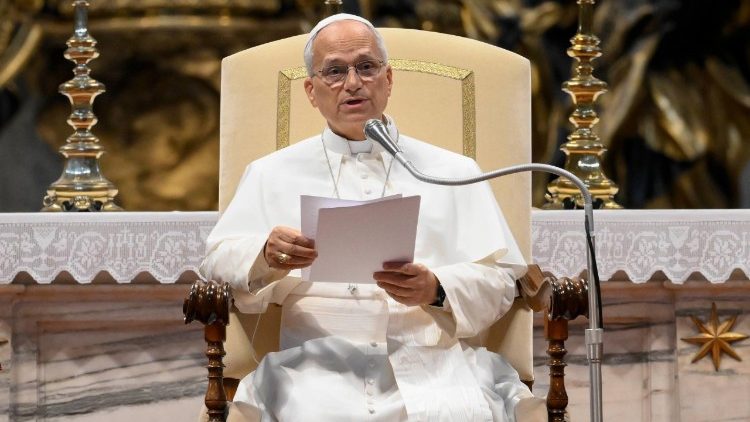
After the summer recess, Pope Leo XIV has resumed this Wednesday the cycle of catechesis dedicated to the Constitution Sacrosanctum Concilium, the document of the Second Vatican Council on the sacred liturgy.
At the general audience held in the Vatican, the Pontiff focused his reflection on the ecclesial dimension of liturgical prayer, emphasizing that the liturgy is not an individual practice nor a wellness technique, but the privileged place of encounter with God and the source of the Church’s spiritual life.
In a cultural context marked by efficiency, consumerism, and the search for merely technical solutions to human needs, Leo XIV warned of the risk of reducing prayer to a psychological exercise or considering it a useless activity. In the face of this mentality, he recalled that the liturgy constitutes “the first source of divine life” and called for rediscovering especially the Liturgy of the Hours as a school of prayer for the faithful and for those preparing to receive Baptism.
Below, we reproduce the full text of the Holy Father’s catechesis:
Brothers and sisters, good morning!
In this catechesis we resume our reflection on the conciliar Constitution on the liturgy Sacrosanctum Concilium (SC). Today we focus on the ecclesial dimension of liturgical prayer.
As the Apostle Saint Paul suggests, it is the Holy Spirit who teaches us to pray. Since the day of Pentecost, the Spirit dwells in the Church, inspiring all its activities and, in particular, prayer.
The life of the first community, born in Jerusalem after the Passover of Jesus, is a life in the Spirit given by the Risen Lord.
“From that time on,” says the Council, “the Church has never ceased to come together to celebrate the paschal mystery: reading ‘what refers to him in all the Scriptures’ (Lk 24:27), celebrating the Eucharist, in which ‘the victory and triumph of his death are once again made present,’ and at the same time giving thanks ‘to God for the ineffable gift’ (2 Cor 9:15) in Christ Jesus, ‘to the praise of his glory’ (Eph 1:12), by the power of the Holy Spirit” (Sacrosanctum Concilium, 6).
In our time, in contexts dominated by a mentality centered on efficiency and consumerism, prayer can seem something useless and ridiculous. In a world where science and technology claim to give all the answers, praying can seem a form of escape. Moreover, even in many Christian families prayer is no longer handed down, while numerous people run the risk of confusing it with yet another technique, psychological in nature and oriented toward personal well-being.
Prayer, on the other hand, as a fundamental dimension of our humanity, deserves to be rediscovered in its truth.
The Constitution Sacrosanctum Concilium took this demand seriously. And this deeply pleased Pope Saint Paul VI, who, when promulgating this first document approved by the Second Vatican Council, declared:
“God in the first place; prayer, our first duty; the liturgy, the first source of the divine life that is communicated to us, the first school of our spiritual life.”
(Address in St. Peter’s Basilica, December 4, 1963).
In the Constitution, in fact, the term “prayer” designates the entire liturgy. This perspective is decisive, because it guided the liturgical reform by making the active participation of the faithful its central axis. The liturgy is presented above all as the place of encounter, of God’s initiative who draws near to humanity in his Son, “the Word made flesh, anointed by the Holy Spirit” (Sacrosanctum Concilium, 5), to whom we can respond “through Christ, with Christ and in Christ, in the unity of the Holy Spirit,” that is, thanks to “the prayer of Christ, with his Body, to the Father” (Sacrosanctum Concilium, 84).
For this reason, Saint Paul VI ardently desired that the Liturgy of the Hours, that is, the Church’s daily public prayer, inseparable from the Eucharist, deeply permeate, revive, guide, and express all Christian prayer and effectively nourish the spiritual life of the people of God (cf. Ap. Const. Laudis canticum).
For this desire to become a reality, the Liturgy of the Hours must be welcomed and lived more and more in the ordinary life of the baptized and of communities.
To the many people who wish to learn to pray, especially catechumens, it can offer the path and the school of Christian prayer.
Each week and each day, the Eucharist and the Liturgy of the Hours are the breath of the Church’s life that makes the Holy Spirit circulate through her Body. In this prayer, Christ “unites to himself the entire community of men and associates it with the singing of this divine hymn of praise” (Sacrosanctum Concilium, 83); thus, day by day, we are more and more associated with the paschal mystery and conformed to it.
Saint Augustine affirms:
“When we speak to God in prayer, we must not separate the Son from him; and when the body of the Son prays, let it not separate its head from itself; let it therefore be the same only Savior of his body, the Lord our Jesus Risen, the Son of God, who prays for us, who prays in us and who is prayed to by us. He prays for us as our priest; he prays in us as our head; we pray to him as our God. Let us recognize, then, our voice in him and his voice in us.”
(Enarrationes in Psalmum LXXXV, PL 37, 1081).
Linked to the Eucharist, whose light it prolongs, the Liturgy of the Hours sanctifies the time of our daily life: in the morning, we begin the day with joy and gratitude; at midday, we ask for the strength of fidelity amid fatigue; in the evening, once work is finished, Vespers accompany the moment of sunset; at night, we fall asleep entrusting ourselves to God’s peace. Each hour is an act of hope: during our earthly pilgrimage we keep watch with the whole Church, awaiting the glorious return of the Lord.