


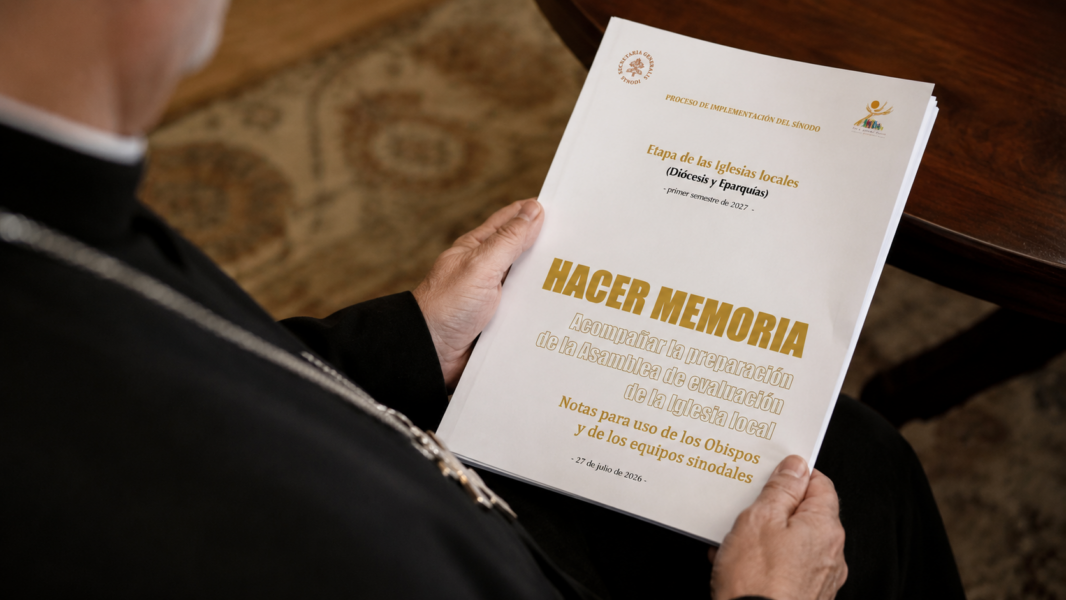
The General Secretariat of the Synod has published the document «Making Memory. Accompanying the Preparation of the Local Church Evaluation Assembly» (available in ENG – ESP – FRA – ITA – POR), a set of instructions addressed to bishops and synodal teams to prepare the diocesan and eparchial assemblies that must be held during the first semester of 2027. The text marks the beginning of the evaluation phase of the implementation of the Synod on Synodality in the particular Churches and establishes the procedure that dioceses must follow before the Ecclesial Assembly scheduled for October 2028 in the Vatican.
The document presents this stage as a time of spiritual discernment and not as a simple organizational review. «Making Memory» means, as it explains, recognizing God’s action in the journey of each community in order to discern the future steps of the Church’s mission.
The bishops, responsible for the process
The instructions emphasize that it is up to each bishop to lead this process in his diocese. To do so, he must convene the participatory bodies, especially the Presbyteral Council and the Diocesan Pastoral Council, appoint or reactivate the synodal team, and personally accompany all phases of the work until validating the final result. Where these teams do not yet exist, the document calls for their establishment «with urgency» to ensure adequate preparation of the assembly.
The General Secretariat stresses that the guidelines do not constitute a rigid model, but a working method that each local Church must adapt to its reality through a process of discernment.
A spiritual evaluation, not an audit
The Secretary General of the Synod, Cardinal Mario Grech, stated on the occasion of the document’s publication that «to evaluate is not a technical exercise, but an experience of gratitude and truth», because «making memory means recognizing what the Lord has brought to maturity in the journey of our communities and allowing ourselves to be guided toward the next steps».
Along the same lines, the text insists that the future Evaluation Assembly does not intend to repeat the synodal consultation begun in 2021, but to help local Churches recognize the fruits, difficulties, and transformations that have emerged during the implementation phase of the Synod’s Final Document.
A report from each diocese and a letter to the other Churches
As part of the process, each diocese and eparchy must prepare a Narrative Account, six to eight pages long, presenting the journey undertaken since the conclusion of the Synod. The document should include the experiences lived, the fruits achieved, and the processes of transformation identified in light of the three areas proposed by the Final Document: the conversion of relationships, of ecclesial processes, and of bonds.
Subsequently, during the Evaluation Assembly convened by the bishop, participants will review this report using the method known as «conversation in the Spirit». They will also draft a Letter to the Other Churches, inspired by the ancient litterae communionis of the early Church, in order to share the main fruits of the synodal process.
What the dioceses must evaluate
The instructions invite local Churches to examine specific aspects of the Synod’s implementation, including the promotion of a synodal spirituality, the participation of the lay faithful in ecclesial responsibilities, processes of discernment and decision-making, transparency and accountability, the missionary renewal of parishes and communities, ecumenical and interreligious relations, as well as formation initiatives for synodality.
The document also recalls words spoken by Leo XIV at the conclusion of the Extraordinary Consistory of June 2026:
«Synodality is not a set of meetings, nor a method of work. It is a spiritual style. It is born of encounter, grows in listening, and matures in discernment».
A process that will conclude in 2028
Once approved by each bishop, the Narrative Account and the Letter must be sent before June 30, 2027 to the national or regional synodal teams and to the General Secretariat of the Synod. Subsequently, the assemblies of the episcopal conferences and the Eastern Catholic Churches will be held, followed by the continental assemblies during 2028, before the celebration of the Ecclesial Assembly in the Vatican scheduled for October of that year, which will mark the culmination of the implementation process of the Synod begun in 2021.