


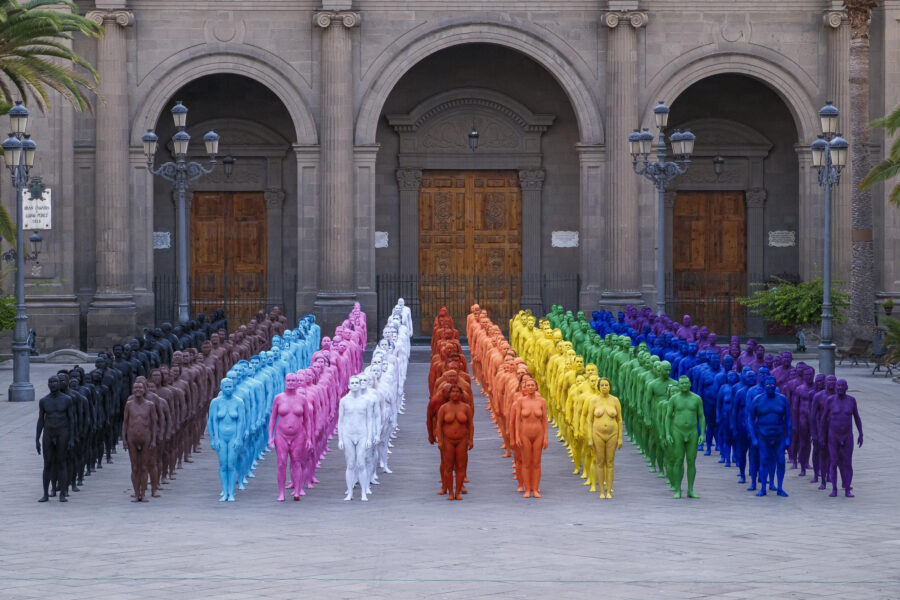
Nearly 500 people posed nude this Sunday in front of the cathedral of Santa Ana in Las Palmas de Gran Canaria, painted with the colors of the rainbow flag, in an intervention organized by American photographer Spencer Tunick as part of the Culture & Business Pride festival. The image, conceived specifically to turn the main church of the diocese into the backdrop for an LGTBI movement claim, took place in Plaza de Santa Ana coinciding with the feast day of the city’s patron saint.
Far from expressing rejection of the use of the cathedral as the setting for this intervention, the bishop of the Canary Islands, José Mazuelos, stated that he was not against the initiative and even described it as “marketing for the city.”
The cathedral turned into the stage for an LGTBI claim
The intervention consisted of forming a giant human rainbow flag with several hundred volunteers completely nude and painted in different colors. Spencer Tunick directed the composition from the rooftop of the Casas Consistoriales and took various shots with the participants facing the cathedral’s façade.
It was not just any location. The organizers chose the square in front of the episcopal see and main church of the diocese for an image meant to symbolize, according to its promoters, “diversity, freedom, and the rights of LGTBIQA+ people.”
The session was also held on the feast day of Santa Ana, when the cathedral was hosting liturgical celebrations in honor of the city’s patron saint.
The faithful were unable to access Mass normally
The security measures organized for the photo session initially prevented access for cathedral staff and the faithful arriving for the first morning Mass.
The situation forced Bishop José Mazuelos to request the intervention of the National Police to create an access corridor to the church. Eventually, attendees were able to enter for the 10 a.m. Eucharistic celebration.
The newspaper adds that some participants in the intervention later entered the cathedral still covered in the paint used to form the rainbow flag.
Mazuelos: “anything that is marketing for the city is good”
Despite what happened, the bishop of the Canary Islands made it clear that his objection was not directed against the artistic intervention or the location chosen to carry it out, as he reported to Canarias7.
“Not only am I not against this artistic intervention, but I support it to the extent that I understand that anything that is marketing for the city is good,” he told journalists.
His only criticism focused on the lack of communication from the organizers, explaining that if the Diocese had been informed in advance, it would have better organized access to the cathedral, which has three entrances.
This position was made even more explicit in statements to El País, where he insisted that the presence of hundreds of nude people in front of the cathedral posed no problem for him. “I have no problem,” he stated, before adding: “When we go to the beach, we see nude bodies, don’t we?”
Mazuelos’s statements therefore represent an explicit acceptance that an intervention of this nature took place in front of the main church of the diocese, limiting his objections to the organizational issues that arose during the celebration.
A new provocation in front of a Catholic church
The choice of the cathedral as the backdrop for the composition did not go unnoticed. Spencer Tunick himself acknowledged that he had initially conceived the work using both perspectives of the square—the one facing the cathedral and the one directed toward the Casas Consistoriales—and stated that this type of action constitutes support for the LGTB movement.
The image released by the organization thus turns the façade of the Gran Canaria cathedral—with Mazuelos’s approval—into the visual frame for an ideological claim linked to the Culture & Business Pride festival.