


Order of the Camaldolese Hermit Benedictine Monks! I was fascinated by the discovery. Of course, I was not inventing anything new: the Holy Spirit had already communicated in the eleventh century to a holy man a form of eremitic life under the Rule of Saint Benedict.
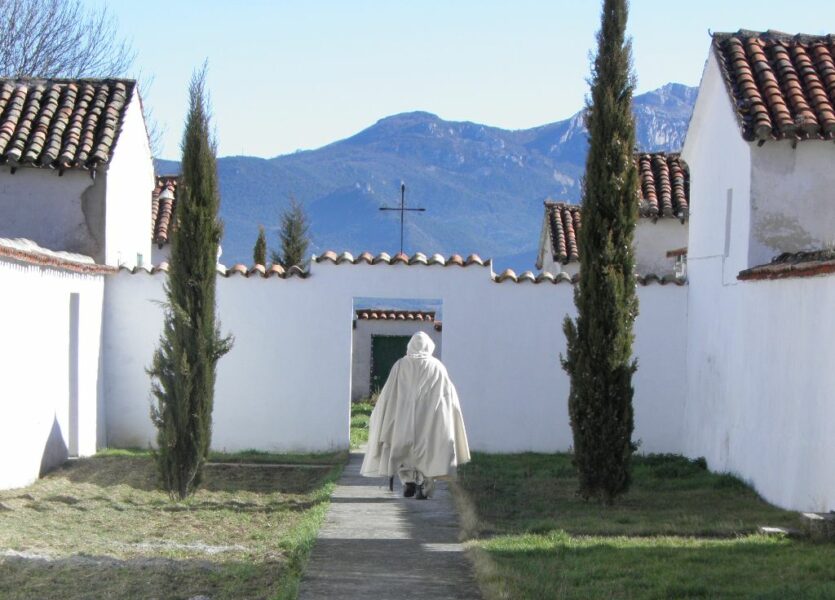
I read everything I could about the Camaldolese. The Camaldolese life is a call to intimacy with God, to renunciation of the world, and to total surrender to the divine will. According to the Constitutions of the Camaldolese hermits of Monte Corona, “the Montecoronese Eremitic Institution, taking essential elements from Cenobitism—rule of life, obedience, and common life—and from Eremitism—solitude, silence, custody of the cell—appears as a harmonious fusion of both ways of life. Each hermit dwells in a cell separate from the others, leaving only for communal prayer or the morning hours of work and for community recreations. The hermit continually strives to reduce his own needs and seeks in all things poverty, humility, simplicity, and withdrawal. Seeking first the Kingdom of God in all things (Mt 6:33), the hermit renounces every form of self-assertion and all earthly values of any kind. The Hermitage is the place of the search for God.”
It is a very small order, which in 2019 had only one community in Spain, in the diocese of Burgos, where they could no longer accept more vocations, since it was at full capacity—twelve hermits—and had a waiting list of aspirants.
I was seriously considering applying to be placed on that waiting list, after several visits, when the COVID pandemic broke out. Locked in my house, struggling with students in online classes, with plenty of free time, alone, I saw more and more clearly that the eremitic life was what God was calling me to.
As soon as I could in 2021, I returned to visit the Camaldolese hermitage in Burgos, receiving the wonderful news that they were going to found a new community in Córdoba. But that same year something happened that changed my life: Pope Francis promulgated Traditionis Custodes. And that awakened my curiosity about the traditional Latin Mass, something I had never considered before. By now it is evident that the same thing happened to countless people—an effect of the motu proprio that undoubtedly the Pope did not expect. But the Spirit blows where He wills. I had already begun attending the traditional Mass sporadically that year. I decided to do so regularly, and that changed my life.
After some time, it became clear to me that the Camaldolese hermitage was no longer a possibility: I could not reconcile the eremitic life under the Rule of Saint Benedict with the liturgy reformed by Paul VI.
What could I do? I had already made, unconsciously but firmly, the decision to leave my job and sell my apartment. I began the 2022/23 academic year knowing that I would not continue as a teacher once it ended. I firmly believed that the Lord was calling me to the deep, prayerful silence of the hermit. But at the same time, I was very clear that I did not want to attend the new Mass again. Yet moving to Le Barroux or Fontgombault in France was not an option, despite the traditional liturgy, precisely because they are cenobitic.
What did seem clear to me, reading about the life and work of Dom Gérard Calvet, founder of the Benedictine Abbey of Le Barroux, was that the only solution to the deep crisis in the Catholic Church was the refounding or founding of new communities with traditional liturgy and doctrine. I had no possibility of founding anything. I was alone. And I am neither a priest nor a monk. But I could imitate Dom Gérard in his departure to the hermitage, alone, praying the Divine Office and working, even if I could attend Mass only on Sundays and holy days of obligation. In the biography of Dom Gérard Calvet written by the historian Yves Chiron, which I recommend reading, one discovers how, from the mid-1960s onward, the French mountains were populated by hermits fleeing the devastation of the Council, in the manner of the hermits of the late Middle Ages, when a great crisis of monasticism occurred. Thus, as a simple layman, burdened with my sins, I thought that I could indeed kindle a hearth, initiating what John Senior—following Newman—called, in The Restoration of Christian Culture, the little monasteries: “The greatest contribution to the restoration of the order of human society as a whole would be the founding, in every city, town, and rural area, of contemplative religious communities, committed to a life of consecrated silence, so that silence may be present in our work and in our days as the watchful arbiter of a game, to judge and measure all our noisy achievements.”
Note: This article is part of a series in which the author recounts his experience of eremitic life and his spiritual journey. To be continued.
Chapter 1: A House in Ruins in the Monegros
Chapter 2: From the Corrupting World to the Desert, to Seek God… and Be Tempted