


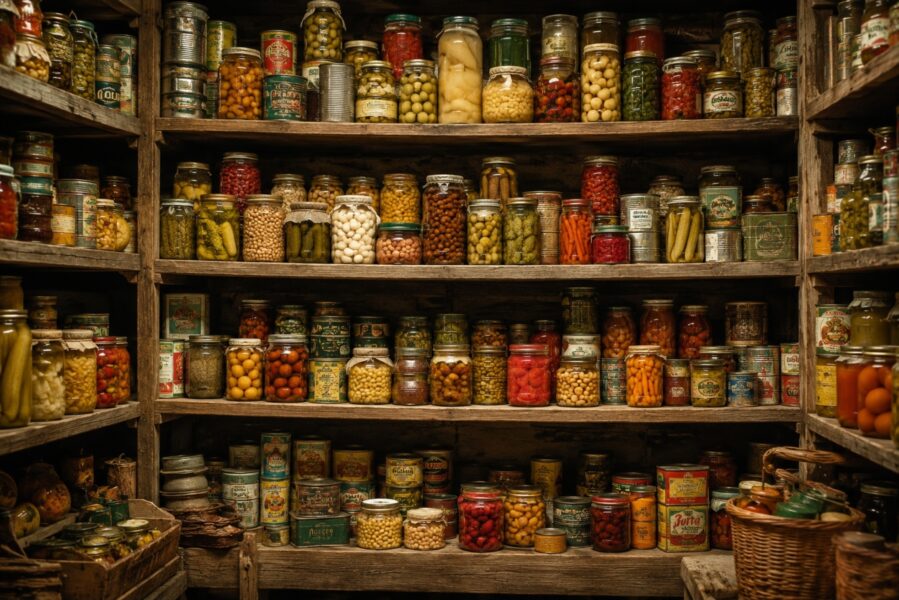
Open the pantry. Everything you find inside —the tuna in brine, the peach in syrup, the chickpeas floating in their liquid of uncertain nature— shares one condition: it is perishable. Only what rots is preserved. To preserve is, by definition, a rearguard operation: a way of losing the battle against corruption more slowly.
Now think of the Pythagorean theorem. No one has ever thought of “preserving” it. No one seals it in jars, no one protects it from moisture, no one fears that a bad harvest will leave us without it. The square of the hypotenuse will remain equal to the sum of the squares of the legs even if all libraries burn and every language on earth is forgotten.
Yet for two centuries some have called themselves conservatives regarding the highest truths: truths about God, about man, about good and evil, about family and justice. Truths that are —if you will allow the literary device— well above mathematics. They treat eternal truth as if it were seasonal fruit.
The problem, though it may seem so, is not a quarrel over words.
The self at the center of the jar
Look at the grammar. The one who preserves is the subject; what is preserved is merely the object: the passive reality upon which one acts. The conservative thus places himself, perhaps without noticing, at the center of the scene. He decides, he protects, he preserves. And truth is reduced to a peach in syrup: inert, dependent, almost grateful that someone has deigned to can it.
But this inverts the order of the universe. Truth does not depend on me: I depend on it. I am not the one who sustains it: it is it that sustains me. I am not the one who guards it: it is it that guards me.
The error of conservatism does not necessarily lie in its contents, which are often estimable. It lies in its syntax: it has placed man as the subject in a sentence where he can only be the object.
It is no coincidence that the word is modern. The conservative is born as a reaction to the French Revolution, and every reaction is defined by what it reacts against: it accepts the opponent’s board and resigns itself to playing on it, always with the black pieces, always on the defensive.
The conservative is, at bottom, a late child of modernity, because he shares its central premise: that man is the measure, the agent, the protagonist of history. The revolutionary wants to transform the world; the conservative, to preserve it. But both believe themselves masters of deciding what to do with it. They argue heatedly about how to manage the estate without noticing one detail: the estate is not theirs.
To observe and to transmit
The correct attitude toward permanent truths is taught by mathematics. No one preserves them, and yet no human inheritance has reached us so intact. They have crossed empires, fires, invasions, and dark centuries without any jar, because each generation has done with them the only two things one can do with a truth: observe it and transmit it.
The mathematician observes: he contemplates an exactness he did not create and that existed before him. And then he transmits: he hands to the next generation what he received, with the naturalness of one who passes on something that was never his property.
In that movement of contemplation and delivery, mathematics grows. Each age adds theorems the previous one ignored. But notice the verb mathematicians themselves use: theorems are discovered, not invented. They were already there, waiting for eyes capable of seeing them. Even when man contributes something new, he does not become its owner: he remains an explorer of a continent he did not found.
That is the portrait of a living tradition: not a frozen deposit, but a knowledge that expands without betraying itself. Danger never threatens truth. Two plus two will not cease to equal four. It is we, poor wretches, who may cease to know it.
Imagine a mathematically amnesiac humanity: each generation forced to reinvent zero, to rebuild geometry from nothing, to rediscover number theory by groping, despising on principle everything accumulated over five thousand years. No child would progress beyond counting on fingers. No bridge would stand. It would be a civilization of Sisyphuses, condemned to spend all its strength starting over every morning.
That, exactly that, is what the modern mentality demands in the realm of truths about man and God: that each age refound morality, reinvent marriage, redefine the person, and renegotiate with God the conditions of existence, as if twenty centuries of intelligence, experience, and holiness had clarified nothing worth receiving. What in mathematics we would call barbarism, in essential matters we call modernism.
José Antonio, in his article La Gaita y la Lira, put it with great precision: ideals must be anchored “where numbers sing their exact song,” at the height of that two plus two that has equaled four since the origin of creation, even if thousands of springs have withered.That is man’s position before essential truths: subordinate, adhered, received. We are not their owners. We are their witnesses and their heralds.
The conservative tends toward melancholy, because he lives dependent on an expiration date. He tends toward managed defeat, because one who always plays on the defensive can only aspire to lose more slowly. He tends toward the museum, because preserving ends up resembling embalming all too closely. And he tends, above all, to negotiate endlessly the contents of the jar: how much syrup must be added so the peach becomes tolerable to the palate of the age.
Whoever observes and transmits, by contrast, does not live cornered. He knows that truth is not in danger. The danger is only ours: to remain without eyes to contemplate it and without children capable of receiving it.
I am not a conservative. And I am not one for the reasons usually wielded against that word, but for another, earlier and humbler: because I have nothing to conserve. The truths that matter are not mine, do not depend on me, and do not expire with me. My place before them is that of the messenger: to learn them with wonder and deliver them, still burning, to those who come after.