


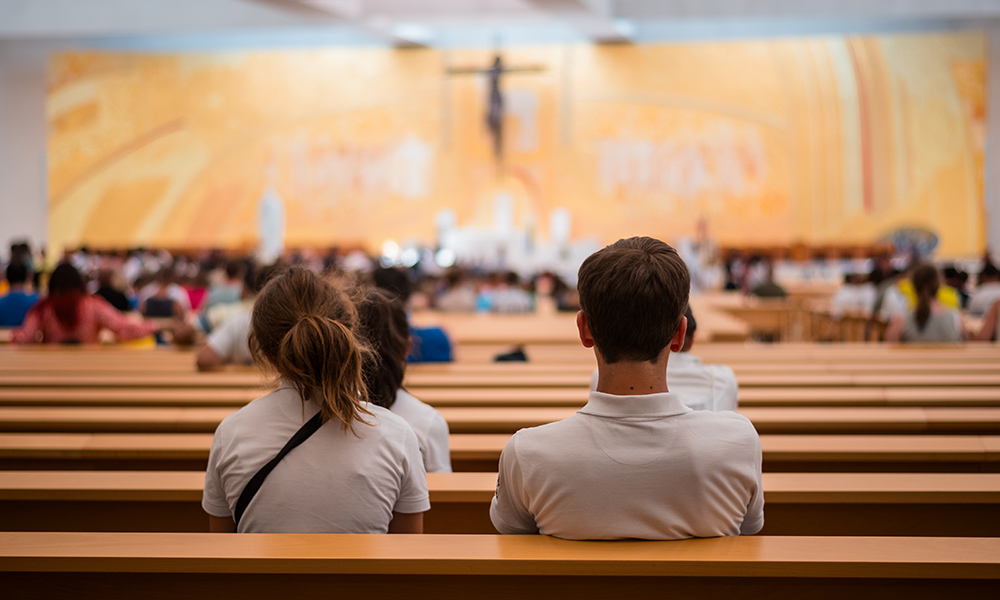
Young Brazilian Catholics are calling for a Church with greater emphasis on holiness, more solid doctrinal formation, and a liturgy celebrated with greater reverence. At the same time, they consider the excessive prominence of sociopolitical issues to be one of the main factors hindering their participation in ecclesial life.
This is reflected in the National Survey on Youth Evangelization 2025, prepared by the Episcopal Commission for Youth of the National Conference of Brazilian Bishops (CNBB) and recently presented to the Permanent Council of the Brazilian episcopate. The study, conducted with responses from 11,498 Catholics aged 12 to 29 from all regions of the country, offers a snapshot of the concerns and expectations of a new generation of the faithful.
A generation seeking spiritual depth
Far from calling for a Church more adapted to current cultural trends, young people express a growing interest in deepening the foundations of the faith. Holiness and the Christian life appear as the topic that arouses the most interest, followed by integral formation, mental health, the dialogue between faith and reason, and Christian ethics.
This same trend is confirmed when they are asked what aspects they consider priorities for the life of the Church. The responses once again place holiness, the Word of God, the Eucharist, and Christian spirituality at the top, reflecting the desire for deeper formation and an ecclesial life with Jesus Christ at the center.
The liturgy and politicization, among the main concerns
If there is a particularly significant section in the survey, it is the one that analyzes what drives young people away from the life of the Church.
Alongside factors such as academic commitments, pressure to meet certain expectations, or lack of welcome, two concerns stand out above the rest. In the open responses, 52.3% mention the lack of care for the liturgy and tradition, while 47.7% consider the emphasis given to sociopolitical issues excessive. The authors of the report themselves highlight both aspects as one of the main concerns expressed by the participants.
The family remains the main transmitter of the faith
Despite the profound cultural changes experienced by Brazilian society in recent decades, the family continues to be the main sphere for the transmission of the faith. 65.1% of young people say they have come to know Catholicism thanks to their parents or grandparents, far ahead of the parish, friends, the internet, or school.
The religious practice of the respondents is also significant. 68.5% say they attend Mass at least once a week—one in four does so daily—and 93.6% have received the sacraments of Christian initiation.
A shift in priorities
The survey results point to a change in sensibility among many young Brazilian Catholics. After decades in which the country’s pastoral ministry was strongly influenced by currents arising from liberation theology and a marked sociopolitical commitment, the new generations seem to be calling for greater balance, restoring the prominence of doctrine, liturgy, and spiritual life.
The report’s conclusions clearly summarize this trend: young people are asking for greater attention to the liturgy and tradition, show reservations about the excessive politicization of ecclesial life, and wish to deepen especially in holiness, the Eucharist, and Christian spirituality as the axes of Christian life.