


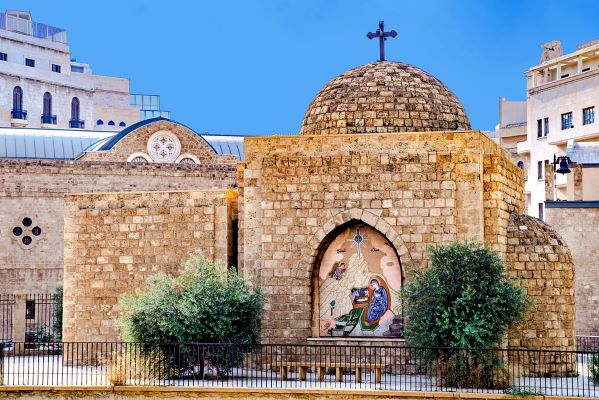
Twenty years after the 2006 war between Israel and Hezbollah, Lebanon’s Christians continue to face the consequences of a conflict that left a deep mark on the country and accelerated the emigration of numerous families.
In an interview with Rome Reports, journalist Jaume Figa Vaello, author of Flores en el desierto, has analyzed the situation of Christian communities in the Middle East based on 26 testimonies gathered during a one-month stay in the region, especially in Lebanon.
Despite the ongoing population outflow, Christians are still estimated to represent between 30% and 35% of the country’s inhabitants. Lebanon also retains a unique status in the Middle East: it remains the state in the region with the largest Christian presence and with significant political influence from this community.
“We are staying. This is our land”
Figa highlights the deep-rooted attachment of Lebanese Christians and their determination to remain in the country despite successive wars, the economic crisis, and political instability.
“What lies behind this is a great love for the homeland,” the journalist explains.
In this context, he refers to the so-called Kissinger report, unofficially cited, which allegedly proposed the departure of Christians from the country to America or Canada in order to turn Lebanon into a territory for Palestinians.
According to Figa, the Christians’ response was clear: “We are staying. This is our land.”
For the author, this decision helps explain why Christian communities have remained in the country despite mass emigration and the difficulties accumulated over decades.
Twenty-six stories of faith and hope
The book Flores en el desierto brings together 26 stories of Christians from the Middle East who share two central elements: faith and hope.
“It seems very graphic to me that in an arid desert, where there is nothing, a flower should bloom, precisely because there is hope,” Figa states.
The journalist explains that these two words summarize the meaning of the work and the experience of communities that maintain their Christian identity amid poverty, violence, and persecution.
The testimonies give a face to people who have chosen to stay, rebuild their lives, or continue serving their communities despite an increasingly hostile environment.
The religious uniqueness of Lebanon
Figa emphasizes Lebanon’s particular situation within the Middle East, where Christians maintain a public and political presence that does not exist in the same way in other countries of the region.
“Lebanon is a Christian country where there is religious freedom,” he maintains.
The author compares this reality with that of other territories, such as Iraq, where numerous Christian communities have suffered direct persecution and have been forced to abandon their homes.
Among the stories collected in the book is that of a priest who had to flee Iraq in the face of threats from Islamist groups that persecuted and murdered Christians.
Although Lebanon maintains a political system that recognizes the presence of different religious confessions, its Christian communities are going through one of the most difficult moments in their recent history.
Hezbollah, “a state within a state”
In Figa’s view, one of the country’s main problems is the political and military weight of Hezbollah.
“For us it is a terrorist group; for them it is a paramilitary political group,” he explains. “The problem is that Hezbollah is a state within a state.”
The organization’s influence adds to the institutional weakness, corruption, and economic crisis that have affected the country for years.
Figa identifies corruption precisely as another of the major obstacles to Lebanon’s recovery and to the permanence of its Christian communities.
The stories gathered in Flores en el desierto thus portray a community that, despite war, emigration, and political fragility, continues to fight to keep the Christian presence alive in the Middle East.