


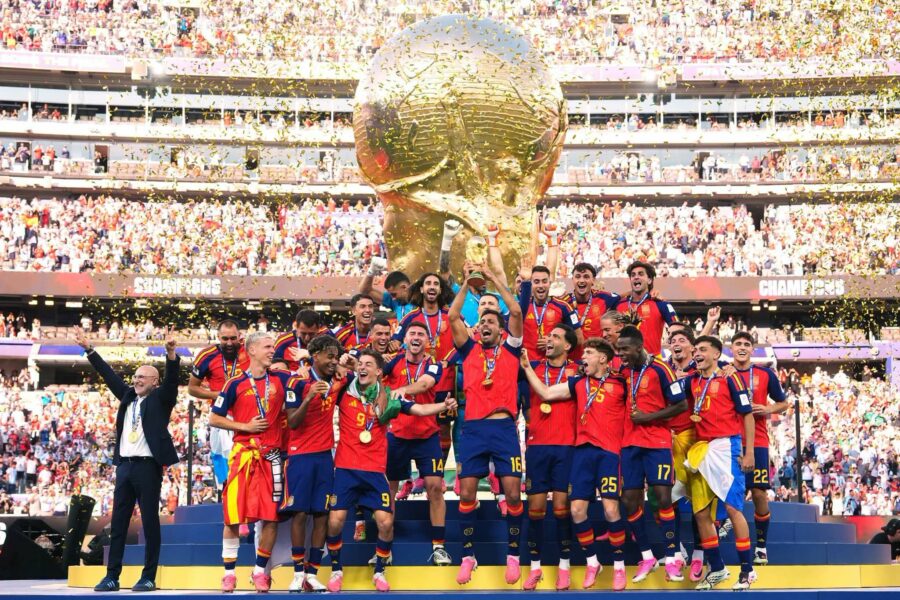
Spain claimed its second World Cup after defeating Argentina 1-0 in the final played in New Jersey this Sunday. Ferran Torres scored in extra time the goal that returned the Spanish national team to the pinnacle of international football sixteen years after the title in South Africa.
The triumph closed a tournament in which faith once again became visible on the pitch. Not as an official FIFA initiative or as an identity shared by all participants, but through statements, prayers, and personal gestures from players who did not hide their religious convictions from the cameras.
Faith within the Spanish national team
The Spanish dressing room is not confessionally homogeneous. Lamine Yamal professes Islam, other players have not spoken publicly about their beliefs, and some of the protagonists of the second star have openly shown their Catholic faith.
The best-known case is that of Luis de la Fuente, the national team’s head coach, who has described himself as a “practicing Catholic” and has explained that he prays daily. During the World Cup he clarified that he does not ask God to win matches, but that prayer gives him strength, security, calm, and confidence.
“I pray every day, but not because I’m in a World Cup or because I want to get a result,” the coach said, adding that he considers it unfair to ask for victory for himself when opponents may also be believers.
Ferran Torres, scorer of the decisive goal against Argentina, showed during the camp the medals he wears under his shirt. “I have the cross and a Virgin. I think it’s something that gives me a lot of support, that gives me a great deal of faith, and for me it’s something very important,” explained the Valencian striker.
Nico Williams also publicly expressed his trust in God. Before the final he shared a photograph of himself kneeling on the grass and pointing toward the sky, accompanied by the phrase “God is great.” His family story also maintains a close connection with the Church: his parents, originally from Ghana, received help from Cáritas and from the then-priest Iñaki Mardones when they arrived in Bilbao. The footballer’s older brother was named Iñaki in gratitude to that priest.
These expressions were joined by the gesture of Mikel Merino after scoring the winning goal against Portugal on July 6. The Navarrese player put on the red scarf and celebrated the goal with a “¡Viva San Fermín!”, in reference to the patron saint of Pamplona and the festivities that began that same day.
These manifestations do not turn Spain into a confessional team, nor do they allow the title to be attributed to divine intervention. They simply show that some of its main protagonists do not feel the need to hide their faith in an area subject to enormous public exposure.
Prayers among opponents
Religious scenes were not limited to the champion team. In other matches, such as between Germany and Curaçao, several players from both teams gathered to pray in the center of the pitch.
The Germans Jonathan Tah and Felix Nmecha joined the Caribbean players’ prayer after a match that had ended in a wide German victory. Nmecha later explained that during the game they were rivals, but once it was over they recognized each other again as Christians and brothers.
“We all believe that Jesus is glorified through the game, and that’s why we pray together,” he said.
The scene was especially significant because it did not occur after a close victory, but after a heavy defeat for Curaçao. The shared prayer did not erase the result, but it showed that sporting rivalry did not cancel out a common faith.
The Croatians Igor Matanović and Kristijan Jakić also spoke openly about Catholicism before their debut. Matanović stated that prayer gives him strength because he feels that God listens to him, while Jakić maintained that faith is part of life and of the identity of the Croatian national team.
Other players in the tournament, such as the American Cristian Roldán, the Mexican Santiago Giménez, the Portuguese Cristiano Ronaldo, or the Frenchman Kylian Mbappé, have likewise spoken about prayer, the Bible, and gratitude to God as elements present in their careers.
Argentina also brought its faith to the final
Faith was not only on the Spanish side in the decisive match. Lionel Messi has described his talent on numerous occasions as a gift received from God and usually points to the sky after scoring.
The Argentine national team also maintains a deep-rooted popular religiosity. Images of the Virgin of Luján, Padre Pío, and Pope Francis were placed in its dressing room, while Messi’s boots were blessed in the basilica dedicated to Argentina’s patron saint before the tournament.
In a culture that allows the public display of almost any aspect of personal life but often views faith with discomfort, the World Cup did leave one relevant fact: in one of the greatest global spectacles, numerous footballers spoke about God, prayed with their opponents, and carried religious signs without relegating them to private life. That naturalness remains significant.